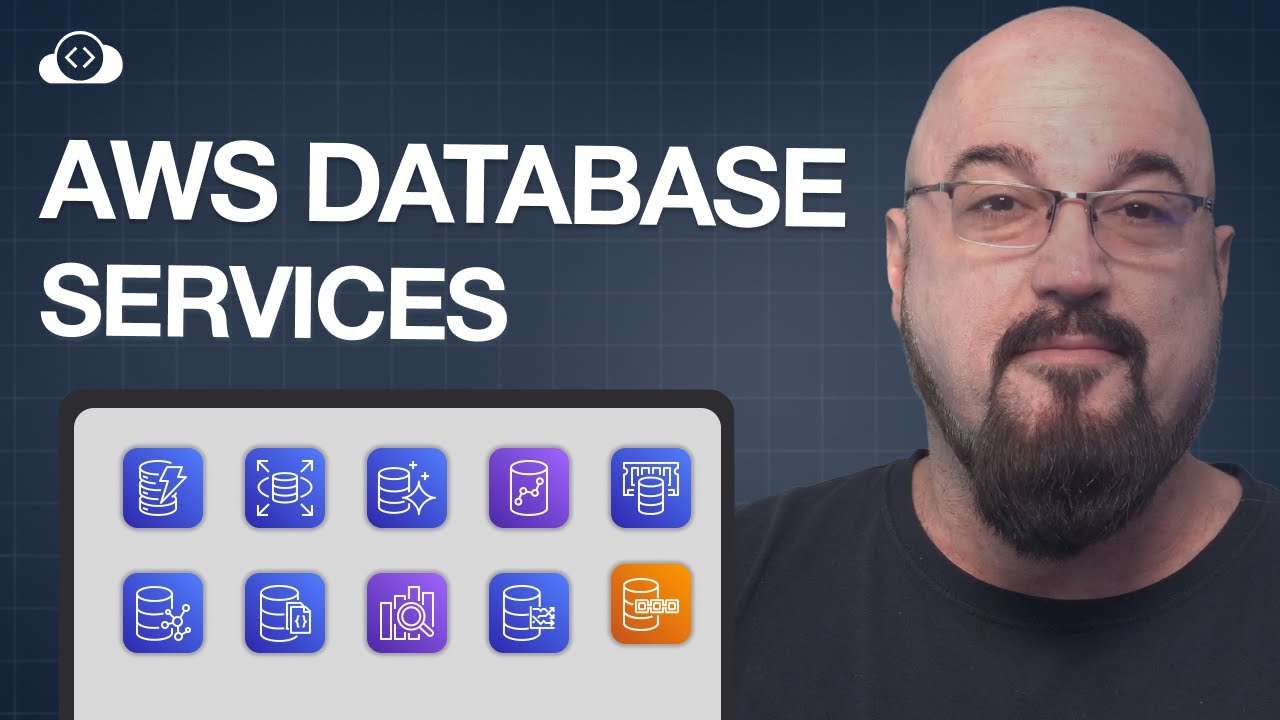
The Ultimate Guide to AWS Database Services
Source: YouTube · KodeKloud · published Jun 7, 2025 · 33:19
AWS offers three main database types: self-managed, SQL, and NoSQL. The primary goal is to match database services to specific use cases like transactional processing, reporting, or search. 0:30
Key Takeaways:
• SQL databases (RDS, Aurora, Redshift) are for structured, relational data; RDS supports MySQL, PostgreSQL, Oracle, MariaDB, and SQL Server; Aurora is faster and more scalable than standard RDS; Redshift is for analytics and reporting, not transactions 1:50
• NoSQL databases serve specialized needs: DynamoDB for fast key-value lookups, Document DB for hierarchical documents (like MongoDB), Neptune for graph-based relationship analysis, and Time Stream for high-volume IoT data with timestamps 3:00
• Fully managed services like DynamoDB, Document DB, and Neptune reduce operational overhead; Elasticache and OpenSearch provide caching and search capabilities, respectively 3:20
• Quantum Ledger Database ensures immutable, auditable records—ideal for security-critical transactions 31:55
Choose the right database based on data structure, performance needs, and use case: relational for transactions, reporting, or structured data; NoSQL for speed, scalability, or specific data types. 32:00
Sources:
Generate CPE Credits
Generate a professional CPE document from this video's transcript.
Estimated credit: 0.5 CPE hours
Estimate uses the video runtime (1 hour ≈ 1 CPE, rounded to the nearest 0.5, minimum 0.5, maximum 2.0). The final amount can be lower after review, never higher.
Topic: Cloud Security. Commonly maps to: Security Architecture and Engineering, Communication and Network Security. Exact CISSP domains are assigned during generation.
Free account. One generation at a time, with a daily limit.
CPEBuddy is independent and not affiliated with or endorsed by ISC2, ISACA, or any certification body. Exports are formatted for common CPE submissions; acceptance is at your certification body's discretion.
Transcript Preview
First 800 characters of the transcript
[Music] Hey there, I'm Michael from CodeCloud. Welcome to this lesson from our AWS cloud practitioner certification course. In this video, we'll help you build a strong foundation in cloud computing with AWS. So, if you want to learn more or go deeper, check out the full course details below and let's get started. All right, welcome cloud practitioners. This is going to be about the core AWS services and we're going to talk about databases. So database services, databases basically are applications that store data both structured and unstructured. So let's let's talk about it. So first of all, there's only three types of databases also known as data stores inside of AWS. There's ones that you manage yourself. So you know we'll talk about what that is, but like there ones that you set up, y…