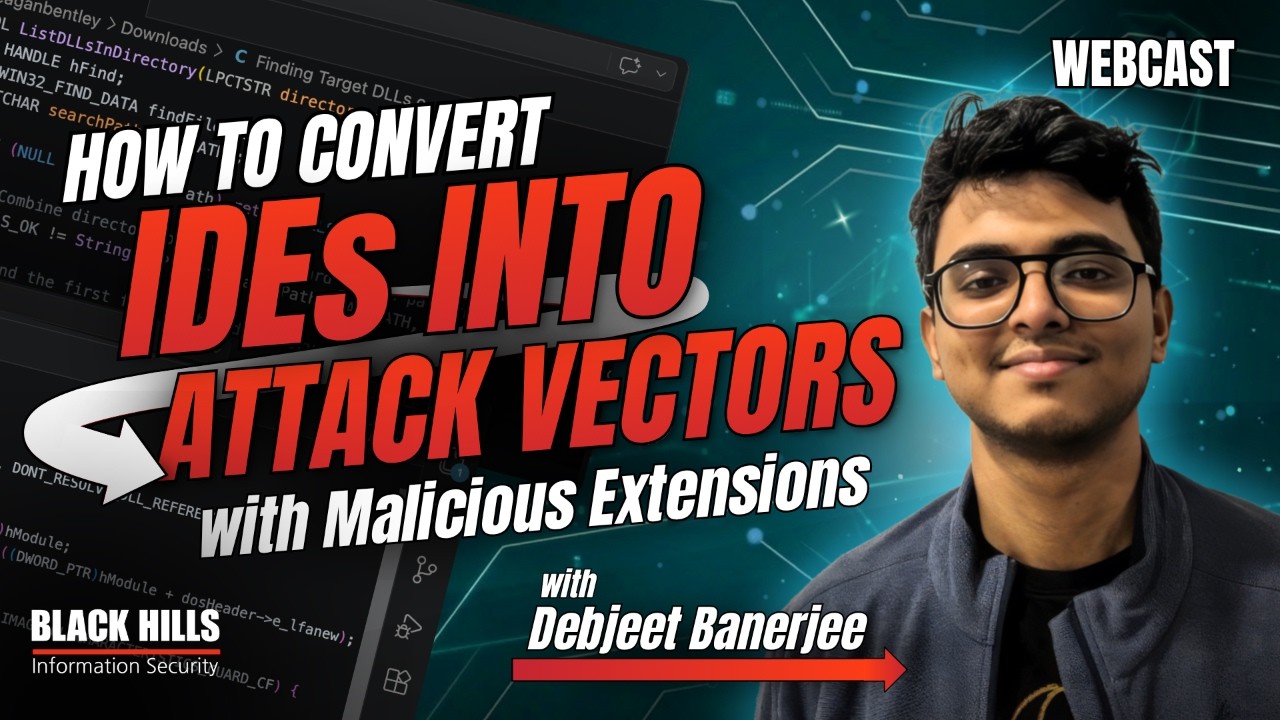
How to Convert IDEs Into Attack Vectors with Malicious Extensions
Source: YouTube · Black Hills Information Security · published Jul 10, 2026 · 1:09:17
This presentation by Black Hills Information Security malware developer DB demonstrates how IDE extensions can be weaponized as initial access vectors, leveraging VS Code's architecture to bypass security controls 0:42.
Key Takeaways:
• VS Code is an ideal target because developers possess high-value credentials, the environment is cross-platform via Electron, and extensions run in isolated processes that won't crash the IDE if they fail 5:59.
• AI-powered editors like Windsurf and Cursor are essentially VS Code wrappers, meaning they inherit the exact same extension-based attack surface 7:16.
• Real-world campaigns like the Solidity malware (costing $500K in crypto) and the GitHub breach used typosquatting, SEO manipulation, and compromised auto-updates to deliver payloads 10:16.
• Attackers can go "native" by bundling Rust-compiled shellcode runners as Node.js add-ons (.node files), making reverse engineering significantly harder 22:54.
• A self-modifying extension can spoof its identity by rewriting its extensions.json metadata to mimic legitimate, verified extensions and hide VSIX installation indicators 41:15.
Organizations should prevent disk-based VSIX installations, enforce extension whitelisting, and maintain software bills of materials to mitigate these supply chain risks.
Sources:
- 0:42 Introduction to converting IDEs into initial access vectors
- 5:59 Why targeting developers and VS Code is a "cheat code"
- 7:16 AI editors extending the attack surface
- 10:16 Case studies: Solidity, GitHub, and GlassForm campaigns
- 22:54 Going native with Rust and Node.js add-ons
- 41:15 Spoofing extension metadata to hide malicious origins
Generate CPE Credits
Generate a professional CPE document from this video's transcript.
Estimated credit: 1 CPE hours
Estimate uses the video runtime (1 hour ≈ 1 CPE, rounded to the nearest 0.5, minimum 0.5, maximum 2.0). The final amount can be lower after review, never higher.
Topic: Cybersecurity. Commonly maps to: Security and Risk Management, Security Operations. Exact CISSP domains are assigned during generation.
Free account. One generation at a time, with a daily limit.
CPEBuddy is independent and not affiliated with or endorsed by ISC2, ISACA, or any certification body. Exports are formatted for common CPE submissions; acceptance is at your certification body's discretion.
Transcript Preview
First 800 characters of the transcript
Hello everybody. Welcome to the Black Hills Information Security webcast for today on a Thursday. We've got Dibjet here or DB for short. He's got a fantastic presentation for us about IDE and extensions and stuff and and how to do bad things with permission uh to test stuff. TBG, take it away. We'll come back >> at the end for Q&A. >> All right. Thanks. So, starting it right away with a little introduction and a little story. So, for today's topic is going to be like the title says it all. How do we convert an IDE into an initial access vector? But before that, let me just start with some introductions. Uh, click. So, hi everyone who just joined in. Uh, I'm DB. I have been a malware developer with Black Hills Information Security for a bit more than 3 years now and I love it here. It's an …