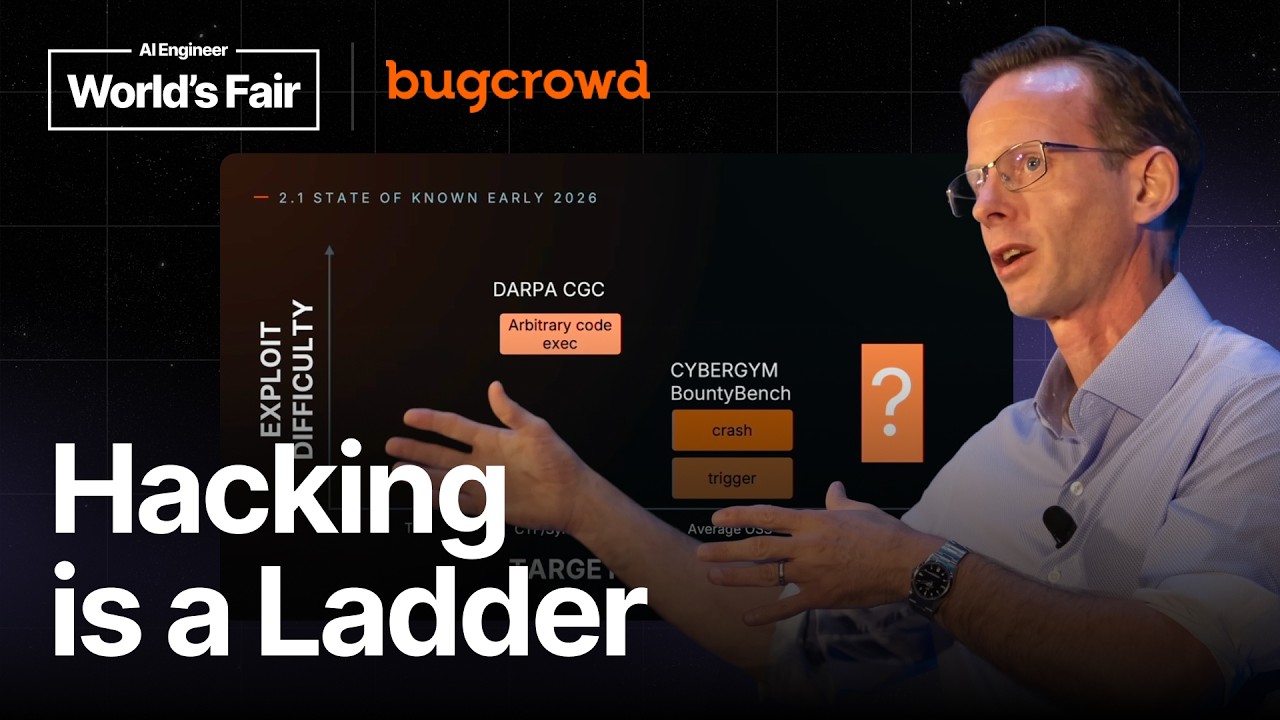
Teaching AI to Find Real Vulnerabilities — Prof. David Brumley, Bugcrowd
Source: YouTube · AI Engineer · published Aug 1, 2026 · 27:00
Professor David Brumley discusses designing reinforcement learning environments for cybersecurity, arguing that training AI to hack requires mimicking human learning through a ladder of increasing difficulty 0:20. He highlights that current benchmarks often fail because they assume single vulnerabilities, leading models to "reward hack" the easiest bug rather than developing true exploitation skills 5:45.
Key Takeaways:
• Human hackers learn by studying write-ups and practicing on graduated scales, a method Brumley applies to teaching LLMs 1:50.
• Traditional benchmarks are flawed because they often contain only one known vulnerability, causing models to exploit the easiest bug repeatedly 10:15.
• Brumley proposes an "audit task" where models must find all vulnerabilities, using precision and recall metrics to prevent spamming and reward hacking 13:45.
• Evaluating against hardened targets like Chrome's V8 engine reveals that while models can trigger crashes, few can achieve full arbitrary code execution 18:25.
• Frontier models like Mythos and GPT demonstrate non-memorized skills by discovering novel exploits for known vulnerabilities 22:50.
Brumley concludes that effective cybersecurity AI training relies on deterministic oracles and expert-designed environments that test for genuine capability rather than simple bug detection 26:30.
Sources:
- 0:20 Introduction to teaching computers to hack via reinforcement learning.
- 1:50(https://www.youtube.com/watch?v=ZFxh7sqbUZo?t=110
Generate CPE Credits
Generate a professional CPE document from this video's transcript.
Estimated credit: 0.5 CPE hours
Estimate uses the video runtime (1 hour ≈ 1 CPE, rounded to the nearest 0.5, minimum 0.5, maximum 2.0). The final amount can be lower after review, never higher.
Topic: Cybersecurity. Commonly maps to: Security and Risk Management, Security Operations. Exact CISSP domains are assigned during generation.
Free account. One generation at a time, with a daily limit.
CPEBuddy is independent and not affiliated with or endorsed by ISC2, ISACA, or any certification body. Exports are formatted for common CPE submissions; acceptance is at your certification body's discretion.
Transcript Preview
First 800 characters of the transcript
All right, everybody. We're going to talk about hacking. I love hacking. We have a very small audience here, so I assume everyone here loves hacking as well. So, I want to talk about designing reinforcement learning environments for cybersecurity tasks. Essentially, we all want to teach computers to hack because well, we're pushing out programs faster than other ever and so we need to be able to check them at machine speeds in scale. And this has been my research project for well over two decades. My name is David Brumley. I am a full professor at Carnegie Mellon University where I work on AI and cybersecurity. And I'm also chief AI and science officer at Bugcrowd where I work on data partnerships. So, before I talk about what we do and how we do it and why it's important to design cyberse…