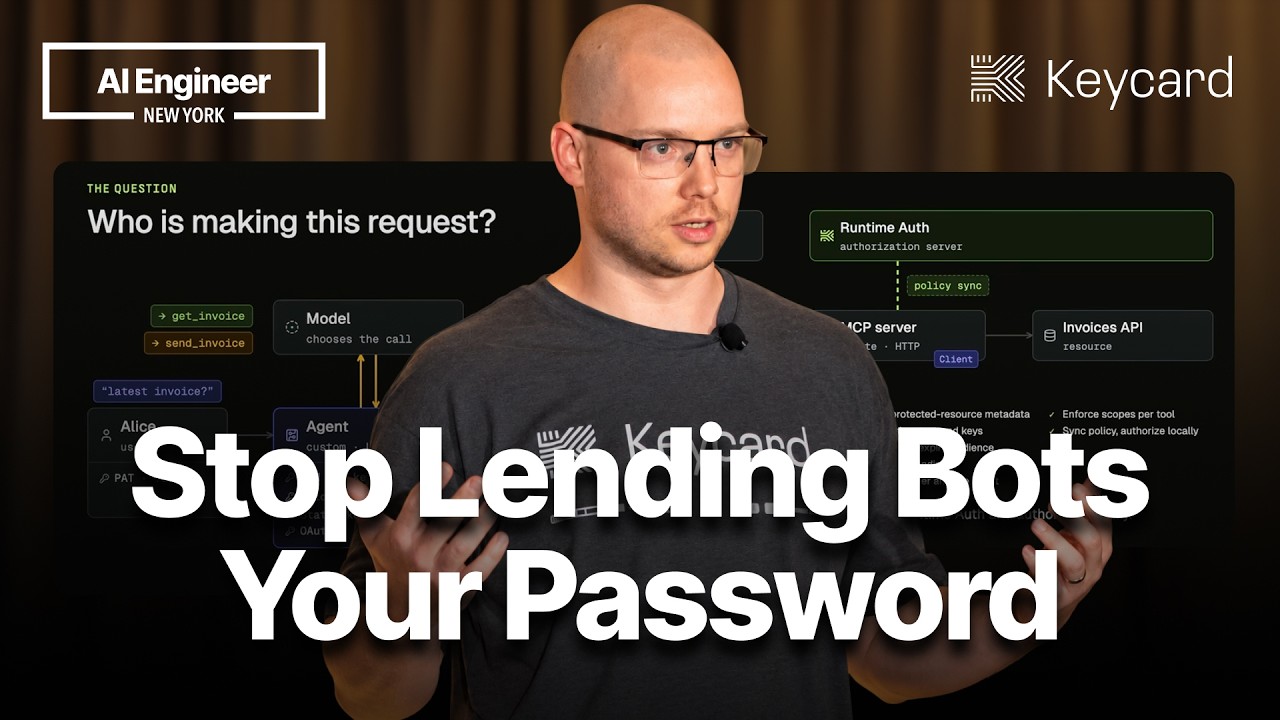
Who Is Making This Request? Agent Auth 101 - Kamil Potrec, Keycard
Source: YouTube · AI Engineer · published Oct 28, 2026 · 18:30
BLUF:
The speaker argues that traditional static credentialing is insecure for AI agents due to their non-deterministic nature, advocating instead for dynamic, short-lived credentials and identity federation to ensure proper attribution and security 1:50-2:00.
Key Takeaways:
• The Attribution Gap: Current systems often pass user tokens directly to agents, making it impossible to distinguish whether an action was taken by the user or the agent, leading to security risks 3:30-3:40.
• Limitations of Service Accounts: Agents frequently rely on over-privileged service accounts to access backend infrastructure, which aggregates permissions and increases the blast radius of potential abuse 2:40-2:50.
• Dynamic Credentialing via OAuth: Instead of static keys, agents should use dynamic, scoped credentials issued per interaction, allowing for immediate revocation and limiting exposure 5:45-5:55.
• Agent Identity Requirements: A robust agent authentication system requires distinct agent identities separate from user identities, along with policy engines to define delegation semantics 8:25-8:40.
• Gateway Challenges: While API gateways can provide a control plane for credential injection and request attenuation, they introduce latency, complexity, and single points of failure that must be managed carefully 13:00-13:10.
• Keycard’s Solution: The speaker promotes Keycard’s control plane which federates identities, provides policy enforcement, and offers SDKs to help organizations implement secure agent authentication without building everything from scratch 16:30-16:45.
Closing Statement:
As AI agents become more autonomous, relying on legacy authentication methods is no longer viable; organizations must adopt dynamic identity and strict policy controls to secure agent interactions.
Sources:
- 1:50-2:00 Discussion of static keys vs. dynamic credentialing for agents.
- 3:30-3:40 Explanation of the attribution problem in agent actions.
- 5:45-5:55 Benefits of using OAuth for dynamic, scoped credentials.
- 8:25-8:40 Requirements for agent identities and delegation policies.
- 13:00-13:10 Overview of using gateways for credential injection and control.
- 16:30-16:45 Introduction to Keycard’s control plane and SDK offerings.
Generate CPE Credits
Generate a professional CPE document from this video's transcript.
Estimated credit: 0.5 CPE hours
Estimate uses the video runtime (1 hour ≈ 1 CPE, rounded to the nearest 0.5, minimum 0.5, maximum 2.0). The final amount can be lower after review, never higher.
Topic: Cybersecurity. Commonly maps to: Security and Risk Management, Security Operations. Exact CISSP domains are assigned during generation.
Free account. One generation at a time, with a daily limit.
CPEBuddy is independent and not affiliated with or endorsed by ISC2, ISACA, or any certification body. Exports are formatted for common CPE submissions; acceptance is at your certification body's discretion.
Transcript Preview
First 800 characters of the transcript
[music] >> Uh hi everybody. My name is Kamil. I work at Key Card in a product team. I'll be talking to you today about agent authentication authorization requirements. We have around 18 minutes ish. That's nowhere close to be able to cover this topic. So, my goal today is to give you kind of high-level overview of what's required to do this, how to kind of solve these problems, and give you context to come and ask us questions at the booth. We downstairs. So, just whatever questions you have, feel free to grab me at the end or go find Peter. He has all the answers. We're going to start with this fairly simple diagram. You're probably familiar with this in any of the talks you have about agents and how they communicate with MCP servers and other agents around. But, what usually people don't…