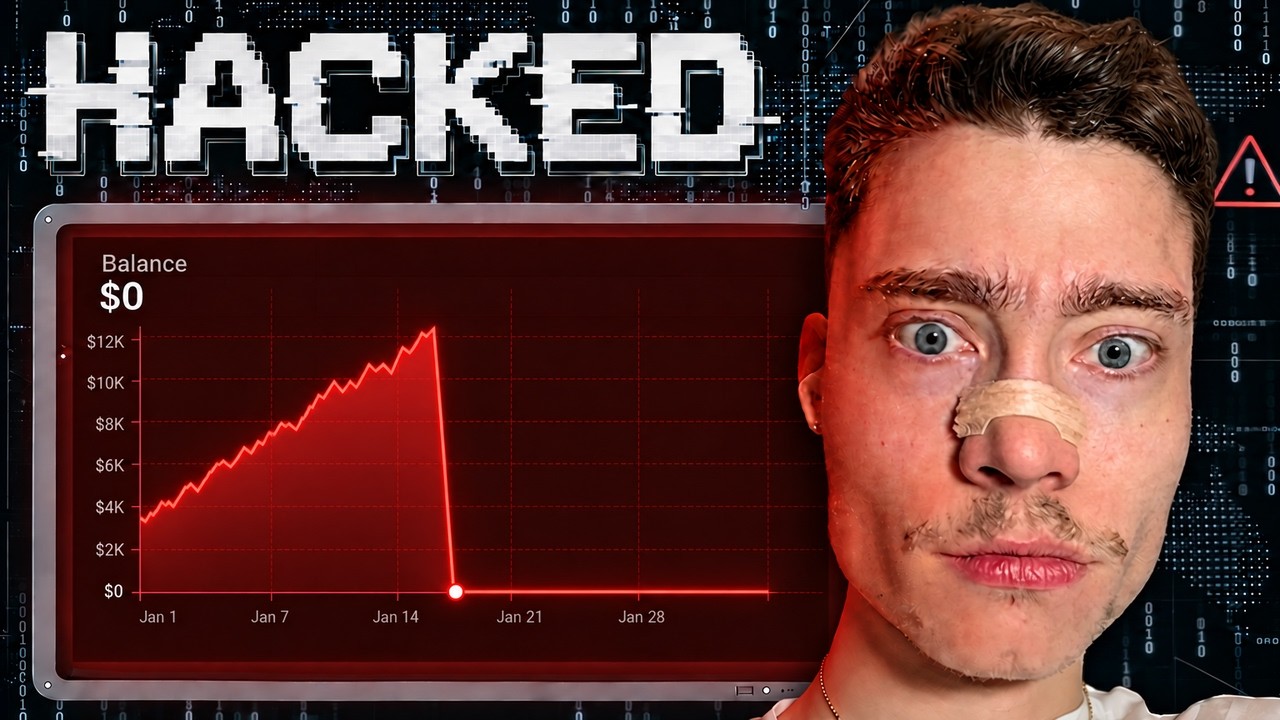
OpenCode hack is INSANE.
Source: YouTube · David Ondrej · published Oct 18, 2026 · 31:36
[BLUF]
The Open Code platform suffered a major breach via a large-scale AI model distillation attack, highlighting a new threat vector where hackers target regular users to steal API keys and bypass defenses at major AI labs 2:45-2:50. To defend against this escalating "AI-powered warfare," developers must transition from manual security checks to autonomous, AI-driven agentic loops that continuously pentest their own codebases 12:30-12:35.
Key Takeaways:
• The Shift in Attack Targets: Hackers are no longer just targeting major AI labs like Anthropic and OpenAI, which have strong defenses; they are now targeting consumer-facing tools like Open Code to steal user API keys for distillation attacks 2:45-2:50.
• Distillation Attacks Explained: This breach involved using compromised API keys to train smaller, cheaper models on data from frontier models (like Opus or GPT-4), effectively stealing intellectual property and tokens at scale 0:52-1:00.
• Rising Cyber Risk: Data from a16z shows that cyber vulnerabilities are skyrocketing, with nearly 90% of critical CVEs being exploited before patches are available, making traditional defense timelines obsolete 14:38-14:50.
• Automated Defense Strategy: Developers must use frontier models to create autonomous "agentic loops" that continuously scan, segment, and pentest their own codebases in the cloud, rather than relying on manual or one-off security scans 12:30-12:35.
• Isolated Sandboxes: Effective AI security requires running agents in isolated cloud sandboxes to prevent resource conflicts and ensure secure, independent testing of different parts of the codebase 28:00-28:10.
The era of AI-powered hacking is here, and individuals and small teams are now primary targets for sophisticated distillation attacks. By adopting autonomous, AI-driven security loops, developers can proactively identify and fix vulnerabilities before bad actors exploit them, staying ahead in this new cyber landscape.
Sources:
- 2:45 Discussion on the shift of distillation attacks from AI labs to consumer users.
- 0:52 Explanation of what a distillation attack is and how it works.
- 14:38 Presentation of a16z data showing the exponential growth of cyber vulnerabilities.
- 12:30 Recommendation to use AI to protect against AI-powered hacks.
- 28:00 Explanation of the importance of isolated cloud sandboxes for agent security.
Generate CPE Credits
Generate a professional CPE document from this video's transcript.
Estimated credit: 0.5 CPE hours
Estimate uses the video runtime (1 hour ≈ 1 CPE, rounded to the nearest 0.5, minimum 0.5, maximum 2.0). The final amount can be lower after review, never higher.
Topic: Cybersecurity. Commonly maps to: Security and Risk Management, Security Operations. Exact CISSP domains are assigned during generation.
Free account. One generation at a time, with a daily limit.
CPEBuddy is independent and not affiliated with or endorsed by ISC2, ISACA, or any certification body. Exports are formatted for common CPE submissions; acceptance is at your certification body's discretion.
Transcript Preview
First 800 characters of the transcript
So, Open Code just got hacked. This is one of the most popular AI coding tools out there. Basically, an open source version of Cloud Code, and it just got one of the biggest breaches um of this year, and a lot of you are probably impacted. So, here is what the official Open Code account tweeted. We had a security breach last night related to a large scale distillation attack that impacted 1.4% of Open Code console users, which doesn't sound like a lot until you realize that there's literally millions of people using Open Code. So check your email if you're open code user. You'll see that. But the scary part here is that it was a distillation attack. Okay? It's not just like a random breach or you know a single person doing this. It was a large scale distillation attack. So what does this m…