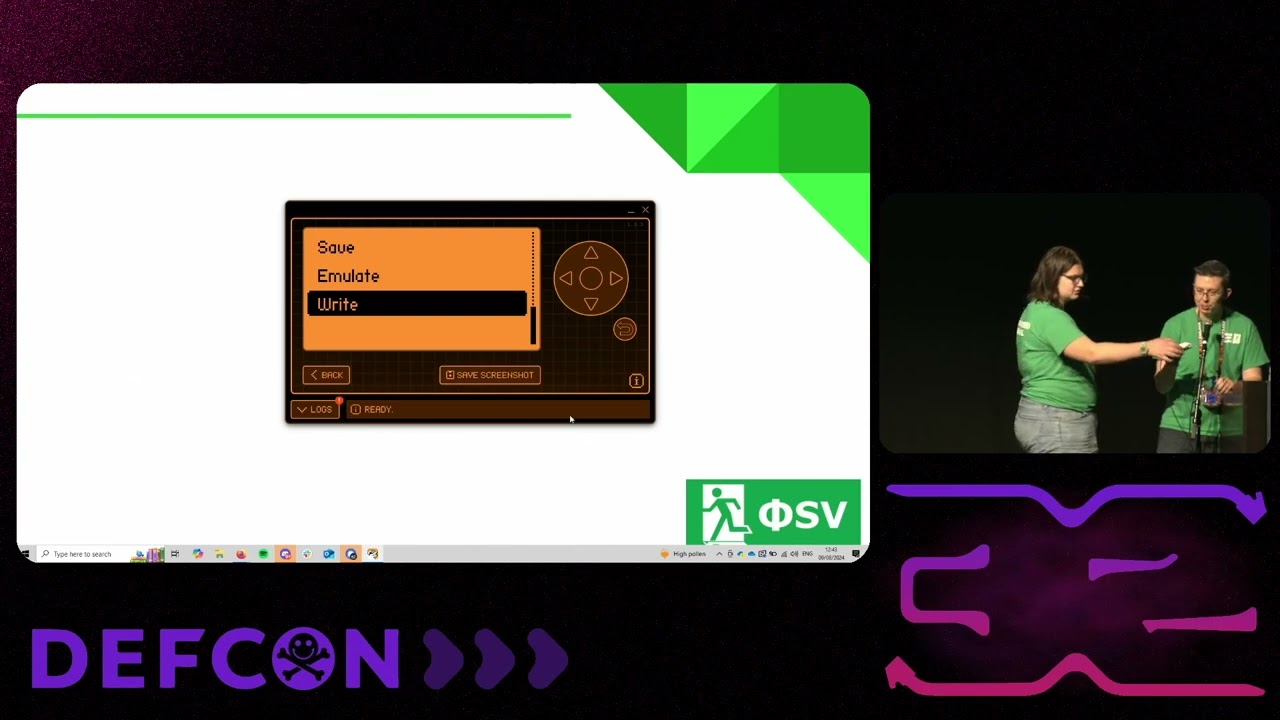
DEF CON 32 - RFID 101 - Ege Feyzioglu & Andrew M
Source: YouTube · DEFCONConference · published Oct 16, 2024 · 20:58
RFID technology is fundamentally simple and vulnerable to attacks due to its reliance on unencrypted magnetic fields, making it easy to clone and intercept 2:30-2:49. The core of RFID operation involves a reader generating a magnetic field that powers a chip in a tag, allowing it to transmit an ID—this process is passive and unencrypted, exposing it to physical snatching and reading 3:06-3:48.
Key Takeaways:
• RFID tags transmit raw IDs via magnetic fields, which can be easily intercepted with simple loop antennas 2:30-2:49.
• Encryption can enhance security using pre-shared keys and challenge-response mechanisms, especially in high-frequency RFID systems (13.56 MHz) 5:31-6:06.
• Poor implementation—such as using identical keys across all devices—creates massive security flaws, as seen in HID’s past products 6:30-7:25.
• Low-frequency RFID tags can be cloned using tools like the Flipper Zero, which reads and writes data to badges in seconds 8:57-9:33.
• Brute-forcing small keyspaces (e.g., 4-byte IDs) is feasible over time, especially with passive exposure 11:05-11:57.
• Physical tampering (e.g., temper wires) can be bypassed depending on reader design, and even with proper setup, alarms may be circumvented through repeated attacks 14:33-19:59.
RFID access feels secure at first glance, but it's not a silver bullet—like physical keys, it requires proper management, deactivation, and encryption to be truly safe. Users should treat RFID keys like passwords or physical keys: lost or compromised, they must be immediately revoked 12:37-13:16.
Sources:
Generate CPE Credits
Generate a professional CPE document from this video's transcript.
Estimated credit: 0.5 CPE hours
Estimate uses the video runtime (1 hour ≈ 1 CPE, rounded to the nearest 0.5, minimum 0.5, maximum 2.0). The final amount can be lower after review, never higher.
Topic: Cybersecurity. Commonly maps to: Security and Risk Management, Security Operations. Exact CISSP domains are assigned during generation.
Free account. One generation at a time, with a daily limit.
CPEBuddy is independent and not affiliated with or endorsed by ISC2, ISACA, or any certification body. Exports are formatted for common CPE submissions; acceptance is at your certification body's discretion.
Transcript Preview
First 800 characters of the transcript
all right everyone thank you so much for coming to the RFID talk um this is going to be a quick introduction to how RFID works and uh what you can do to you know play around with it uh have have a little fun and hopefully it will uh we will end with some suggestions on uh how we can make our ID a little bit safer and what the common problems are and then we're going to end with a quick demonstration on how to use the uh The Flipper zero I'm sure y'all are very familiar with that um if not we're going to introduce you to that as well so oh yeah before that introductions my name is a that's spelled like that uh the top name that you see over there uh we're from the physical security Village uh if you like what you see here and would like to see more of the physical side of uh like physical s…