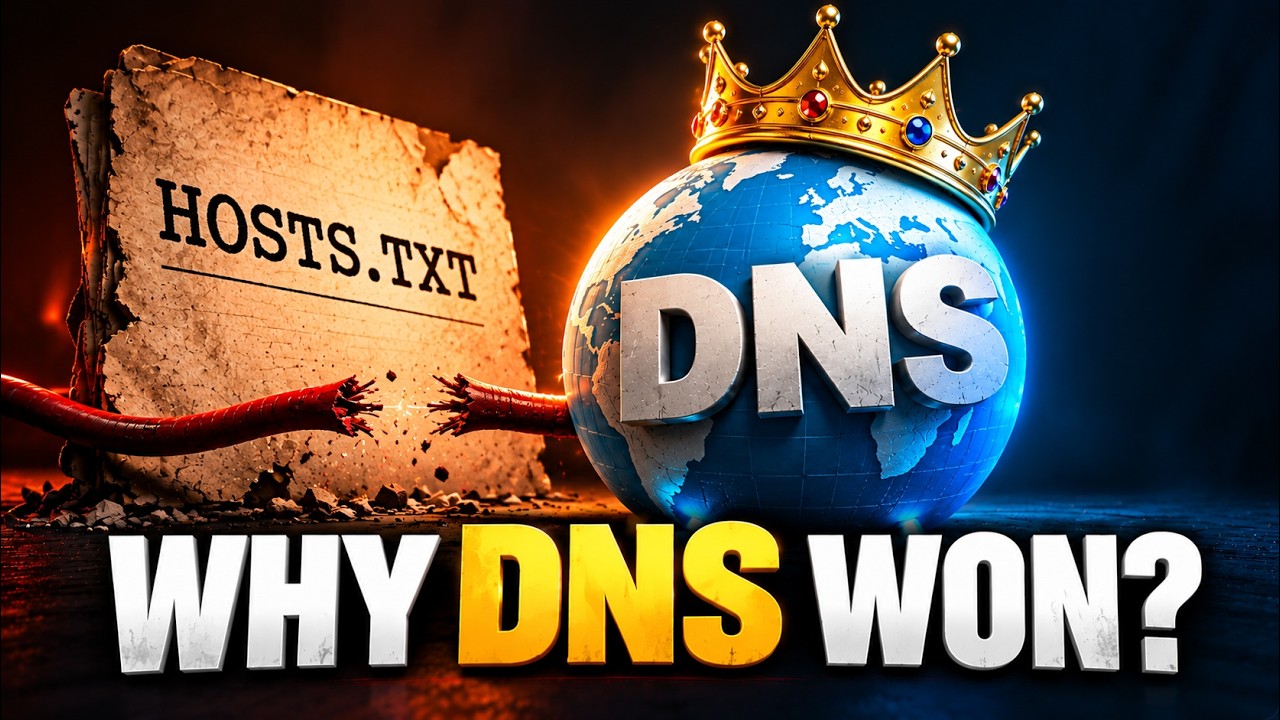
The Untold Story of DNS
Source: YouTube · CodeSource · published Oct 29, 2026 · 15:10
BLUF: The Domain Name System (DNS) evolved from a fragile, centralized file into a resilient, distributed hierarchy, though its foundational design choices regarding caching and authentication created vulnerabilities that required decades of community effort to mitigate.
Key Takeaways:
• The original Arpanet relied on a single hosts.txt file managed by one team, which became unsustainable as the network grew, leading Paul Mockapetris to design DNS as a distributed, hierarchical tree structure in 1983 2:00-3:00.
• Mockapetris explicitly warned in the 1983 specifications that caching, while necessary for speed, was a "potential source of incorrect results," a flaw that would later enable DNS spoofing attacks 5:18-5:30.
• John Postel acted as the de facto authority for DNS for decades, maintaining the root zone and assigning numbers, effectively serving as the "god" of the internet until his death in 1998 8:20-8:40.
• In 1997, Eugene Kashpar exploited DNS caching vulnerabilities to redirect traffic from Network Solutions, demonstrating that the lack of authentication allowed for significant disruption and fraud 9:15-9:40.
• In 2008, researcher Dan Kaminsky discovered a critical flaw in DNS's 16-bit transaction ID system, allowing attackers to hijack domain names via cache poisoning in seconds, prompting a historic, synchronized global patch 12:15-13:40.
• The internet's governance shifted from US government contracts to the non-profit ICANN, and the introduction of DNS Security Extensions (DNSSEC) provided cryptographic verification to address the original design's lack of trust mechanisms 14:30-15:00.
The DNS remains a cornerstone of the internet, balancing scalability with security through continuous community-driven updates and the eventual adoption of cryptographic verification.
Sources:
- 2:00-3:00 The creation of the DNS hierarchy to replace the centralized
hosts.txtfile. - 5:18-5:30 Early warnings about the dangers of DNS caching in the 1983 specifications.
- 8:20-8:40 John Postel's role as the central authority and "god" of the internet.
- 9:15-9:40 Eugene Kashpar's 1997 DNS cache poisoning attack on Network Solutions.
- 12:15-13:40 Dan Kaminsky's 2008 discovery of the DNS cache poisoning vulnerability and the global response.
- 14:30-15:00 The transition to ICANN and the implementation of DNSSEC for security.
Generate CPE Credits
Generate a professional CPE document from this video's transcript.
Estimated credit: 0.5 CPE hours
Estimate uses the video runtime (1 hour ≈ 1 CPE, rounded to the nearest 0.5, minimum 0.5, maximum 2.0). The final amount can be lower after review, never higher.
Topic: Cybersecurity. Commonly maps to: Security and Risk Management, Security Operations. Exact CISSP domains are assigned during generation.
Free account. One generation at a time, with a daily limit.
CPEBuddy is independent and not affiliated with or endorsed by ISC2, ISACA, or any certification body. Exports are formatted for common CPE submissions; acceptance is at your certification body's discretion.
Transcript Preview
First 800 characters of the transcript
In 2008, a researcher in Seattle works out that he can hijack any name on the internet in about 10 seconds. Your banks, your email providers, anyone's. You type the right address, see the right address, and land on his machine. He's found it by accident in DNS, the system that turns every name you type into a number, and the hole isn't in anybody's code. It's in the design. The man who invented DNS even warned about it in one sentence back in 1983. The researcher doesn't sell what he's found. He makes a phone call. Before long, 16 engineers from rival companies are sitting together at Microsoft, agreeing to say nothing. The man he calls has been here before. 10 years earlier, his phone rang, too. That time, the caller pulled root servers away from the US government's machine with a single …