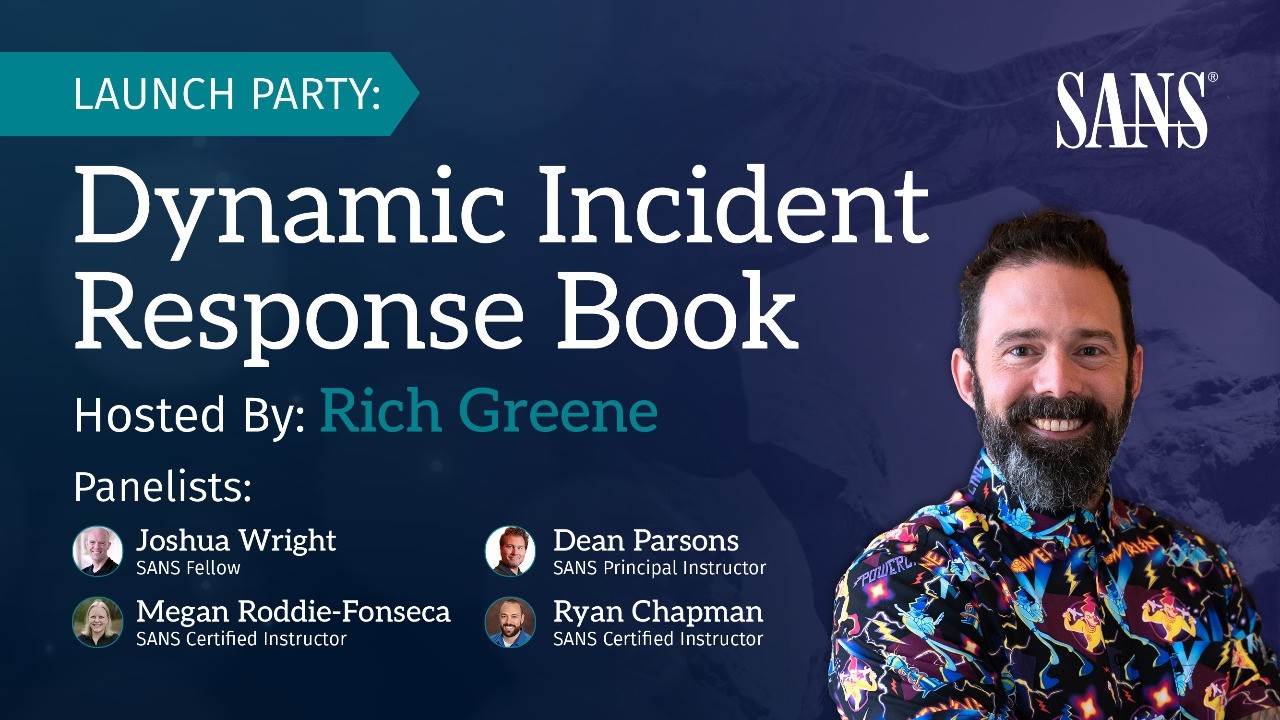
Launch Party: Dynamic Incident Response Book
Source: YouTube · SANS Digital Forensics and Incident Response · published Sep 16, 2026 · 51:05
BLUF:
Dynamic Incident Response offers a modern, adaptive framework for security teams to handle complex incidents where scope and priorities shift, moving beyond the static linear models of the past 1:22. The book emphasizes that responders must continuously re-scope investigations based on new evidence rather than following a rigid A-to-Z process 7:00.
Key Takeaways:
- Adaptive Scoping is Critical: Traditional incident response often fails because it assumes a linear progression. Responders must iterate back through earlier steps (like identification) as new indicators of compromise emerge, ensuring the true scope of the breach is understood 7:00.
- Evolution of Ransomware: Modern cyber extortion is no longer just about encryption; attackers use multi-vector campaigns involving data theft, SSO compromise, and cloud enumeration, requiring visibility into non-traditional endpoints like GitLab and SSO providers 11:20.
- Cloud Visibility Challenges: Organizations often lack necessary data plane logs (e.g., file access events) by default. Responders must use risk modeling to prioritize logging high-value assets (like HR data) over low-value ones to balance cost and security needs 17:15.
- OT/ICS Specific Risks: Operational Technology environments differ significantly from IT; 80% of assets may run proprietary OSs, requiring specialized triage skills and a focus on safety over immediate containment, with heavy reliance on protocol-specific network visibility 25:30.
- Preparation Over Reaction: The most common failure in incident response is inadequate preparation. Teams should focus on converging IT and OT skill sets and ensuring they can detect threats in their specific environment before an incident occurs 42:45.
Closing Statement:
The Dynamic Incident Response framework provides a necessary evolution for security professionals, addressing the realities of modern, multi-vector attacks in IT, cloud, and OT environments. By prioritizing adaptive scoping and proactive visibility, teams can better manage the complexity of contemporary cyber threats.
Sources:
- 1:22 Introduction to the dynamic incident response framework and its purpose.
- 7:00 Discussion on the failure of linear processes and the need for iterative scoping.
- 11:20 Analysis of modern ransomware tactics, including data theft and SSO exploitation.
- 17:15 Strategies for managing cloud logging costs and prioritizing high-value assets.
- 25:30 Differences between IT and OT environments and the need for specialized OT forensics.
- 42:45 The importance of preparation and the "Prepare" phase in incident response.
Generate CPE Credits
Generate a professional CPE document from this video's transcript.
Estimated credit: 1 CPE hours
Estimate uses the video runtime (1 hour ≈ 1 CPE, rounded to the nearest 0.5, minimum 0.5, maximum 2.0). The final amount can be lower after review, never higher.
Topic: Incident Response. Commonly maps to: Security Operations, Security Assessment and Testing. Exact CISSP domains are assigned during generation.
Free account. One generation at a time, with a daily limit.
CPEBuddy is independent and not affiliated with or endorsed by ISC2, ISACA, or any certification body. Exports are formatted for common CPE submissions; acceptance is at your certification body's discretion.
Transcript Preview
First 800 characters of the transcript
[clears throat] Heat. Heat. N. [music] [music] >> [music] >> Good day everyone and welcome. I am so excited to be here for this very, very special occasion. Now, for this little special spot we have carved out for lunch, so make sure you grab some food, grab some coffee, grab a monster, whatever you're vibing with. But we're here to talk about dynamic incident response, a framework for the security teams. God, if you saw my video, I absolutely love the title, right? But when we look at this book, it's a new approach to incident response built around how incidents actually unfold, right? where scope changes, priority shift, and responders have to adapt as new information really starts to come in. Now, joining me today, oh, do we got some people joining today? I have Joshua Wright, Sansfello…