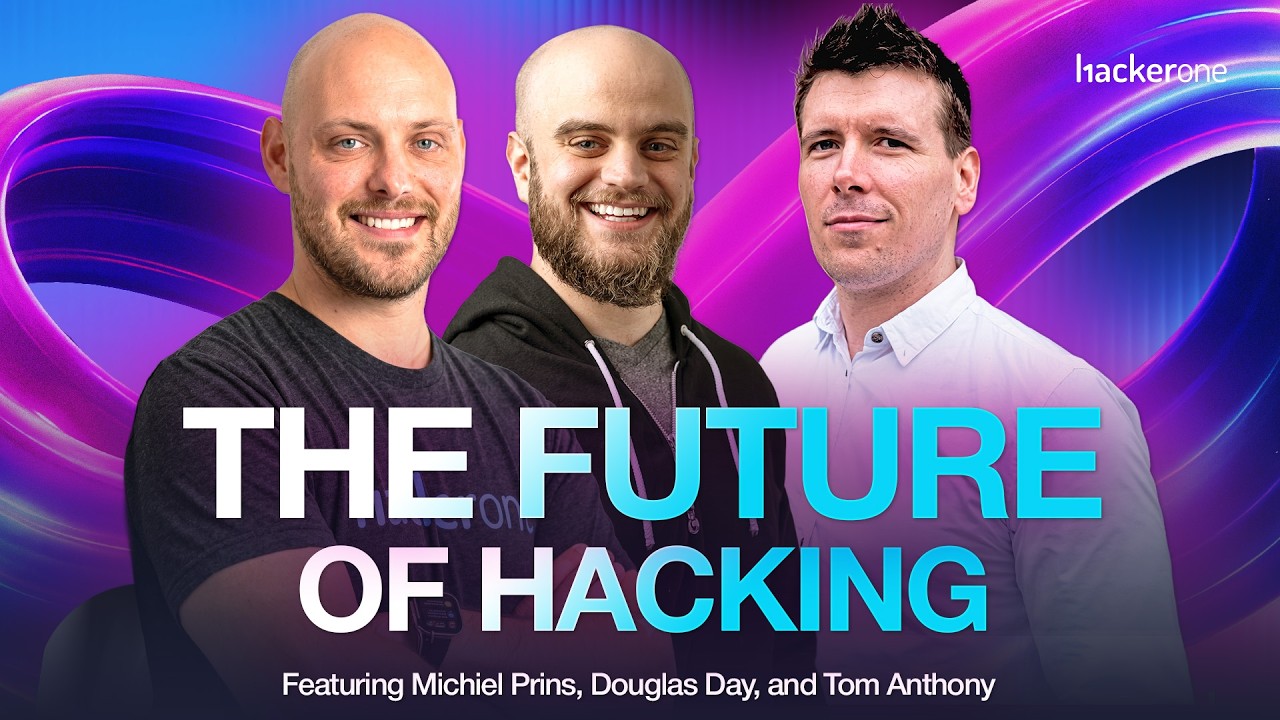
The Future of Hacking: AI That Never Misses a Vulnerability
Source: YouTube · HackerOne · published Aug 17, 2026 · 24:49
BLUF: Security researchers emphasize that AI augments hacking workflows by enabling smart automation and scale, but human adversarial intuition remains critical for context, complex logic, and impact assessment 2:57.
Key Takeaways:
• AI enables "smart automation," allowing researchers to build harnesses that find bugs more effectively than manual efforts, though it often produces noisy results requiring triage 2:15.
• Out-of-the-box LLMs provide poor results; effectiveness depends on feeding the AI prior hacking knowledge, target-specific context, and detailed agent instructions 3:03.
• AI can find vulnerabilities, but it lacks the ability to understand business context and impact, making human hackers essential for maximizing the value of findings 5:05.
• Red team advantages currently outweigh blue teams because attackers only need one break-in path, while defenders must close all gaps, and AI models often inherit defender assumptions 7:03.
• Adversarial intuition and "spidey sense" remain irreplaceable, as humans excel at prioritizing context and identifying subtle cracks that AI agents overlook due to context window limitations 11:42.
• Organizations using AI for defense must train models on their specific application context rather than relying on generic models to compete with attackers who do the same 20:13.
Closing Statement: The integration of AI in security research shifts the hacker's role from manual exploitation to orchestrating automated agents, yet human intuition and contextual understanding remain the decisive factors in identifying high-impact vulnerabilities.
Sources:
- 2:15 Discussion on AI unlocking smart automation and the iterative process of making it work.
- 3:03 Explanation that off-the-shelf LLMs fail without specific hacker knowledge and context.
- 5:05 Analysis of AI's ability to find bugs versus its inability to assess business impact.
- 7:03 The asymmetry between red teams needing one entry point and blue teams needing perfect coverage.
- 11:42 Comparison of human context window and prioritization capabilities against AI agents.
- 20:13 Advice for CISOs to train AI on organizational context rather than using generic models.
Generate CPE Credits
Generate a professional CPE document from this video's transcript.
Estimated credit: 0.5 CPE hours
Estimate uses the video runtime (1 hour ≈ 1 CPE, rounded to the nearest 0.5, minimum 0.5, maximum 2.0). The final amount can be lower after review, never higher.
Topic: Cybersecurity. Commonly maps to: Security and Risk Management, Security Operations. Exact CISSP domains are assigned during generation.
Free account. One generation at a time, with a daily limit.
CPEBuddy is independent and not affiliated with or endorsed by ISC2, ISACA, or any certification body. Exports are formatted for common CPE submissions; acceptance is at your certification body's discretion.
Transcript Preview
First 800 characters of the transcript
Alex made a point I want to call out. It's not just about finding more vulnerabilities. It's about fixing classes of bugs, not individual findings. That mindset shift from reactive patching to structural exposure reduction is one of the most useful reframes of the day. Our next session is a panel and one I'm personally excited about. We're going to hear directly from members of the security researcher community about how they're using AI in their work, what their trade craft actually looks like, and what that means for organizations on the receiving end. Joining us is Hacker 1's co-founder and senior director of product management prince alongside security researchers Douglas Stay and Tom Anthony. Please welcome our panel. >> All right, welcome everybody. Uh my name is Mikil Prince uh co-f…