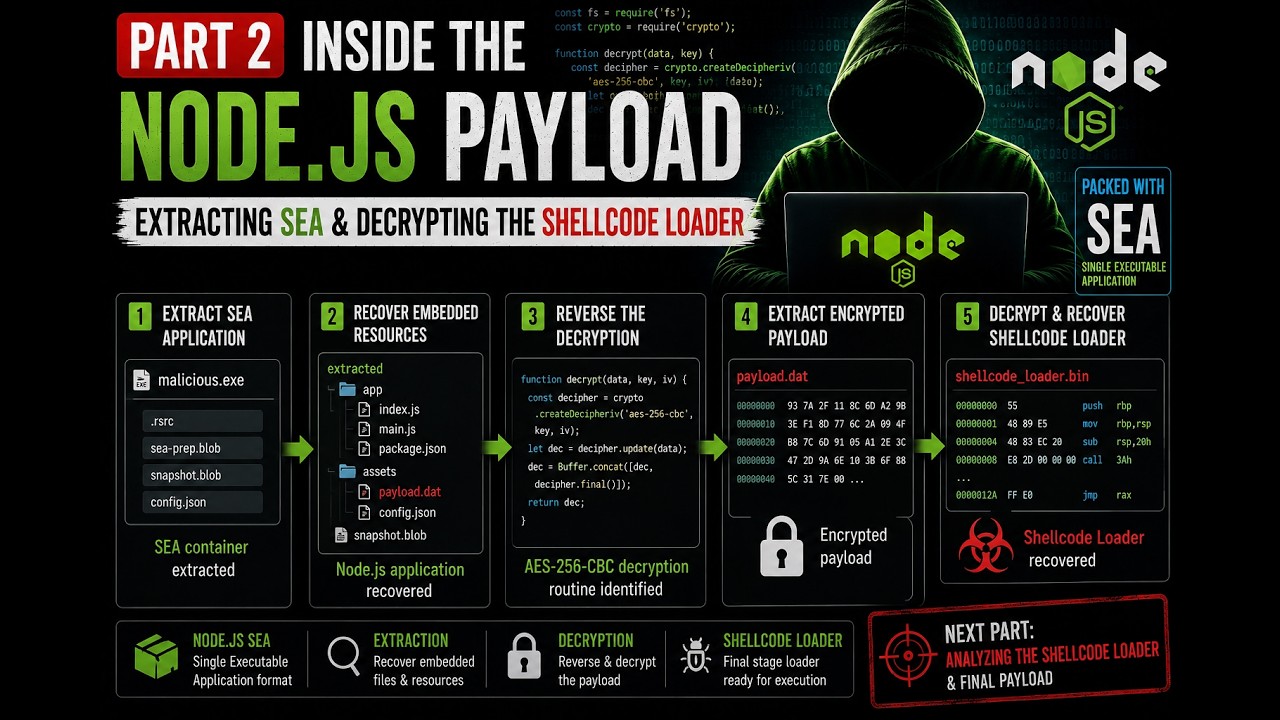
Inside the Node js Payload | Extracting SEA & Reversing the Shellcode Loader Part 2
Source: YouTube · Malware Research Diary · published Jul 22, 2026 · 31:46
[BLUF] This analysis dissects a complex Node.js malware dropper, tracing a multi-stage attack chain from DLL side-loading and encrypted JavaScript payloads to shellcode injection for persistence on Windows systems 2:43.
Key Takeaways:
• The initial Node.js application is encoded in a container format; analysts identified a hidden 6MB Windows executable (third stage) by locating the 'MZ' header within the binary data 1:29.
• This JavaScript payload establishes persistence by creating desktop shortcuts, scheduling tasks named "Windows Defender Verify," and preparing for process injection 7:08.
• The malware utilizes XOR decryption with the key "red team VM" to decrypt embedded shellcode and other data structures within the script 16:40.
• The final stage involves extracting, decrypting, and injecting shellcode into a running process, representing a sophisticated attack transitioning from DLL side-loading to final execution 24:09.
• The complete attack chain requires detailed debugging to fully understand the final shellcode's behavior, highlighting the complexity of modern malware evasion techniques 29:00.
[Closing statement] This case study underscores the necessity of deep static and dynamic analysis to uncover hidden resources and decryption logic in multi-stage malware. Further investigation is needed to determine the specific actions of the final decrypted shellcode.
Sources:
Generate CPE Credits
Generate a professional CPE document from this video's transcript.
Estimated credit: 0.5 CPE hours
Estimate uses the video runtime (1 hour ≈ 1 CPE, rounded to the nearest 0.5, minimum 0.5, maximum 2.0). The final amount can be lower after review, never higher.
Topic: Malware Analysis. Commonly maps to: Security Operations, Security Architecture and Engineering. Exact CISSP domains are assigned during generation.
Free account. One generation at a time, with a daily limit.
CPEBuddy is independent and not affiliated with or endorsed by ISC2, ISACA, or any certification body. Exports are formatted for common CPE submissions; acceptance is at your certification body's discretion.
Transcript Preview
First 800 characters of the transcript
Hello everyone. Let's resume back to analyzing this um NodeJ node application. So um yeah after taking a look at this um so the the application is um encoded in um sea format but they are hidden from the um the resource. So um so yeah we wouldn't be able to extract it. But one interesting about this is um so I found looking through the strings at the very end um found this sequence of data and let's take a look and see um notice there's also an executable at the very end. So um may maybe let's do that first. So where's my Right. So let's do Python data open secondhand state bin bin v binary we so data find binary so so we find this location right so from here I want to see if we can find Um MC form here is that correct? So data um this this plus let's say 20 um mgz. Nope, that's not the on…