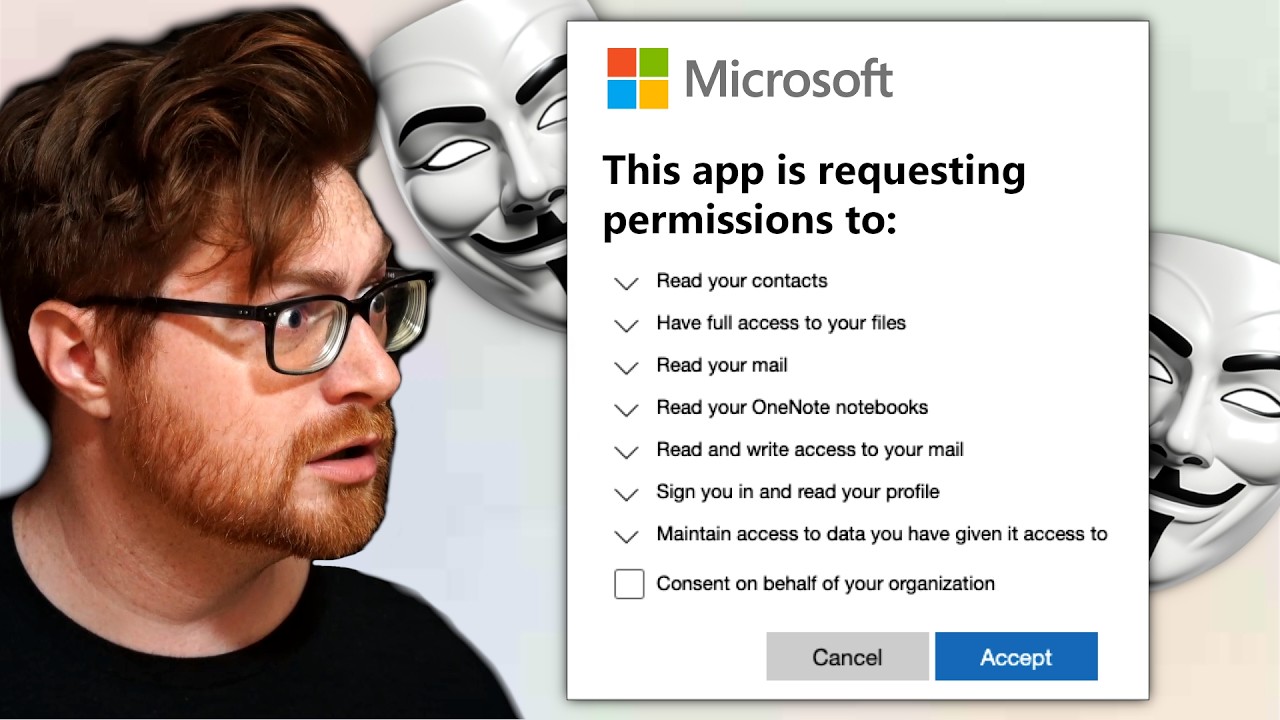
Permission to Hack You: Illicit Consent Grant Attack
Source: YouTube · John Hammond · published Jul 24, 2024 · 26:34
The video demonstrates how attackers exploit OAuth 2.0 through illicit consent grant attacks to compromise Microsoft 365 accounts by tricking users into granting excessive permissions to malicious applications 0:00-0:39.
Key Takeaways:
• OAuth 2.0 is commonly used for account connections but can be abused in spear phishing attacks where attackers create rogue applications to steal sensitive data 1:37-2:07
• Attackers set up malicious Azure apps with broad permissions (email access, files, contacts) and use social engineering to trick victims into granting consent 12:15-15:04
• Once victims grant consent, attackers obtain access tokens that allow them to read emails, access files, and potentially compromise entire organizational data 19:23-21:01
• These attacks can be detected through Azure Entra ID audit logs showing "consent to application" events and by analyzing OAuth request URLs for suspicious client IDs 25:02-25:59
The video highlights both the attacker methodology and defensive measures, emphasizing the importance of carefully reviewing application permissions before granting consent.
Sources:
- 0:00-0:39 Introduction to OAuth 2.0 and security risks
- 1:37-2:07 Explanation of illicit consent grant attacks
- 12:15-15:04 Configuring malicious Azure application with permissions
- 19:23-21:01 Demonstration of successful token theft
- 25:02-25:59 Detection methods through audit logs
Generate CPE Credits
Generate a professional CPE document from this video's transcript.
Estimated credit: 0.5 CPE hours
Estimate uses the video runtime (1 hour ≈ 1 CPE, rounded to the nearest 0.5, minimum 0.5, maximum 2.0). The final amount can be lower after review, never higher.
Topic: Cybersecurity. Commonly maps to: Security and Risk Management, Security Operations. Exact CISSP domains are assigned during generation.
Free account. One generation at a time, with a daily limit.
CPEBuddy is independent and not affiliated with or endorsed by ISC2, ISACA, or any certification body. Exports are formatted for common CPE submissions; acceptance is at your certification body's discretion.
Transcript Preview
First 800 characters of the transcript
Have you ever seen a website that asks for your permission to act as one of your other online accounts? Things like logging in with Google or hey connecting your Twitch account for Streamlabs or whatever or GitHub or even Zapier trying to connect to Notion, HubSpot, whatever. This is a convenience. It's pretty handy to use one account to work with another. And it is used but also even abused especially in spear fishing attacks and other risks cyber security threats to an organization, a company, a business, even you. the end user, the individual or the person working on the computer here. And look, this is all put together. The way this is done when you see that functionality is by using OOTH. OOTH 2.0 is described as an open protocol to allow secure authorization in a simple and standard …