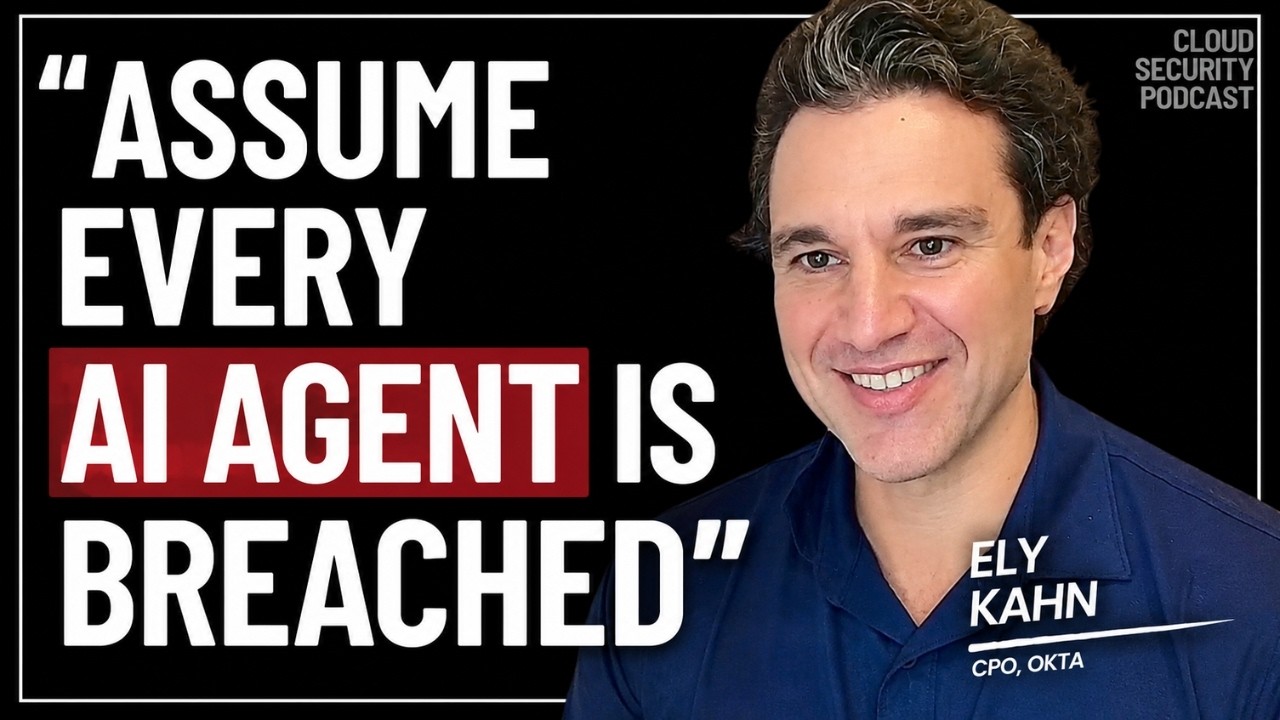
Who Governs Your AI Agents? Identity, Offboarding & Open Standards
Source: YouTube · Cloud Security Podcast · published Jul 2, 2026 · 34:45
AI agents must be treated with an "assume breach" mindset because prompt injection remains unsolved, making least-privileged identity management the highest-ROI security action organizations can take 0:00 18:06.
Key Takeaways:
• A major recent breach occurred when attackers found a long-lived, over-privileged token tied to a third-party agent, allowing them to move laterally and steal source code 0:09.
• Cross-App Access (XAA) is a new open standard extending OAuth, developed by Okta and Anthropic, that lets agents securely pass permissions without permanent API keys or constant user pop-ups 9:08.
• XAA (resource access) and SPIFFE (cryptographic workload identity) solve different problems and are designed to work together rather than compete 13:25.
• Agent authorization matures from static API keys to coarse-grained scopes (XAA), then to fine-grained data-sensitivity controls, and ultimately to intent-based security with zero standing privilege 19:14.
• No one is properly offboarding AI agents; organizations must apply identity governance—like access reviews and automated "kill switches"—just as they do for human employees 22:48.
While the core identity building blocks remain the same, CISOs should immediately start by discovering all agents—including shadow AI—and replacing broad API keys with scoped, ephemeral tokens.
Sources:
Generate CPE Credits
Generate a professional CPE document from this video's transcript.
Estimated credit: 0.5 CPE hours
Estimate uses the video runtime (1 hour ≈ 1 CPE, rounded to the nearest 0.5, minimum 0.5, maximum 2.0). The final amount can be lower after review, never higher.
Topic: Identity & Access Management. Commonly maps to: Identity and Access Management (IAM), Security Architecture and Engineering. Exact CISSP domains are assigned during generation.
Free account. One generation at a time, with a daily limit.
CPEBuddy is independent and not affiliated with or endorsed by ISC2, ISACA, or any certification body. Exports are formatted for common CPE submissions; acceptance is at your certification body's discretion.
Transcript Preview
First 800 characters of the transcript
Agents will be breached, and we have to assume breach on agents. >> Wrong position is almost an impossible problem to solve with the way we use systems today. >> Their entire source code stolen basically because an attacker found a token, a long-lived over-privileged token associated with the agent that they are using. >> have a great answer for identity of AI agents. At least not one that we have been solidly getting behind. >> People give agents long-lived, broadly scoped permissions to basically do anything that they may need to do in the future. And this is where companies can get into trouble. >> You know, you spoke about off-boarding. I I don't even know anyone who's talking about off-boarding an AI agent. I don't even know if that's a thing people do. People just make agents and the…