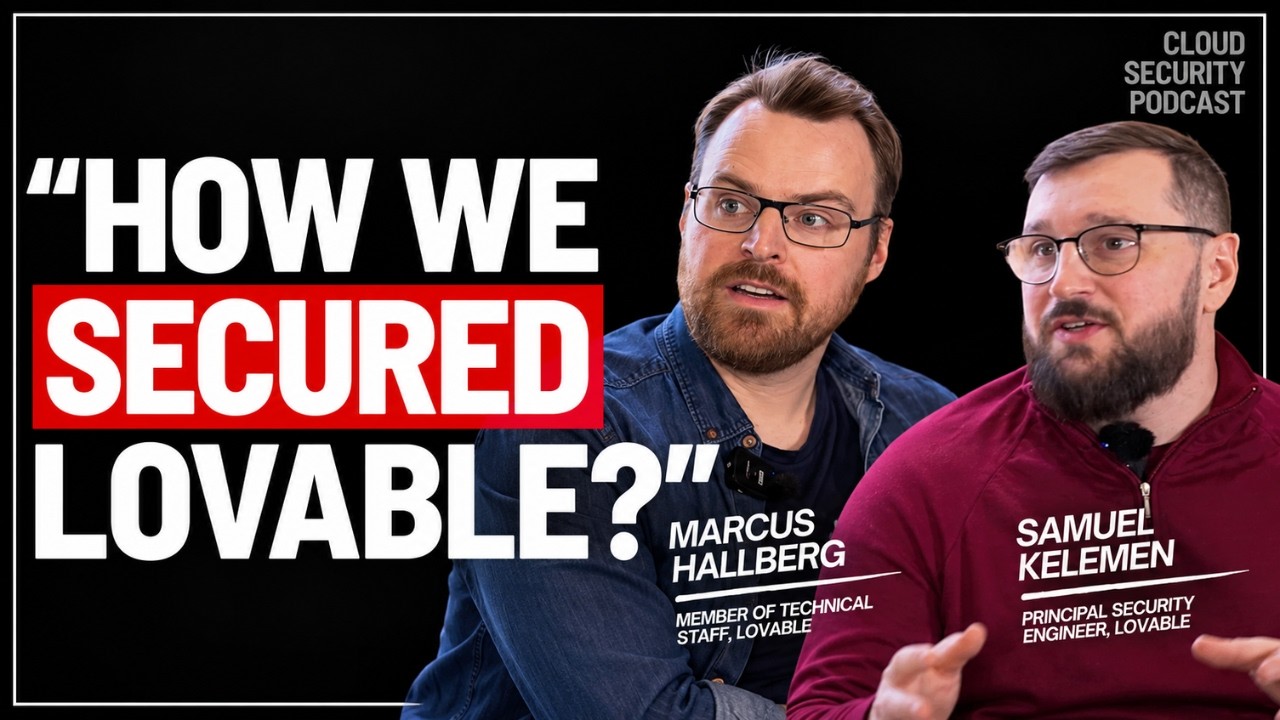
Securing Millions of AI-built Apps: How Lovable Defends Against Insider Threats
Source: YouTube · Cloud Security Podcast · published Sep 11, 2026 · 1:10:33
Security engineers from Lovable share how they detected and defended against a year-long trust misuse attack on customer projects, emphasizing that AI-native platforms must pair accessibility with verification, strong identity, and secure-by-default guardrails 0:00.
Key Takeaways:
• Trust Misuse Attacks: Attackers posing as hired developers refined malicious techniques for over a year, testing them in their own projects before weaponizing them — even mimicking legitimate agent commit messages to hide malicious changes in plain sight 11:25
• Delegate Work, Not Thinking: Teams must verify AI-generated code, have agents present plans before executing, and maintain strong CI/CD and testing practices — AI doesn't need to be perfect, just verified 38:15
• Identity Challenges: The industry must decide whether agents should be attributed as themselves or act as impersonated users — a problem analogous to the cloud's shift from service account keys to delegation and impersonation 33:00
• Staged Adoption: Start with guardrails like predefined skills and guidelines, then graduate to sandboxed environments for agentic work as trust and maturity grow 36:20
• Platform Leverage: One security improvement in the builder is amplified across 40+ million apps; platforms should offer "Lego-like" security primitives so even non-technical users build securely by default 53:30
AI democratizes software creation, but organizations must treat it as a powerful yet fallible collaborator — pairing automation with verification, identity attribution, and user education to stay ahead of evolving threats.
Sources:
Generate CPE Credits
Generate a professional CPE document from this video's transcript.
Estimated credit: 1 CPE hours
Estimate uses the video runtime (1 hour ≈ 1 CPE, rounded to the nearest 0.5, minimum 0.5, maximum 2.0). The final amount can be lower after review, never higher.
Topic: Cybersecurity. Commonly maps to: Security and Risk Management, Security Operations. Exact CISSP domains are assigned during generation.
Free account. One generation at a time, with a daily limit.
CPEBuddy is independent and not affiliated with or endorsed by ISC2, ISACA, or any certification body. Exports are formatted for common CPE submissions; acceptance is at your certification body's discretion.
Transcript Preview
First 800 characters of the transcript
We need to delegate our work but not our thinking. >> You don't think about this prompting in in English or any other language. It's just malicious. >> It's only when you look at the actual source code and the commit itself that you see what they were actually trying to do. >> We're empowering a lot more people to write applications. >> When our agent writes code, the ultimate way for the agent to do that can be tweaked in certain ways to make sure that the ultimate code that gets written is more or less secure. >> I think most of us are running in YOLO mode. We will have like asynchronous [music] agents running all the time everywhere. Imagine being paged on an ungodly hour that someone is trying to access your network and misuse the trust that you have between your customers and the deve…