Black Hat USA 2026 | Applying Information Retrieval to Vulnerability Research
Source: YouTube · Black Hat · published Sep 21, 2026 · 28:16
The speaker argues that vulnerability discovery is primarily an attention management problem rather than a detection capability issue, and proposes using Sift Rank, a list-wise document ranking algorithm, to help small language models focus their limited attention on the most relevant code snippets 1:01. By externalizing the burden of attention management, Sift Rank allows smaller models to leverage their latent semantic reasoning capabilities to identify potential vulnerabilities more effectively than traditional agent loops or zero-shot classification 3:43.
Key Takeaways:
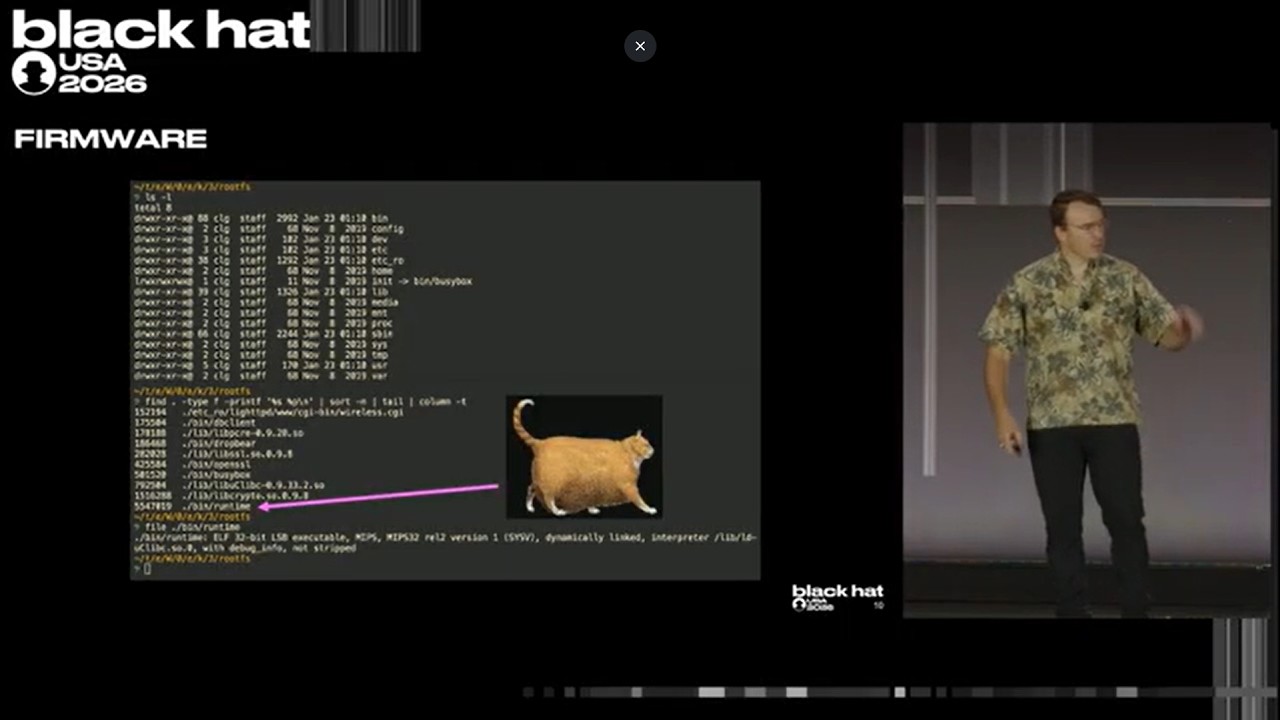
• The speaker demonstrates Sift Rank on a WattBox device, where the algorithm sifts through 5,700 decompiled functions to identify a critical command injection vulnerability that granted unrestricted root access 6:21.
• Sift Rank operates by repeatedly ranking small batches of code snippets against a vague query, using statistical tests to identify functions that consistently rank higher than random chance 11:17.
• In evaluations using the BinPwn dataset, Sift Rank outperformed zero-shot classification by over double in precision, presenting an average of only three functions to review compared to thirty 18:07.
• The ranking approach excels because it avoids the pitfalls of absolute binary classification, which often fails due to incomplete information and the model's inability to provide calibrated confidence scores 22:40.
• Sift Rank performs well across various model sizes, with smaller models like GPT-5 Nano matching or beating larger models when used within the ranking framework 20:11.
This method offers a scalable way to prioritize security analysis by focusing human attention on the highest-probability candidates, a strategy that can also be applied to SOC alert triage and SAST finding prioritization 25:28. The tool is open-source and continues to iterate, providing a practical solution for managing the information overload inherent in modern vulnerability research.
Sources:
- 1:01 Introduction of the core hypothesis regarding vulnerability discovery as an attention problem.
- 3:43 Explanation of externalizing attention management to unlock small model capabilities.
- 6:21 Demonstration of Sift Rank on the WattBox firmware codebase.
- 11:17 Description of the iterative ranking and statistical significance process.
- 18:07 Presentation of precision results comparing Sift Rank to zero-shot classification.
- 22:40 Analysis of why relative ranking outperforms absolute classification in information-deficit scenarios.
- 25:28 Discussion of broader applications for Sift Rank beyond vulnerability research.
Generate CPE Credits
Generate a professional CPE document from this video's transcript.
Estimated credit: 0.5 CPE hours
Estimate uses the video runtime (1 hour ≈ 1 CPE, rounded to the nearest 0.5, minimum 0.5, maximum 2.0). The final amount can be lower after review, never higher.
Topic: Cybersecurity. Commonly maps to: Security and Risk Management, Security Operations. Exact CISSP domains are assigned during generation.
Free account. One generation at a time, with a daily limit.
CPEBuddy is independent and not affiliated with or endorsed by ISC2, ISACA, or any certification body. Exports are formatted for common CPE submissions; acceptance is at your certification body's discretion.
Transcript Preview
First 800 characters of the transcript
What's up, Black Hat? I'm Caleb Gross. And today we are going to sift or get off the pot. Or perhaps more appropriately, we will apply information retrieval to vulnerability research. And I'm going to open with an argument that I have been more and more convinced by. Which is that vulnerability discovery is essentially an attention problem. Uh that is, we are not terribly lacking for detection capability, but rather it is attention that is extremely limited. Um To examine a large code base, attention is a precious resource that must be managed really well. And so the open question for me is how might large language models become a better first-class tool for vulnerability discovery, keeping in mind that attention, I think, is the most precious resource uh that we want to scale more effecti…