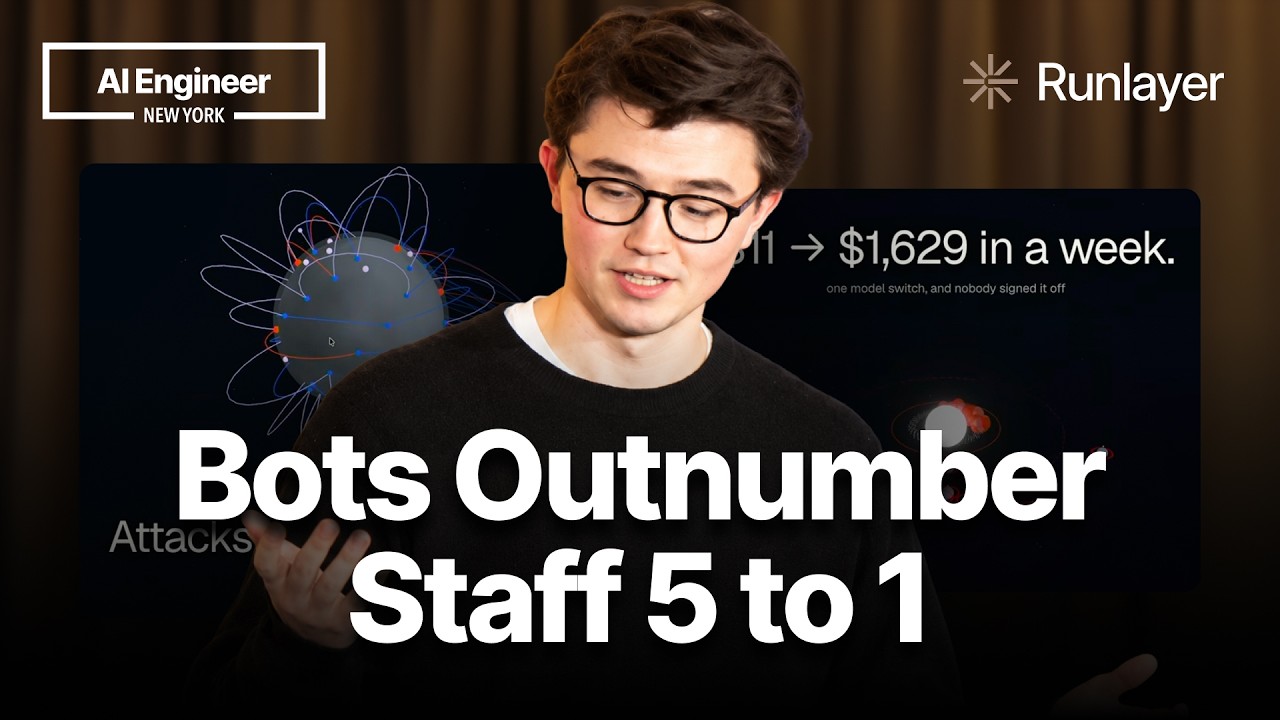
300 Agents, 60 People: How We Secured Our Own AI Agents - Aiden Sochowski, Runlayer
Source: YouTube · AI Engineer · published Oct 27, 2026 · 16:35
BLUF: Runlayer engineers highlight the critical need for centralized monitoring of AI agents to mitigate security risks like data exfiltration and to control escalating operational costs 0:28. They argue that effective governance requires continuous behavioral analysis rather than static rule-based policies 1:31.
Key Takeaways:
• Visibility Gap: Most organizations lack oversight of the agents running within their infrastructure, leading to unmanaged devices and unpredictable authentication patterns 0:28.
• Scale of Risk: Internal monitoring revealed that agent usage significantly outpaces human users; for instance, a ~60-person company may have over 300 active agents running daily 1:31.
• Contextual Security: Static policies are insufficient for preventing attacks that evolve over a session, such as prompt injection in PR reviews, necessitating dynamic classifier models to detect intent drift 8:12.
• Cost Management: Switching to more expensive models or encountering frequent errors in poorly written MCP servers can cause costs to balloon by 100x, requiring strict budgeting and justification for high-intelligence tasks 14:12.
Closing Statement:
Securing and managing AI agents requires a shift from static permissioning to continuous behavioral monitoring. By tracking tool calls and context drift, organizations can identify high-risk actions early and prevent both security breaches and cost overruns.
Sources:
- 0:28 Discussion on the lack of visibility into client and internal agent usage.
- 1:31 Statistics on the number of agents running daily compared to human employees.
- 8:12 Explanation of why static policies fail against complex, session-long attacks like prompt injection.
- 14:12 Examples of cost escalation due to model switching and error loops in MCP servers.
Generate CPE Credits
Generate a professional CPE document from this video's transcript.
Estimated credit: 0.5 CPE hours
Estimate uses the video runtime (1 hour ≈ 1 CPE, rounded to the nearest 0.5, minimum 0.5, maximum 2.0). The final amount can be lower after review, never higher.
Topic: Cybersecurity. Commonly maps to: Security and Risk Management, Security Operations. Exact CISSP domains are assigned during generation.
Free account. One generation at a time, with a daily limit.
CPEBuddy is independent and not affiliated with or endorsed by ISC2, ISACA, or any certification body. Exports are formatted for common CPE submissions; acceptance is at your certification body's discretion.
Transcript Preview
First 800 characters of the transcript
[music] So, uh, my name is Aiden. I'm one of the founding engineers here at Runlayer. And, uh, today I'm going to kind of walk you through, uh, I guess like our process of how we internally, uh, kind of secured a lot of our agents. So, uh, across a lot of companies that we see now nowadays, um, you know, most people have zero visibility into their clients or into the agents that they're running within their company, um, you know, a lot of people are running, uh, you know, MCP clients that are running locally on their machine. Uh, they signed up for some random, uh, you know, agentified product on the internet. Um, and these things are connecting to MCP servers. People are authenticating all over the place. Um, and there's nothing that's really accounted for. Um, a lot of these are running …