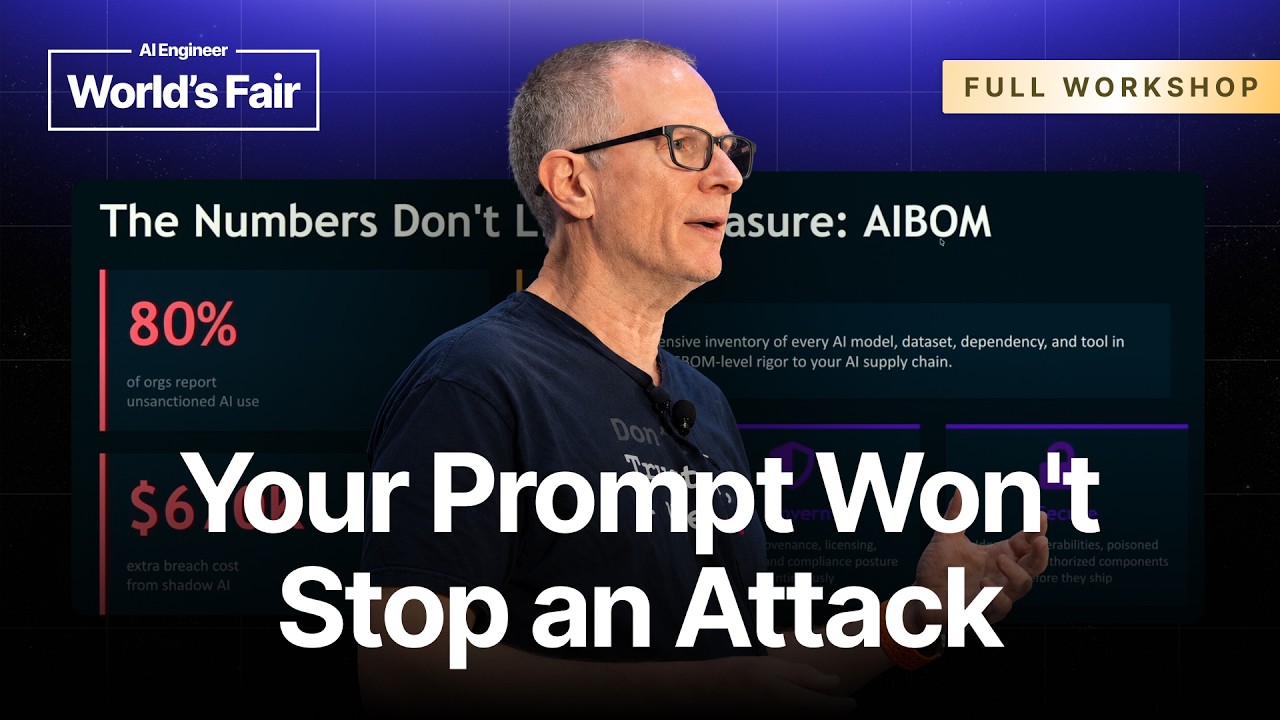
AI Security Engineer Foundations + Certificate — Micah Silverman, Snyk
Source: YouTube · AI Engineer · published Oct 11, 2026 · 2:00:02
BLUF: This presentation introduces the "AI Security Engineer" role, detailing critical vulnerabilities in AI systems like prompt injection and shadow AI, and advocating for proactive defenses such as AI Bill of Materials (AIBOM) and structured threat modeling to secure the evolving AI supply chain 1:05.
Key Takeaways:
• Prompt Injection remains the #1 risk, with indirect injection occurring when LLMs confuse data with instructions, such as hidden text in email signatures 6:18.
• Sensitive information disclosure often stems from poor access controls; developers must ensure LLMs do not have access to secrets or data they shouldn't see, rather than relying solely on system prompts 9:31.
• Supply chain vulnerabilities in AI include using unvetted third-party models and dependencies, requiring rigorous provenance validation and ongoing monitoring 16:36.
• Data and model poisoning involves manipulating training data or model parameters to influence outputs, with examples ranging from malicious training sets to the "Nightshade" project which tricks AI image classifiers 19:31.
• Shadow AI poses significant risks as unapproved tools operate invisibly and non-deterministically, often outpacing organizational governance and leading to data leakage 23:11.
• The AI Bill of Materials (AIBOM) is essential for tracking AI components, datasets, and dependencies, allowing organizations to enforce policies and fail builds if unauthorized models are introduced 31:36.
• Model Context Protocol (MCP) servers can introduce command injection risks if they execute shell commands with unsanitized inputs, as seen in the Figma Linker vulnerability 17:22.
• Vibe coding and agentic workflows require strict guardrails, such as separating environments and mandatory human approval for destructive operations, to prevent catastrophic errors like accidental database deletion 23:32.
Closing Statement:
Securing AI applications requires a shift from reactive patching to proactive design, treating AI models as first-class infrastructure components that demand rigorous monitoring, access control, and continuous threat modeling.
Sources:
- 1:05 Introduction of the AI Security Engineer foundations curriculum.
- 6:18 Explanation of direct vs. indirect prompt injection vulnerabilities.
- 9:31 Discussion on sensitive information disclosure and access controls.
- 16:36 Overview of supply chain vulnerabilities in AI development.
- 19:31 Details on data and model poisoning techniques and examples.
- 23:11 Analysis of Shadow AI risks and governance challenges.
- 31:36 Introduction of AI Bill of Materials (AIBOM) for inventory and policy enforcement.
Generate CPE Credits
Generate a professional CPE document from this video's transcript.
Estimated credit: 2 CPE hours
Estimate uses the video runtime (1 hour ≈ 1 CPE, rounded to the nearest 0.5, minimum 0.5, maximum 2.0). The final amount can be lower after review, never higher.
Topic: Cybersecurity. Commonly maps to: Security and Risk Management, Security Operations. Exact CISSP domains are assigned during generation.
Free account. One generation at a time, with a daily limit.
CPEBuddy is independent and not affiliated with or endorsed by ISC2, ISACA, or any certification body. Exports are formatted for common CPE submissions; acceptance is at your certification body's discretion.
Transcript Preview
First 800 characters of the transcript
Welcome everybody. Please grab your seats. We're going to get rolling. And uh just for a little bit of shenanigans, right at the beginning, I'm going to take a selfie. If you don't want to be in the selfie, just turn away. You did consent to having your image used everywhere at all times, but you know, I want to respect you. So, uh, feel free to turn away. I'm going to do a quick selfie because, uh, this is kind of thrilling for me. Hold, please. Let's see. Can I get the thing in? All right, that'll do. Thank you. Tight. All right, let's get rolling. So, for the next two hours, I hope you all use the facilities because there are no breaks. We're going to go through the six modules up on the screen. And this is what we're calling at sneak the AI security engineer foundations curriculum. So …