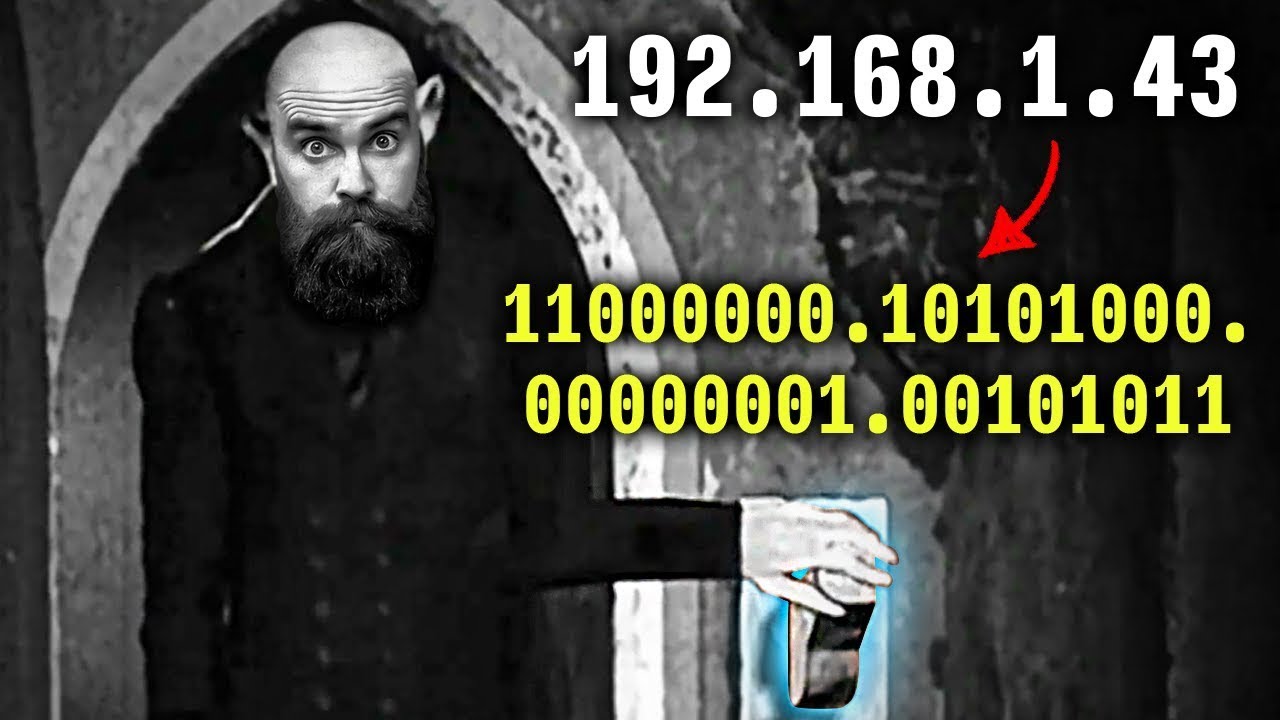
i bet you can't do this (because you still suck at subnetting)
Source: YouTube · NetworkChuck · published May 23, 2022 · 18:46
This video teaches how to convert IP addresses between decimal and binary formats, which is essential for understanding subnetting 0:00-0:12.
Key Takeaways:
• IP addresses are 32 bits total, divided into 4 octets of 8 bits each 2:01-3:18
• In binary, 1 means "on" and 0 means "off" like a light switch 4:02-4:10
• To convert binary to decimal, use the powers of two chart (128, 64, 32, 16, 8, 4, 2, 1) 5:01-5:54
• Converting decimal to binary involves working backward with the same chart 11:30-13:00
Mastering this conversion skill is foundational for becoming proficient at subnetting 1:11-1:26.
Sources:
Generate CPE Credits
Generate a professional CPE document from this video's transcript.
Estimated credit: 0.5 CPE hours
Estimate uses the video runtime (1 hour ≈ 1 CPE, rounded to the nearest 0.5, minimum 0.5, maximum 2.0). The final amount can be lower after review, never higher.
Topic: Cybersecurity. Commonly maps to: Security and Risk Management, Security Operations. Exact CISSP domains are assigned during generation.
Free account. One generation at a time, with a daily limit.
CPEBuddy is independent and not affiliated with or endorsed by ISC2, ISACA, or any certification body. Exports are formatted for common CPE submissions; acceptance is at your certification body's discretion.
Transcript Preview
First 800 characters of the transcript
Okay, this is gonna break
your brain just a little bit, but this right here is an IP
address. What? Yeah, no, it is, but you're probably thinking Chuck, no
IP addresses look like this and sure. You're right. But this right
here is how your computer, how all computers see your IP address. It's like putting on some special glasses
and seeing the code in the matrix. This is your IP address in the
matrix. So get your coffee ready. We're about to get jacked
in to the matrix. That's
how you say it, right? Yeah, let's go. So here is an IP address.
This might be your IP address. And if you watch the previous episodes
in this series, this looks familiar. This is nice and fuzzy. Four numbers,
four octets separated by three dots, but then we just put
on our matrix glasses. We're seeing this IP addres…