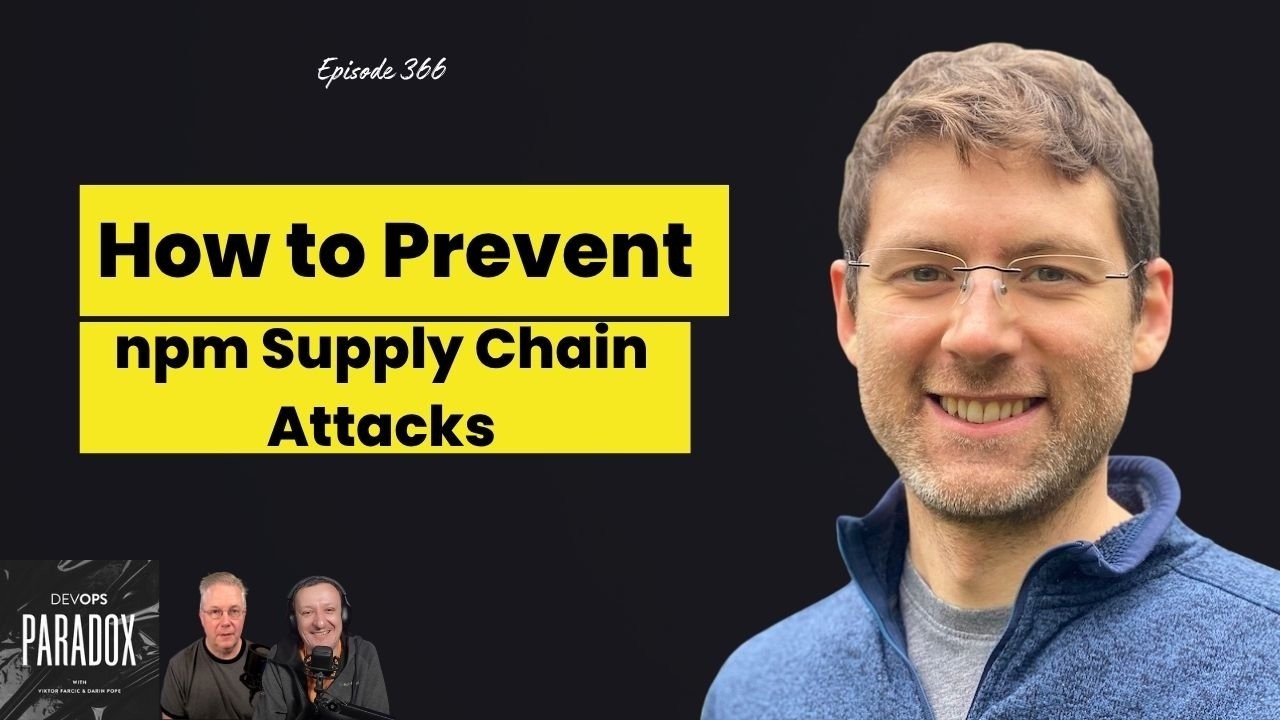
DOP 366: How to Prevent npm Supply Chain Attacks
Source: YouTube · DevOps Paradox · published Sep 2, 2026 · 52:44
The discussion highlights the critical vulnerabilities in the NPM supply chain, particularly how default configurations allow arbitrary code execution, and outlines a multi-layered defense strategy involving isolated development environments, stricter dependency management, and runtime policy enforcement to mitigate these risks.
Key Takeaways:
• The default behavior of npm install is a primary security vector because it allows developers to run arbitrary code via pre- and post-install scripts, which can be exploited to deliver malware to laptops, CI flows, or production systems 0:00-0:27.
• NPM has historically been under-resourced and slow to implement security features, despite being owned by Microsoft, though recent additions like trusted publishing and staged releases aim to address single points of failure 3:31-4:02.
• Relying on a single maintainer for package publication is risky; new features like staged releases require two approvals to prevent compromised credentials from directly pushing malicious code, though this adds friction for solo developers 9:52-10:15.
• Developers should enforce a "cool-down period" (e.g., 7 days) for new dependencies to avoid installing recently compromised packages, as many supply chain attacks are short-lived and undetected in real-time 38:40-39:26.
• Isolating the development environment using VMs or containers prevents malware from accessing host-level secrets like keys or passwords, serving as a crucial layer of defense when other measures fail 24:00-24:27.
• The JavaScript ecosystem's reliance on excessive transitive dependencies increases the attack surface, but AI tools may eventually reduce this need by allowing developers to write specific, vetted code rather than importing large, generic libraries 42:28-45:06.
While no single solution can fully secure the NPM ecosystem, combining architectural isolation with proactive dependency monitoring significantly reduces the risk of supply chain attacks. As AI lowers the barrier to writing custom code, the industry may shift away from heavy dependency trees, further hardening the ecosystem against future compromises.
Sources:
- 0:00 Explanation of how
npm installallows arbitrary code execution via pre/post-install scripts. - 3:31 Discussion on NPM's historical lack of security prioritization under Microsoft/GitHub ownership.
- 9:52 Details on staged releases requiring two approvals to mitigate single-maintainer breaches.
- 38:40 Recommendation of a 7-day cool-down period for new dependencies to catch short-lived attacks.
- 24:00 Benefits of using VMs or containers to isolate development environments from host system threats.
- 42:28 Analysis of excessive transitive dependencies in JavaScript and the potential role of AI in reducing them.
Generate CPE Credits
Generate a professional CPE document from this video's transcript.
Estimated credit: 1 CPE hours
Estimate uses the video runtime (1 hour ≈ 1 CPE, rounded to the nearest 0.5, minimum 0.5, maximum 2.0). The final amount can be lower after review, never higher.
Topic: Cybersecurity. Commonly maps to: Security and Risk Management, Security Operations. Exact CISSP domains are assigned during generation.
Free account. One generation at a time, with a daily limit.
CPEBuddy is independent and not affiliated with or endorsed by ISC2, ISACA, or any certification body. Exports are formatted for common CPE submissions; acceptance is at your certification body's discretion.
Transcript Preview
First 800 characters of the transcript
So, for example, when you like you start you said at the beginning, and you install a package with npm install, and that's your first mistake because that allows all sorts of arbitrary code execution on your system. There's a lot of different scripts in there. There's a post install, there's a pre-install, and npm allows the developers just to run arbitrary code on your laptop before and after a package is installed, and that's just one of the vectors that are used to get malware onto developer laptops or CI flows or even into production. >> This is Devops Paradox episode number 366. How to prevent npm supply chain attacks. >> [music] >> Welcome to Devops Paradox. This is a podcast about random [music] stuff in which we, Darren and Victor, pretend we know what we're talking about. Most of …