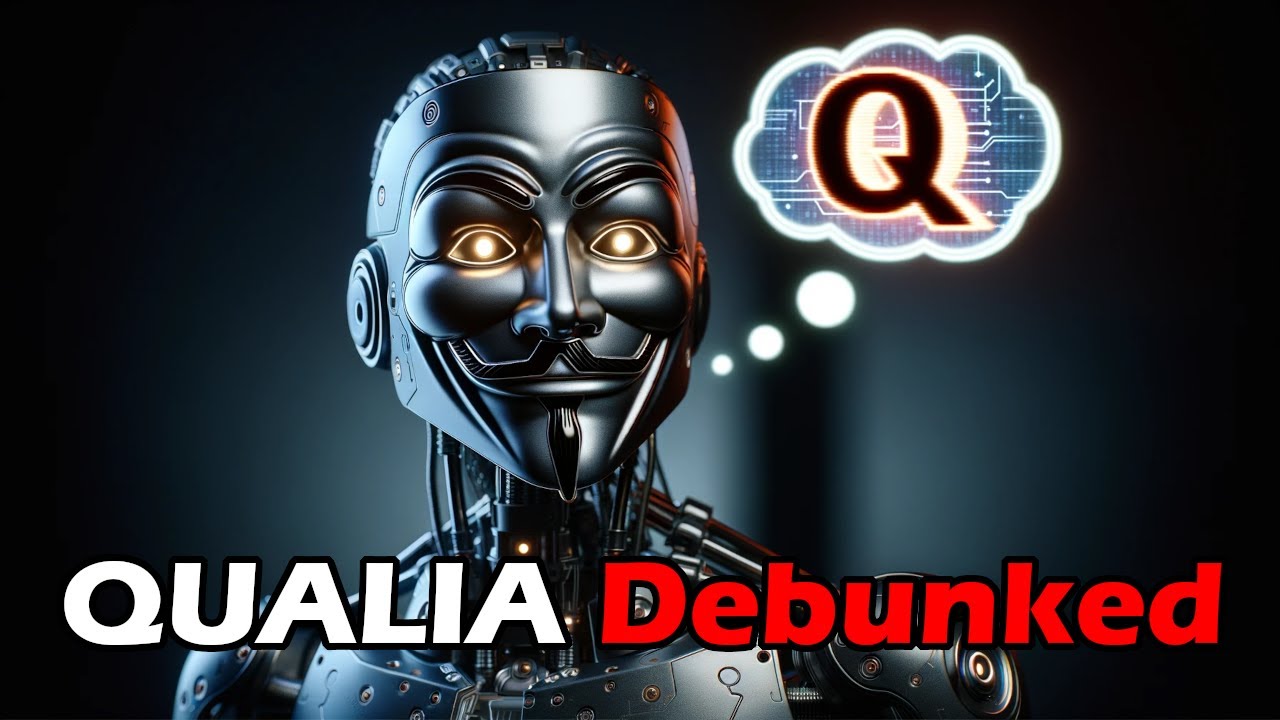
What if Q* broke cybersecurity? How would we adapt? Deep dive! P≠NP? Here's why it's probably fine..
Source: YouTube · David Shapiro · published Nov 29, 2023 · 35:05
The qualia leak alleging an AI breakthrough in cracking encryption is almost certainly a hoax, but the discussion highlights why the P ≠ NP assumption is fundamental to modern cryptography 0:00-0:36.
Key Takeaways:
• QAR is a hybrid AI algorithm combining AAR search with deep Q learning that efficiently solved Rubik's Cube problems, but the qualia leak claiming it broke AES encryption appears thoroughly debunked 1:01-1:27
• Computational complexity involves three key concepts: tractability (problems solvable in reasonable time), provability (ability to verify solutions), and decidability (algorithms with definitive termination points) 5:56-6:43
• The assumption that P ≠ NP underpins modern cryptography, meaning problems like encryption are much easier to create than to solve without the key 12:33-14:50
• If P = NP were true, it would catastrophically impact national security, financial systems, blockchain technology, and could destabilize global geopolitics 19:48-25:42
• Existing mitigation strategies like multi-factor authentication, zero trust environments, and defense-in-depth security models provide protections even if current encryption fails 26:40-34:00
While the qualia leak appears to be misinformation, understanding computational complexity remains essential for appreciating why our current cryptographic systems remain secure.
Sources:
Generate CPE Credits
Generate a professional CPE document from this video's transcript.
Estimated credit: 0.5 CPE hours
Estimate uses the video runtime (1 hour ≈ 1 CPE, rounded to the nearest 0.5, minimum 0.5, maximum 2.0). The final amount can be lower after review, never higher.
Topic: Cybersecurity. Commonly maps to: Security and Risk Management, Security Operations. Exact CISSP domains are assigned during generation.
Free account. One generation at a time, with a daily limit.
CPEBuddy is independent and not affiliated with or endorsed by ISC2, ISACA, or any certification body. Exports are formatted for common CPE submissions; acceptance is at your certification body's discretion.
Transcript Preview
First 800 characters of the transcript
eses is almost certainly safe from the alleged qualia leak or qar uh but what I wanted to do today was to unpack why so this the the answer is fundamentally about uh computational complexity and encryption and namely the P equals NP uh problem and I know that I got this wrong right here so please don't call it out it was a typo um but so let's get some context so if you're watching this you're probably aware of uh you know the qar uh thing the qualia thing and the open AI debacle now what I really want to focus on is qar and qualia and then the P equals NP problem so fortunately uh someone was uh kind enough to find and send me a link to the original qar paper yes there was an actual original qar paper where it was introduced back in March of this year and qar I we we were all mostly right…