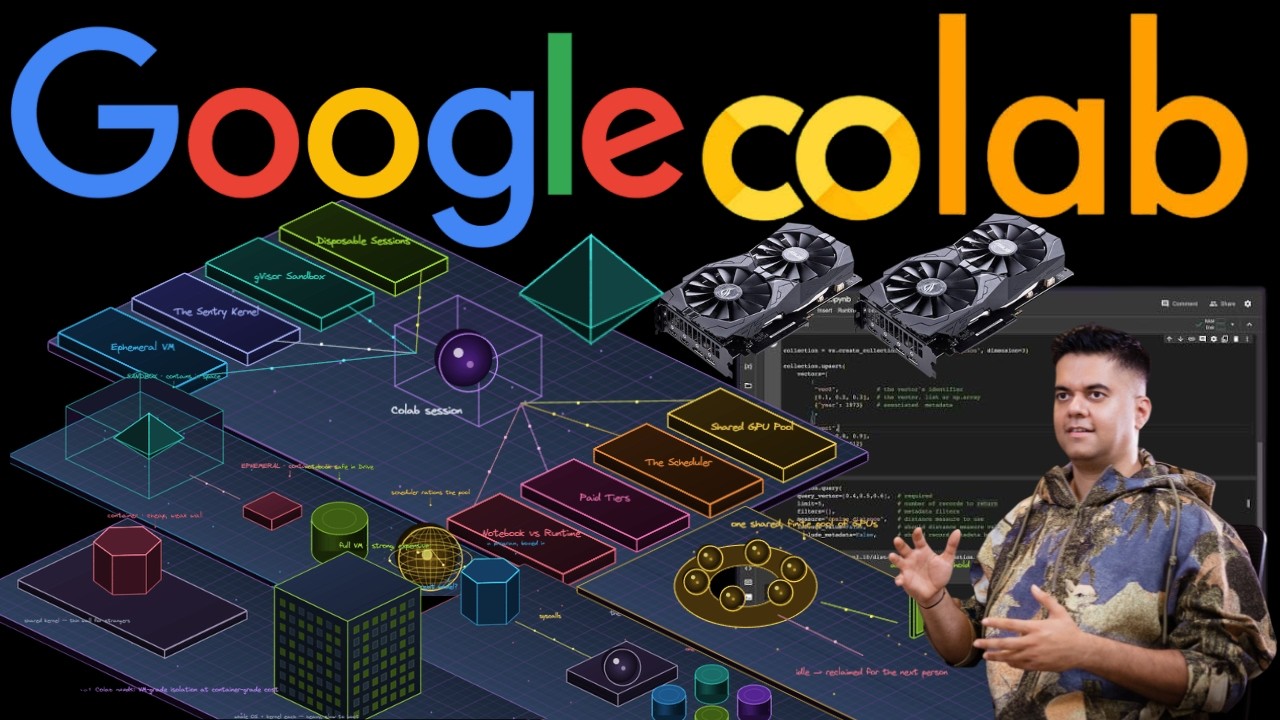
How Google Gives Away Free GPUs to Millions Without Going Broke
Source: YouTube · Akhil Sharma · published Jul 4, 2026 · 24:42
Google Colab safely lets millions of untrusted strangers run arbitrary code on its hardware for free by treating every session as a disposable, sandboxed machine—solving both security and economic challenges with one design principle 0:00.
Key Takeaways:
• Standard containers share a host kernel, making them vulnerable to container escapes, while full VMs are too heavy and expensive to hand out for free at Colab's scale 4:36.
• Colab uses gVisor, an application kernel written in Go, that intercepts system calls before they reach the real host kernel, providing VM-grade isolation at container-grade cost 7:07.
• gVisor's syscall overhead is nearly free for Colab because machine learning workloads are compute-bound and rarely make syscalls, unlike I/O-heavy workloads like databases 10:45.
• Time-based containment ensures runtimes are wiped after ~90 minutes of idle time or a 12-hour hard limit, enabling GPU pool recycling and making the free tier economically viable 13:55.
• The notebook (durable, saved in Drive) and the runtime (ephemeral, throwaway) are completely separate, which explains why variables vanish and packages must be reinstalled each session 17:36.
Colab is ultimately a carefully engineered, subsidized loss leader funded by paid tiers, proving that making workloads disposable and matching isolation to your threat model can make seemingly impossible multi-tenant systems viable.
Sources:
- 0:00 Introduction to Colab's core problem: untrusted code on shared infrastructure
- 4:36 Why containers and VMs fall short for Colab's needs
- 7:07 How gVisor intercepts syscalls to isolate untrusted code
- 10:45 Why gVisor's overhead is negligible for ML workloads
- 13:55 GPU rationing via idle timeouts and session limits
- 17:36 The critical distinction between the notebook and the runtime
Generate CPE Credits
Generate a professional CPE document from this video's transcript.
Estimated credit: 0.5 CPE hours
Estimate uses the video runtime (1 hour ≈ 1 CPE, rounded to the nearest 0.5, minimum 0.5, maximum 2.0). The final amount can be lower after review, never higher.
Topic: Cloud Security. Commonly maps to: Security Architecture and Engineering, Communication and Network Security. Exact CISSP domains are assigned during generation.
Free account. One generation at a time, with a daily limit.
CPEBuddy is independent and not affiliated with or endorsed by ISC2, ISACA, or any certification body. Exports are formatted for common CPE submissions; acceptance is at your certification body's discretion.
Transcript Preview
First 800 characters of the transcript
Right now, millions of people are opening a browser tab, typing code into a notebook, and hitting run. That code isn't executing on their laptop, it's executing on this infrastructure, often with access to a GPU that Google is paying for. And the code can be anything. It might train a neural network, it might try to delete the entire file system, it might scan the network, burn through CPU cycles, or probe the operating system looking for weaknesses. Google doesn't review that code beforehand. The users are complete strangers, yet every day they're allowed to run arbitrary programs on Google's own hardware, and somehow all of this works. Users can't break out and interfere with each other, and the platform doesn't collapse under abuse, and Google hasn't bankrupted itself handing out free c…