WG Checkpoint Restore Meeting for 2026-10-21
Source: YouTube · Kubernetes · published Oct 21, 2026 · 28:55
BLUF: The discussion centers on extending CRIU to support external memory providers for faster GPU state restoration and defining CNCF standards for agent state management in Kubernetes 0:30. It highlights that agentic workloads require higher reliability than traditional apps because they operate without human-in-the-loop oversight 8:50.
Key Takeaways:
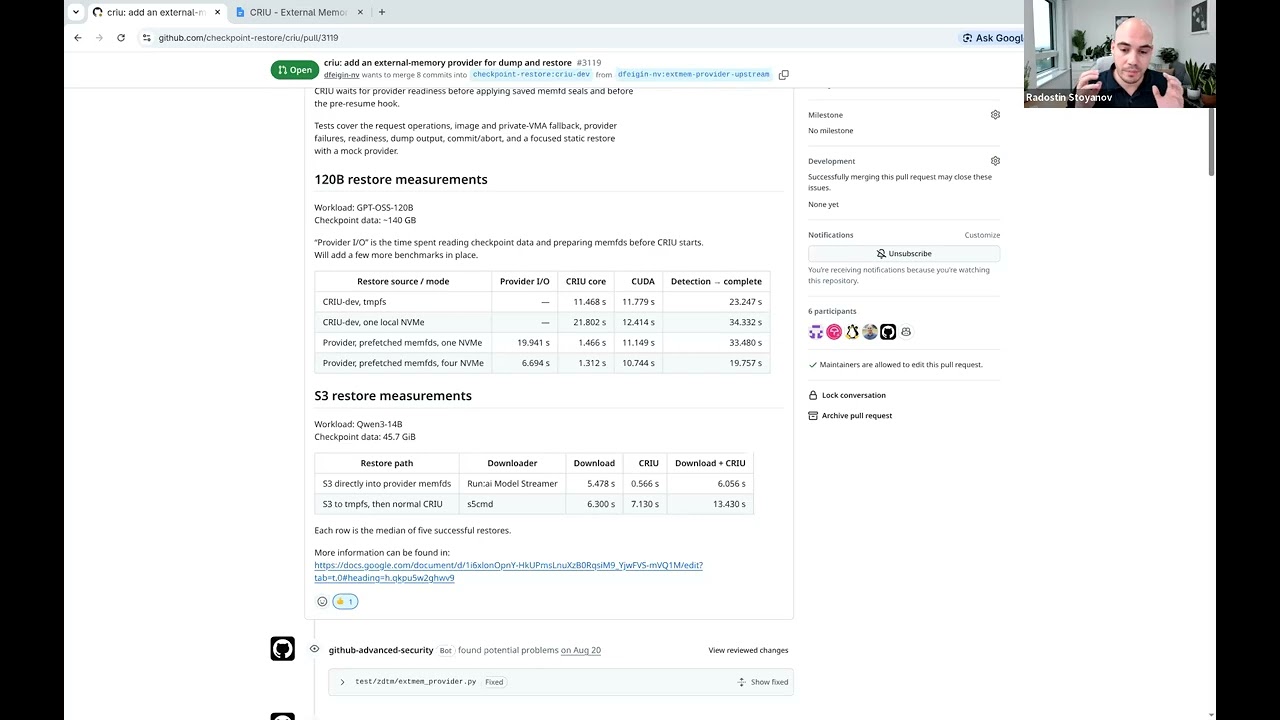
• Nvidia proposes extending CRIU with an external memory provider to stream GPU state directly to external storage, bypassing slow host memory copies 1:20.
• Agentic environments demand strict data integrity and single-point-in-time recovery because agents execute autonomously without immediate human verification 9:15.
• The CNCF Agentics working group is defining standards for memory state to ensure cluster-wide consistency during checkpoint and restore operations 2:45.
• Kubernetes infrastructure can provide snapshot triggers from within containers, but application-level logic must coordinate multi-pod consistency 13:30.
• Future integration with Kubernetes scheduling will likely focus on preemption handling and "checkpoint locality" scoring for nodes 20:35.
• CRIU currently saves container root filesystems, CPU/GPU state, and network connections, while mounting rather than copying persistent volumes 23:40.
Closing Statement:
The community is moving toward standardized, high-performance checkpointing for autonomous agents, requiring tight coordination between container runtimes, Kubernetes schedulers, and application logic.
Sources:
- 0:30 Overview of the Nvidia PR extending CRIU for external memory providers.
- 1:20 Explanation of streaming GPU state to external storage to reduce latency.
- 2:45 Discussion on CNCF Agentics standards for memory state.
- 8:50 Requirements for reliability in agentic workloads without human oversight.
- 13:30 Use of application-triggered snapshots for container state.
- 20:35 Potential integration of checkpointing with Kubernetes preemption and scheduling.
- 23:40 Details on what CRIU saves, including root filesystems and process states.
Generate CPE Credits
Generate a professional CPE document from this video's transcript.
Estimated credit: 0.5 CPE hours
Estimate uses the video runtime (1 hour ≈ 1 CPE, rounded to the nearest 0.5, minimum 0.5, maximum 2.0). The final amount can be lower after review, never higher.
Topic: Cloud Security. Commonly maps to: Security Architecture and Engineering, Communication and Network Security. Exact CISSP domains are assigned during generation.
Free account. One generation at a time, with a daily limit.
CPEBuddy is independent and not affiliated with or endorsed by ISC2, ISACA, or any certification body. Exports are formatted for common CPE submissions; acceptance is at your certification body's discretion.
Transcript Preview
First 800 characters of the transcript
Um hi. Um so yeah, one thing that I want to share with you is um to share my screen. Um so this pull request uh it's from D from Nvidia but um essentially um the pull request extends creo to uh to support external memory provider. Um he he created this document uh some time ago describing the design and how it works but the main idea is that um essentially saving the GPU state to disk is typically very slow. So um if you want to save this to external storage if essentially the current approach is uh to move the GPU state to host memory then from host memory to disk and then from disk to external storage and because these are like um hundreds of kilobytes in some cases of GB state we want to avoid essentially unnecessary data copies and what he's uh proposing in in this full quest is to ess…