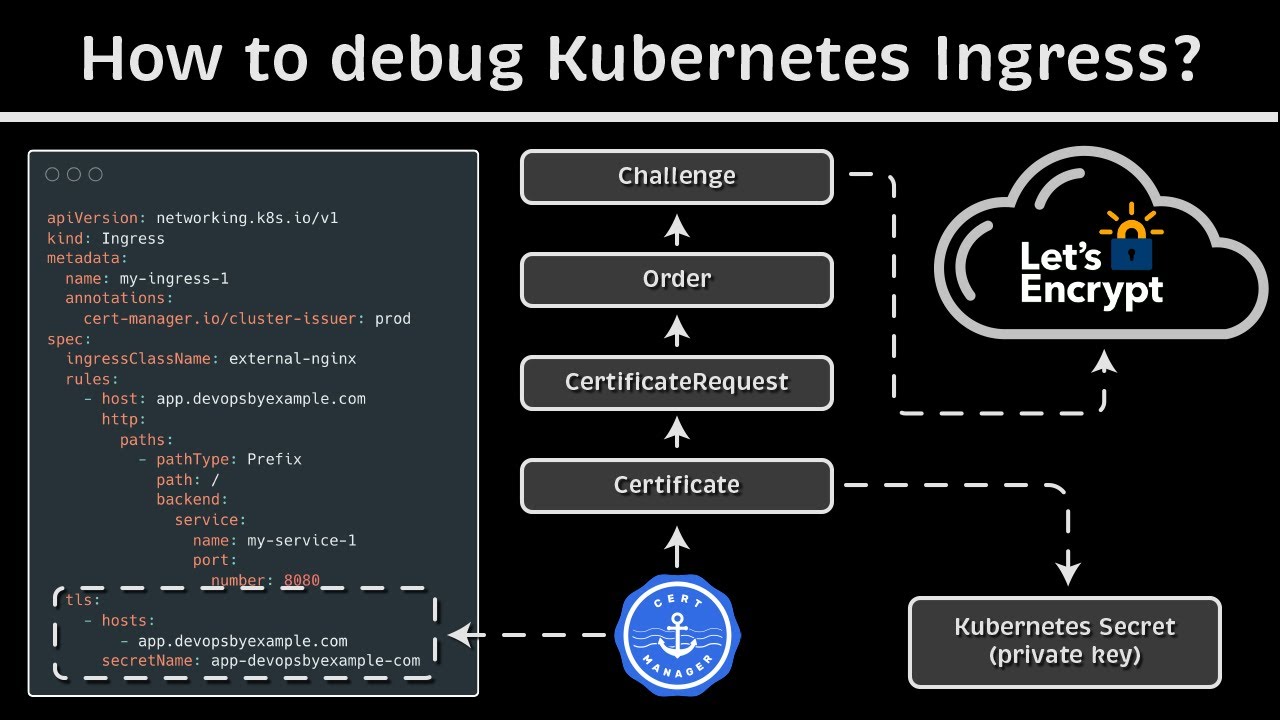
How to debug Kubernetes Ingress? (TLS - Cert-Manager - HTTP-01 & DNS-01 Challenges)
Source: YouTube · Anton Putra · published Apr 29, 2024 · 15:18
This video explains how to secure web applications using TLS certificates from Let's Encrypt, demonstrating both HTTP-01 and DNS-01 challenges in Kubernetes using cert-manager 0:00-3:38.
Key Takeaways:
• TLS encryption prevents man-in-the-middle attacks that could steal sensitive data like credit card numbers or login credentials 0:03.
• Let's Encrypt provides free certificates, but you must prove domain ownership through HTTP-01 or DNS-01 challenges 1:50.
• Cert-manager automates certificate management in Kubernetes, creating and renewing certificates every 60 days 3:43.
• HTTP-01 challenge is easier to set up but DNS-01 is preferred for production, especially during migrations 14:31.
• Encryption occurs at the ingress controller level, with internal cluster traffic remaining unencrypted for performance reasons 5:06.
The video provides practical demonstrations of both certificate challenge methods, with code examples available in a public GitHub repository 7:36.
Sources:
Generate CPE Credits
Generate a professional CPE document from this video's transcript.
Estimated credit: 0.5 CPE hours
Estimate uses the video runtime (1 hour ≈ 1 CPE, rounded to the nearest 0.5, minimum 0.5, maximum 2.0). The final amount can be lower after review, never higher.
Topic: Cloud Security. Commonly maps to: Security Architecture and Engineering, Communication and Network Security. Exact CISSP domains are assigned during generation.
Free account. One generation at a time, with a daily limit.
CPEBuddy is independent and not affiliated with or endorsed by ISC2, ISACA, or any certification body. Exports are formatted for common CPE submissions; acceptance is at your certification body's discretion.
Transcript Preview
First 800 characters of the transcript
Most of the time when we expose
our application to the internet, we want it to be secure. One way we can
protect it is by encrypting all traffic between the client and the application itself.
This would help prevent man-in-the-middle attacks, where an unauthorized entity can intercept every
single packet that you send to the server. For example, if it's an ecommerce website, a hacker
can steal your credit card number if you enter it in the online form to pay for goods. Also, if you
enter the username and password for social media, this information can also be stolen. Now, when
we encrypt the traffic, even if a hacker can still listen to all the communications between
us and the application, they won’t be able to decrypt that data such as credit card
information or a username and a…