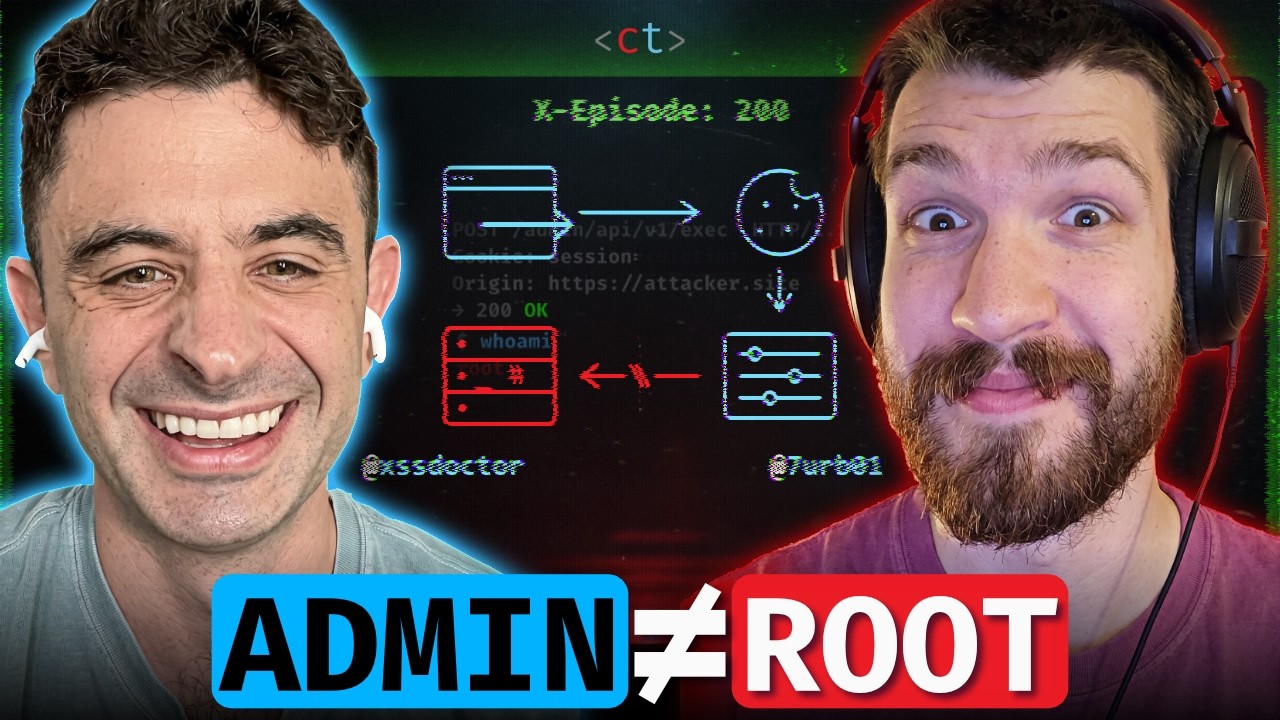
Cloud Hacking w/ Nick Copi (Ep. 200)
Source: YouTube · Critical Thinking - Bug Bounty Podcast · published Nov 12, 2026 · 1:20:10
This episode of Critical Thinking features Turbo discussing cloud hacking methodology, from client-side dashboard bugs to data plane-to-control plane pivots, with practical examples of command injection, confused deputy attacks, and S3 bucket abuse 3:15.
Key Takeaways:
• Turbo describes a command injection bug in a hardened cloud service's custom glue code: a GET route passed a query parameter into a concatenated CLI command, allowing one-click RCE on a victim's instance via a link, then stealing their over-scoped cloud identity for full write access 5:24-6:15. He found it because prior research taught him where custom code lives on such deployments 7:30-7:52.
• Cloud hacking starts with understanding the shared responsibility model and service architecture—reading docs, deploying instances, and reasoning about what compute must exist behind the dashboard 18:21-19:30.
• The core strategy is working "inside out": shell your own data plane instance, inspect managed identities and binaries on the box, then test whether those credentials can list or access other tenants' resources—inverting the control plane's trust in the data plane 39:28, 48:52-51:05.
• Rich syncs like database connectors (JDBC-style config strings) are prime targets—malicious configs can yield code execution or file disclosure, essentially "reverse SQL injection" 41:14-42:17.
• Confused deputy bugs arise in multi-user tenant setups when low-privilege users can create jobs that pass through higher-privilege roles—auditable via raw IAM permission JSON in the console 1:03:48-1:05:52.
• For S3-style buckets, Turbo highlights signed-URL query parameter tricks (e.g., overriding content-type on anonymous-access objects to turn uploaded PNGs into text/html XSS), and notes postMessage trust chains across tiered domains as gadget opportunities 1:13:04-1:14:04, 35:47-36:26.
• AI changes the economics: rather than brute-forcing targets with massive token budgets, understanding the threat model lets you point an "AI battering ram" at the specific weak point for far better results 10:54-11:48, 40:41-40:52.
The episode closes with the hosts agreeing that "real cloud" hacking rewards deep threat modeling over naive scanning, and teasing the show's community resources at ctbb.show 1:19:03-1:19:43.
Sources:
- 5:24-6:15 Command injection bug in cloud service custom code leading to RCE and credential theft
- 7:30-7:52 Why Turbo found it: prior research on similar targets
- 10:54-11:48 AI's impact on bug hunting economics and scoping AI efforts
- 18:21-19:30 Understanding cloud service architecture and threat models
Generate CPE Credits
Generate a professional CPE document from this video's transcript.
Estimated credit: 1.5 CPE hours
Estimate uses the video runtime (1 hour ≈ 1 CPE, rounded to the nearest 0.5, minimum 0.5, maximum 2.0). The final amount can be lower after review, never higher.
Topic: Cloud Security. Commonly maps to: Security Architecture and Engineering, Communication and Network Security. Exact CISSP domains are assigned during generation.
Free account. One generation at a time, with a daily limit.
CPEBuddy is independent and not affiliated with or endorsed by ISC2, ISACA, or any certification body. Exports are formatted for common CPE submissions; acceptance is at your certification body's discretion.
Transcript Preview
First 800 characters of the transcript
So it was as simple as just like >> Oh, so it's surf. >> Yeah. Well, sea surf. C RC surf is what I was calling. Oh, we got to make that a thing. >> We got to make that a thing. Yeah, dude. >> All righty, y'all. I did a thing. I created a CTF challenge. And you know, I haven't done too much of that before and it was a lot of fun. Um, this is in collaboration with the folks over at Yes We Hack at their dojo. We'll link it in the description. Um, and it's a challenge for this month. And man, guys, this bug is freaking fabtabulous. That's an expression. That's a regular expression, right? I can Yeah, people say that. Um, so anyway, check it out. We're going to link it in the description. Um, this is such a fun vulnerability type and a chain as well. So, I think it might even be tricky with AI,…