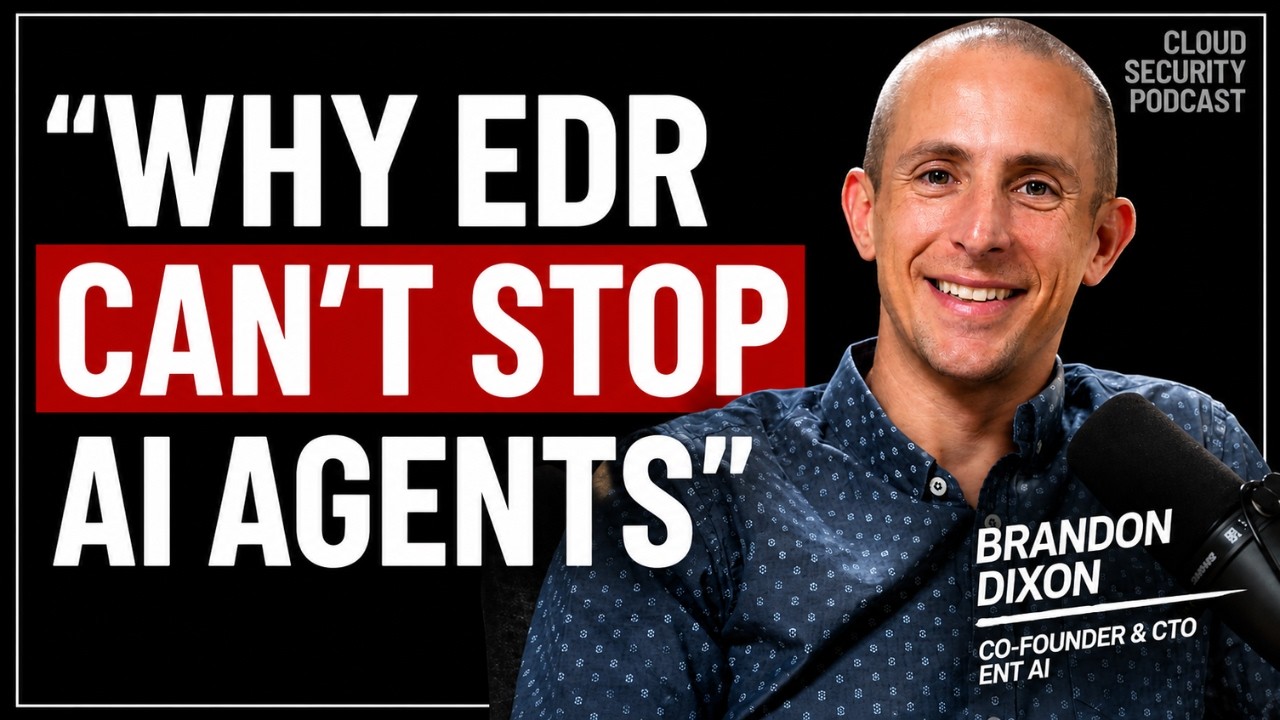
Blind Spots of EDR and Workplace Security for AI Agents | Brandon Dixon, Ent AI
Source: YouTube · Cloud Security Podcast · published Aug 20, 2026 · 52:42
BLUF:
The video argues that endpoint security is the critical foundation for AI governance, as it provides the necessary visibility into unsanctioned AI tools and agent behaviors that traditional cloud-dependent EDRs miss 0:00. Brandon from Ant AI emphasizes that effective AI security requires preventing risks at the source rather than reacting to them in the cloud 32:54.
Key Takeaways:
- The Endpoint as the Security Frontier: Most AI work, including coding agents and local models, happens on the endpoint. Traditional EDRs are often cloud-dependent and reactive, creating blind spots where AI agents can operate without detection 0:42.
- Visibility into Unsanctioned AI: Organizations likely run unsanctioned AI software daily. Endpoint agents can dynamically identify these tools and the intent behind them, distinguishing between human behavior and autonomous agent actions 20:34.
- Beyond Traditional UEBA: Unlike user behavior analytics that rely on statistical baselines and generate alert fatigue, modern endpoint security uses semantic embeddings to understand the context and intent of actions, such as detecting if an agent is attempting to exfiltrate sensitive data 11:31.
- Prevention via Intervention, Not Just Blocking: Effective security balances safety with productivity by using "interventions" like toast notifications or peer-group comparisons rather than hard blocks, which can hinder workflow and user adoption 42:10.
- Skepticism of "Solved" Problems: The AI security landscape is still evolving rapidly. If a vendor claims to have fully solved AI security, it is a red flag, as the threat landscape and agent capabilities change faster than static solutions can adapt 0:14.
Closing Statement:
As AI integration deepens across workplaces, securing the endpoint is no longer optional but essential for maintaining control over data and agent behavior. Organizations must prioritize solutions that offer real-time, contextual visibility to stay ahead of evolving threats.
Sources:
- 0:00 Introduction to the risk of unsanctioned AI and agent formation.
- 0:42 The adversary never stops; AI is embedded daily.
- 20:34 The reality of running unsanctioned AI software.
- 11:31 Using embeddings for semantic context in security.
- 42:10 The concept of user intervention vs. hard blocking.
- 0:14 Red flag if a vendor claims AI security is solved.
Generate CPE Credits
Generate a professional CPE document from this video's transcript.
Estimated credit: 1 CPE hours
Estimate uses the video runtime (1 hour ≈ 1 CPE, rounded to the nearest 0.5, minimum 0.5, maximum 2.0). The final amount can be lower after review, never higher.
Topic: Cybersecurity. Commonly maps to: Security and Risk Management, Security Operations. Exact CISSP domains are assigned during generation.
Free account. One generation at a time, with a daily limit.
CPEBuddy is independent and not affiliated with or endorsed by ISC2, ISACA, or any certification body. Exports are formatted for common CPE submissions; acceptance is at your certification body's discretion.
Transcript Preview
First 800 characters of the transcript
I can almost guarantee if you're not locking your environment down, you are absolutely running unsanctioned AI software. What happens when an agent goes, "Oh, I can actually achieve my objectives by forming three other agents." >> If someone actually says that they have solved the AI security problem, you probably should be red flag right there. >> Don't tell me you've solved [music] this problem because I didn't even have this problem like 3 months ago. It's not like there's some calvary coming that I think is going to do it better than I would. The overarching fear with AI is that by the time that someone realizes that maybe it's broken out of a sandbox and forms some new objective that they don't realize it and now bad things occur. Every single day AI is getting embedded into a new app…