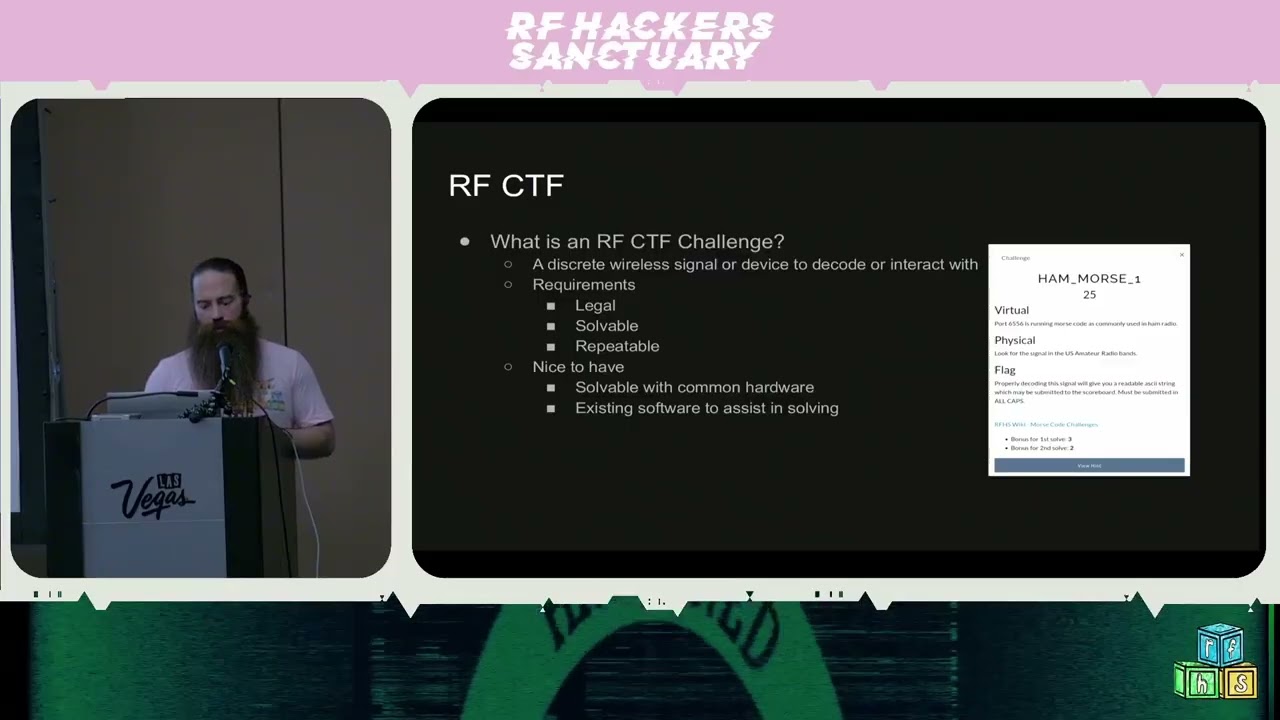
DEF CON 33 - RF Village - Running a Software Defined Radio CTF using challengectl - Dan Perret
Source: YouTube · DEFCONConference · published Oct 22, 2025 · 40:12
Optimized Summary
This presentation explains how to run a software-defined radio capture the flag (RFCTF) using Challenge CTL, an open-source Python tool that manages multiple SDR devices to transmit various RF challenges.
Key Takeaways:
• RFCTF Overview: A radio frequency capture the flag competition focused on learning and experimentation with wireless signals like Wi-Fi, RFID, and other RF communications. The goal is for participants to capture, identify, and decode or interact with various RF signals [2:36].
• Challenge Requirements: Three essential requirements: 1) Legality (must be legal to transmit and receive), 2) Solvability (must have a defined solution), and 3) Repeatability (must work consistently). Commodity hardware compatibility is desirable but not essential [6:28].
• Challenge Types: Multiple types of challenges can be implemented, including Morse code, amplitude shift keying, narrowband FM, upper sideband for amateur radio digital modes, Poxag, and restaurant pager challenges [14:20-15:40].
• Challenge CTL Functionality: This Python-based tool manages multiple SDR devices simultaneously, cycling through different challenges across available devices for better scalability. It can handle more challenges than devices by rotating through them [19:33].
• Implementation Approaches: Three main approaches to creating challenges: 1) Using dedicated hardware (realistic but not scalable), 2) Individual SDR flow graphs (better but ties up one device per challenge), and 3) Challenge CTL (optimal for managing multiple challenges across multiple devices) [9:40-12:50].
• Setup and Usage: The software requires two files: a devices file (listing available SDRs) and a flags file (defining challenges with parameters). Users can generate these files and run challenges with a single command, even with just one SDR device [24:10-27:30].
• Accessibility: Challenge CTL is available on GitHub (github.com/rfhs/challenge
Generate CPE Credits
Generate a professional CPE document from this video's transcript.
Estimated credit: 0.5 CPE hours
Estimate uses the video runtime (1 hour ≈ 1 CPE, rounded to the nearest 0.5, minimum 0.5, maximum 2.0). The final amount can be lower after review, never higher.
Topic: Cybersecurity. Commonly maps to: Security and Risk Management, Security Operations. Exact CISSP domains are assigned during generation.
Free account. One generation at a time, with a daily limit.
CPEBuddy is independent and not affiliated with or endorsed by ISC2, ISACA, or any certification body. Exports are formatted for common CPE submissions; acceptance is at your certification body's discretion.
Transcript Preview
First 800 characters of the transcript
All right, greetings wireless village. Thanks for coming to to my talk today. So, all right, Brandon, how's the audio? All right, so today we're going to be talking about how to run a software defined radio capture the flag using challenge CTL. So, challenge CTL is a software that we use to run the RF capture the flag here and some of the challenges. So, what we're going to talk about today is what is the RFCTF? Uh, if you've heard my my spiel uh during the during this weekend, you've probably you're probably familiar with this. But, just to make sure we're on the same page, we're going to go over what our goals are for the RFCTF. uh what kinds of challenges that we have, Wi-Fi, RFID, the other RF stuff, other RF uh in this case like we kind of use that interchangeably with uh software def…