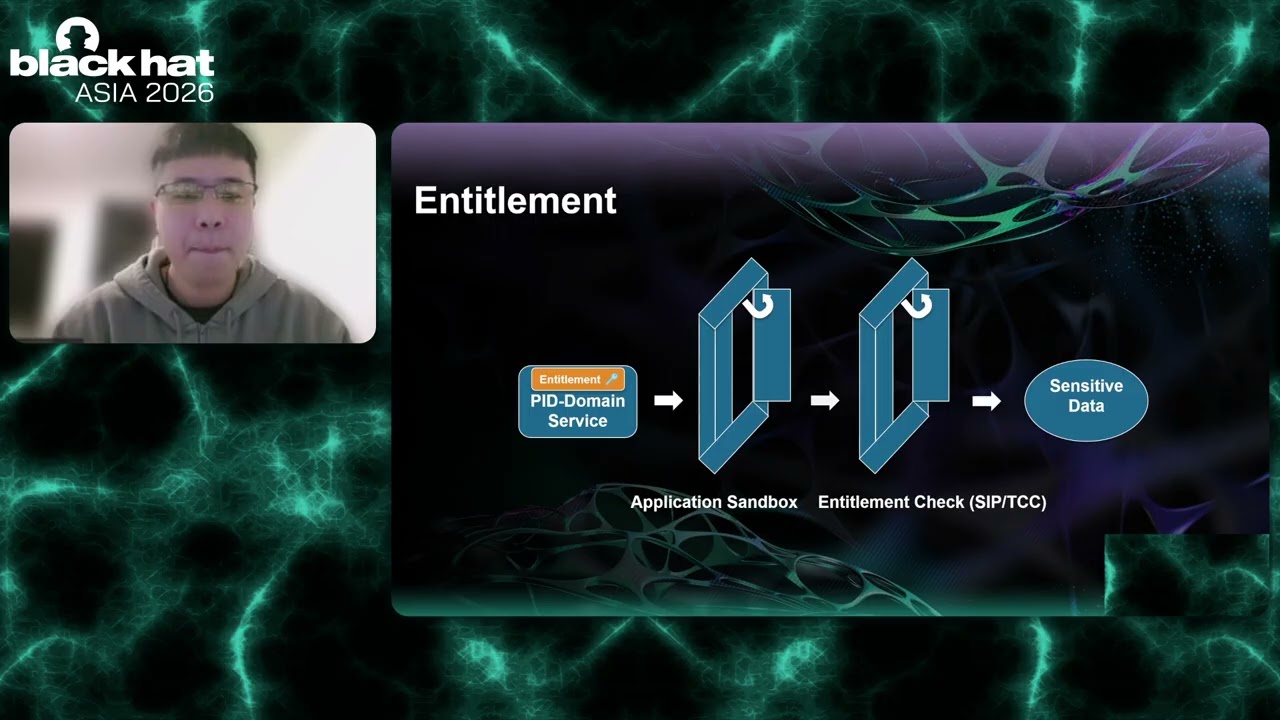
Black Hat Asia 2026 | Large-Scale macOS PID-Domain Vulnerability Discovery with LLM Reasoning
Source: YouTube · Black Hat · published Aug 29, 2026 · 24:43
BLUF: Researchers developed an LLM-assisted static analysis framework to uncover a previously overlooked "Chow-Scone" attack surface in macOS P-domain services, successfully identifying zero-day vulnerabilities that allow sandbox escapes and privilege escalation [2:48] [11:16].
Key Takeaways:
• macOS uses a service delegation model where unprivileged apps communicate with privileged deputy services via XPC to access restricted resources, bypassing their own sandbox limits [3:56].
• P-domain services often run within the exact same sandbox as the calling application but possess higher privileges due to embedded entitlements, creating a hidden attack surface [5:49].
• The research team introduced a three-phase framework combining LLM reasoning with static analysis to map entitlements to sensitive APIs and trace data flows for vulnerability detection [11:19].
• The framework identified 300 P-domain services and nearly 2,400 exposed APIs, leading to 19 acknowledged vulnerabilities and 7 security advisories from Apple [15:46].
• Case studies demonstrated severe impacts, including arbitrary file read via CoreMedia, killing root processes via Match Measurement Helper, and file existence oracle attacks via Distribution Kit [17:06] [19:32] [21:17].
This research highlights that even within the same sandbox context, entitlement differences can be exploited to break isolation, and AI-augmented analysis is crucial for uncovering these complex logical flaws.
Sources:
- 2:48 Explanation of the macOS service delegation model and XPC communication.
- 5:49 Description of P-domain services running in the same sandbox but holding higher privileges.
- 11:16 Introduction of the LLM-assisted static analysis framework phases.
- 15:46 Summary of evaluation results and responsible disclosure outcomes.
- 17:06 Case study on CoreMedia file read sandbox escape.
- 19:32 Case study on killing root processes via Match Measurement Helper.
- 21:17 Case study on file existence oracle attacks via Distribution Kit.
Generate CPE Credits
Generate a professional CPE document from this video's transcript.
Estimated credit: 0.5 CPE hours
Estimate uses the video runtime (1 hour ≈ 1 CPE, rounded to the nearest 0.5, minimum 0.5, maximum 2.0). The final amount can be lower after review, never higher.
Topic: Cybersecurity. Commonly maps to: Security and Risk Management, Security Operations. Exact CISSP domains are assigned during generation.
Free account. One generation at a time, with a daily limit.
CPEBuddy is independent and not affiliated with or endorsed by ISC2, ISACA, or any certification body. Exports are formatted for common CPE submissions; acceptance is at your certification body's discretion.
Transcript Preview
First 800 characters of the transcript
Hello everyone, welcome to our section. Today we are thrilled to present our research AI in the loop large scale Mac OSP domain vulnerability discovery with large language model reasoning. This is a joined effort by our teams of independent security researchers down security lab from Jingong DB app security and the Hong Kong University of Science and Technology. Our agenda today covers five main parts. First, we will start with the fundamentals of the Mac OS sandbox and service navigation. Second, we will dive into a previously overlook chop scone attack surface. Third, we will introduce our large language model assist automatic vulnerability discovery framework. Fourth, we will showcase our evaluations and the real world impact sharing the results of our largest scale analyze and responsi…