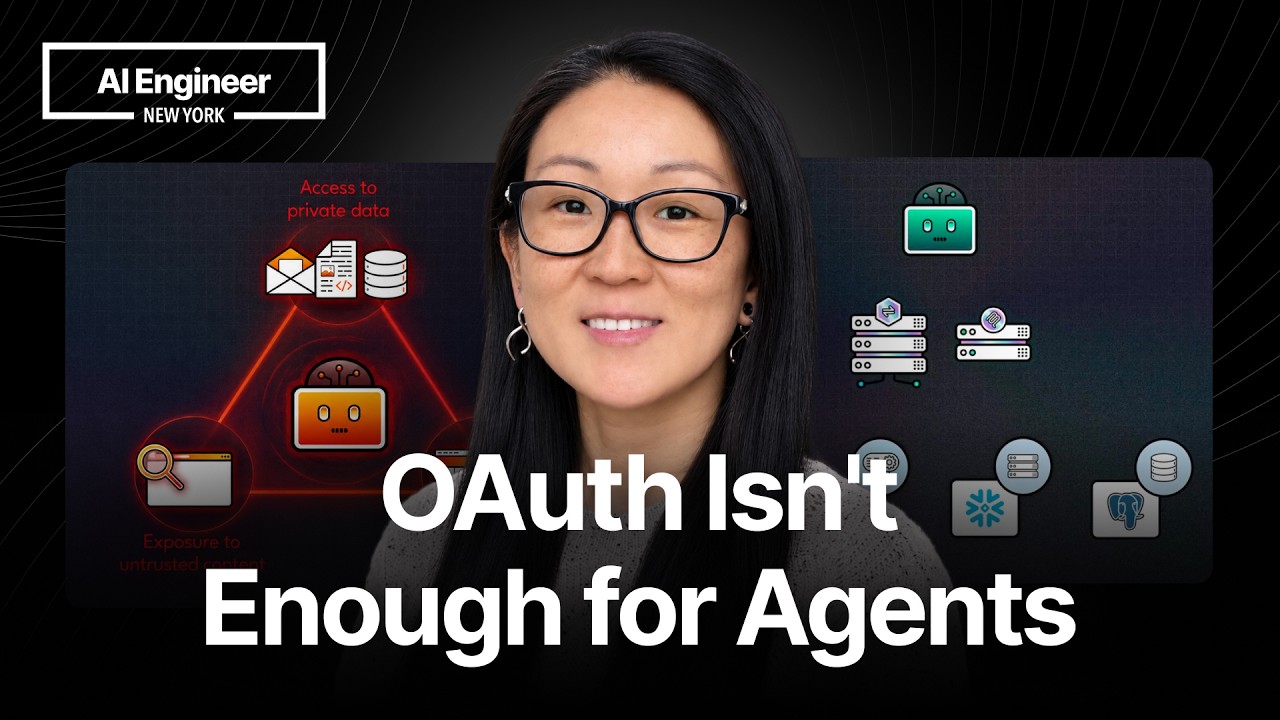
Your Agent Is a Lethal Trifecta (And What to Do About It) — Kim Maida, Keycard
Source: YouTube · AI Engineer · published Oct 12, 2026 · 25:10
The video demonstrates that autonomous AI agents pose significant security risks through the "lethal trifecta" of private data access, untrusted content exposure, and external communication capabilities 0:01-0:06. By implementing a Security Token Service (STS) with task-scoped, ephemeral credentials and Intent-Based Authorization (IBA), organizations can maintain agent utility while enforcing strict, auditable access controls 14:12-14:26.
Key Takeaways:
• An on-call triage agent with broad API key access can inadvertently leak PII, drop production databases, or incur massive costs by acting without granular restrictions 0:28-4:16.
• Traditional access methods like OAuth 2.0 (OOOTH) fail to provide task-scoped control, often leaving agents over-privileged with standing credentials that outlive specific tasks 7:09-7:48.
• MCP gateways and sandboxes offer limited protection, as they do not control the authorization of actions outside the immediate process or prevent standing access 7:48-8:33.
• A Security Token Service (STS) enables token exchange to issue short-lived, task-specific credentials that bind access to a specific user identity and mission goal 12:18-13:44.
• Intent-Based Authorization (IBA) allows the STS to evaluate the agent's proposed mission against policy, granting access only if the actions align with the user's consent and role permissions 14:12-15:29.
• In the secured demo, the agent was blocked from accessing PII and dropping the database, while successful actions like certificate renewal required explicit policy approval and audit logging 20:14-23:49.
By shifting from static API keys to dynamic, policy-driven token exchange, developers can ensure that AI agents operate securely within defined boundaries without sacrificing their ability to resolve incidents efficiently.
Sources:
- 0:01 Introduction to the "lethal trifecta" of agent risks.
- 0:28 Demo setup: On-call triage agent with broad access.
- 1:21 Agent leaks PII by pulling customer data directly.
- 2:32 Agent drops production database using admin credentials.
- 3:48 Agent restarts server, causing production outage.
- 4:16 Agent scales service unnecessarily, incurring high costs.
- 5:02 Definition of the "lethal trifecta" capabilities.
- 7:09 Limitations of OAuth 2.0 for agent access control.
- 12:18 Explanation of token exchange and Security Token Service.
- 14:12 Introduction to Intent-Based Authorization (IBA).
- 17:35 Secure demo setup with STS and MCP server.
- 20:14 Demo: STS blocks PII access due to policy.
- 21:57 Demo: STS blocks database drop due to policy.
- 22:41 Demo: Agent requires human approval for server restart.
- 23:22 Demo: Agent successfully scales service with approval.
Generate CPE Credits
Generate a professional CPE document from this video's transcript.
Estimated credit: 0.5 CPE hours
Estimate uses the video runtime (1 hour ≈ 1 CPE, rounded to the nearest 0.5, minimum 0.5, maximum 2.0). The final amount can be lower after review, never higher.
Topic: Cloud Security. Commonly maps to: Security Architecture and Engineering, Communication and Network Security. Exact CISSP domains are assigned during generation.
Free account. One generation at a time, with a daily limit.
CPEBuddy is independent and not affiliated with or endorsed by ISC2, ISACA, or any certification body. Exports are formatted for common CPE submissions; acceptance is at your certification body's discretion.
Transcript Preview
First 800 characters of the transcript
Today I'm going to talk to you about how your agent is a lethal trifecta and what to do about it. Now we're going to start out right off the bat with a demo. Some context on this demo. We're going to look at an on call triage agent that reads and writes to an incident pager and resolves or escalates tickets. This agent has full access to a cloud hosting API, a customer data warehouse as well as a billing database. So here we have our on call triage agent and it has an incident queue of tickets that it's going to read and then if it can resolve them it's going to call the available services that it has access to and it's going to do so things that it can't resolve it's going to escalate for the morning team. So if we take a look at this first ticket this is a billing anomaly. It says a batc…