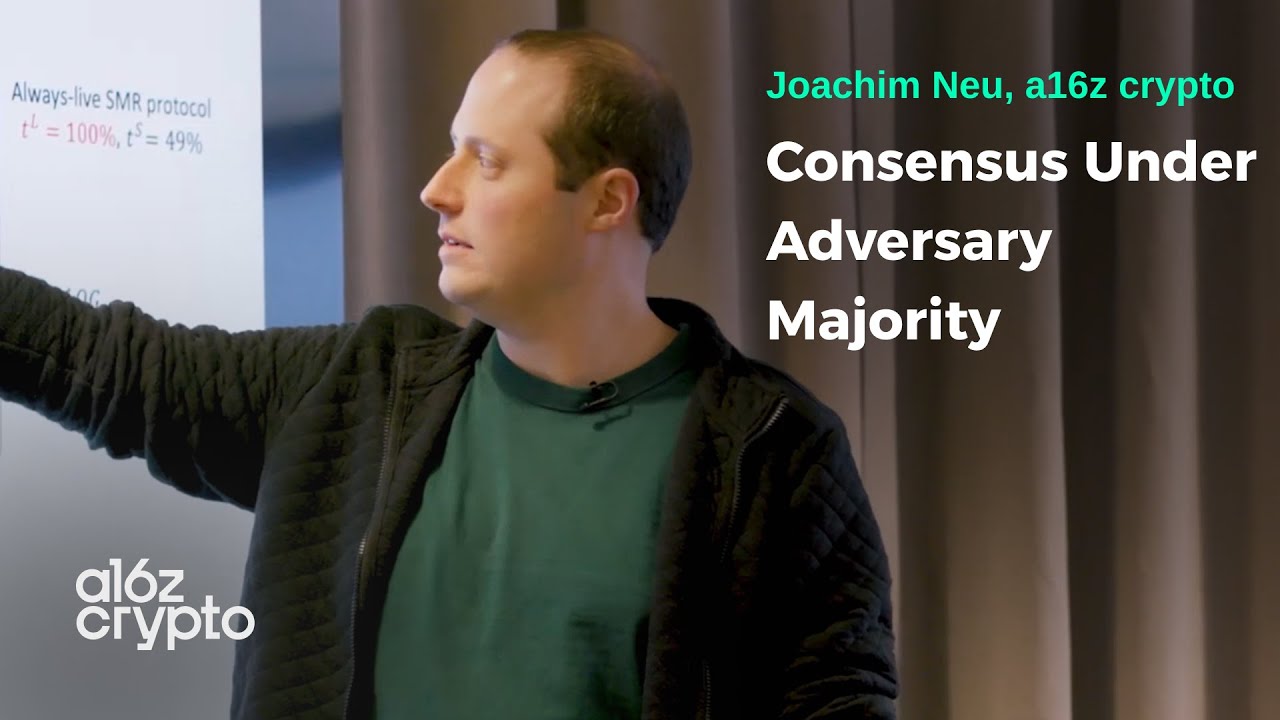
Consensus Under Adversary Majority with Joachim Neu | a16z crypto Research Series
Source: YouTube · a16z crypto · published Oct 29, 2025 · 41:16
The video explains conflicting claims about adversary tolerance in blockchain consensus protocols, revealing how client models and network assumptions determine resilience 1:22, 2:47.
Key Takeaways:
• Different consensus protocols tolerate different adversary fractions: 33% for partially synchronous networks, 49% for synchronous networks, and 99% for specific client models 3:53-4:19
• Client models are defined by two dimensions: sleepiness (always on vs. occasionally offline) and communication capabilities (silent vs. relaying messages) 8:48
• With sleepy and silent clients, 49% adversary tolerance is the maximum achievable, while always-on and communicating clients enable 99% tolerance 11:37
• Two novel protocols achieve different resilience tradeoffs: always safe (99% safe, 49% live) and always live (99% live, 49% safe) 17:15
• For sleepy validators, certain protocols become impossible due to inability to certify outputs, limiting theoretical possibilities 33:02
The research provides a framework to understand blockchain resilience across 16 different models of network synchrony, validator availability, and client behavior 38:22.
Sources:
Generate CPE Credits
Generate a professional CPE document from this video's transcript.
Estimated credit: 0.5 CPE hours
Estimate uses the video runtime (1 hour ≈ 1 CPE, rounded to the nearest 0.5, minimum 0.5, maximum 2.0). The final amount can be lower after review, never higher.
Topic: Cybersecurity. Commonly maps to: Security and Risk Management, Security Operations. Exact CISSP domains are assigned during generation.
Free account. One generation at a time, with a daily limit.
CPEBuddy is independent and not affiliated with or endorsed by ISC2, ISACA, or any certification body. Exports are formatted for common CPE submissions; acceptance is at your certification body's discretion.
Transcript Preview
First 800 characters of the transcript
All right, welcome everyone to the second research seminar of the summer 25 series. Very happy to introduce someone you all know, Yokam Noi, our colleague here at A6Z crypto where he's a research associate. uh today's going to answer a bunch of um confusing questions like why do some people say uh that you can do synchronous consensus with 99% adversary whereas some say you can't do it with 51%. also like what is a client actually really? So, Yoken, >> thank you. Great to be here and great to give this talk. Uh thanks for the introduction. Um thanks for spoilering the talk. Um yeah, so I'm going to be talking about this uh recent paper of ours uh which we presented a few weeks ago at financial crypto. This is joint work uh with my uh former colleagues at Stamford, Stravatson, New Yus, and …