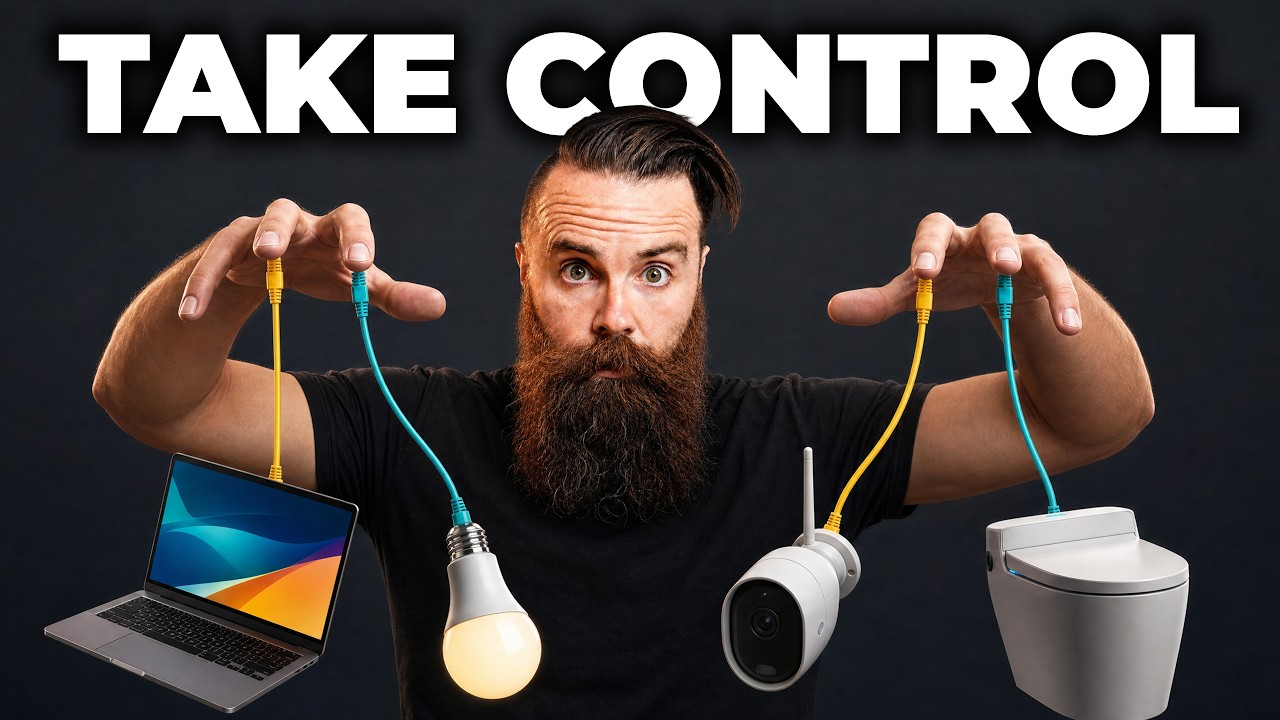
your house needs TWO networks (here's why)
Source: YouTube · NetworkChuck · published Oct 5, 2026 · 21:44
BLUF: Network security expert NetworkChuck demonstrates how to isolate vulnerable IoT devices from a home network using VLANs on an OPNsense firewall and a managed switch, preventing hackers from pivoting to core devices 2:15. By segmenting traffic, he ensures that even if an IoT device is compromised, it cannot access sensitive family data or other network assets 1:32.
Key Takeaways:
• Home networks are dangerous because IoT devices (lights, cameras, fridges) often share a single network, allowing hackers to pivot from one vulnerable device to secure ones like laptops or file servers 0:19.
• The primary solution is network segregation; placing IoT devices on a separate, quarantined network prevents them from communicating with or hacking core family devices 1:26.
• Virtual LANs (VLANs) allow a single physical firewall or router to create multiple isolated logical networks, enabling segregation without needing extra hardware 3:16.
• To make a VLAN functional, you must create a VLAN interface in OPNsense, assign it an IP address, and configure DHCP to ensure devices on the new network receive valid IP addresses 11:11.
• Firewalls deny traffic by default; therefore, you must explicitly create firewall rules to allow the new network to access the internet while blocking it from accessing the main internal network 16:14.
• Managed switches are required for VLANs because they support "tagging," which allows a single cable to carry traffic for multiple different networks simultaneously 7:56.
Closing Statement:
This setup successfully isolates IoT gadgets, significantly hardening the home network against common attacks. Future episodes will address Wi-Fi integration and AI-driven security monitoring.
Sources:
- 2:15 Explanation of the problem: single home networks allow hackers to pivot from vulnerable IoT devices to secure family devices.
- 1:32 The solution: segregating IoT devices into a quarantined network to prevent access to core devices.
- 3:16 Definition of VLANs (Virtual Local Area Networks) and how they create isolated networks on single hardware.
- 11:11 Steps to configure OPNsense: creating a VLAN interface and assigning an IP address to act as the router for the new network.
- 16:14 Importance of firewall rules: denying default access and explicitly allowing internet access while blocking internal network access.
- 7:56 Explanation of managed switches and trunk ports, which carry multiple VLANs over a single connection.
Generate CPE Credits
Generate a professional CPE document from this video's transcript.
Estimated credit: 0.5 CPE hours
Estimate uses the video runtime (1 hour ≈ 1 CPE, rounded to the nearest 0.5, minimum 0.5, maximum 2.0). The final amount can be lower after review, never higher.
Topic: Cybersecurity. Commonly maps to: Security and Risk Management, Security Operations. Exact CISSP domains are assigned during generation.
Free account. One generation at a time, with a daily limit.
CPEBuddy is independent and not affiliated with or endorsed by ISC2, ISACA, or any certification body. Exports are formatted for common CPE submissions; acceptance is at your certification body's discretion.
Transcript Preview
First 800 characters of the transcript
Hey. Your home network is dangerous. Light bulbs, door locks,
cameras, all with WiFi, smart, living on one network. That's a problem. You'd most likely have
forgotten about your smart fridge. Oh, of course. Smart switches as well. Yep. Forgot about that one. It it only takes one
device for a a skilled hacker to pivot into your network. You don't know which
of your IoT devices has a vulnerability until a
hacker takes advantage of it. What's the worst that can happen? Malware in the family nest,
or maybe a few of your devices decides to join
a botnet and attack hospitals. Or sometimes you end up
being streamed on the Internet like in the Truman Show. So can this mini PC I
bought from Japan, this random switch, and AI
running on a Raspberry Pi help protect Mike's
family from their IoT gremlin…