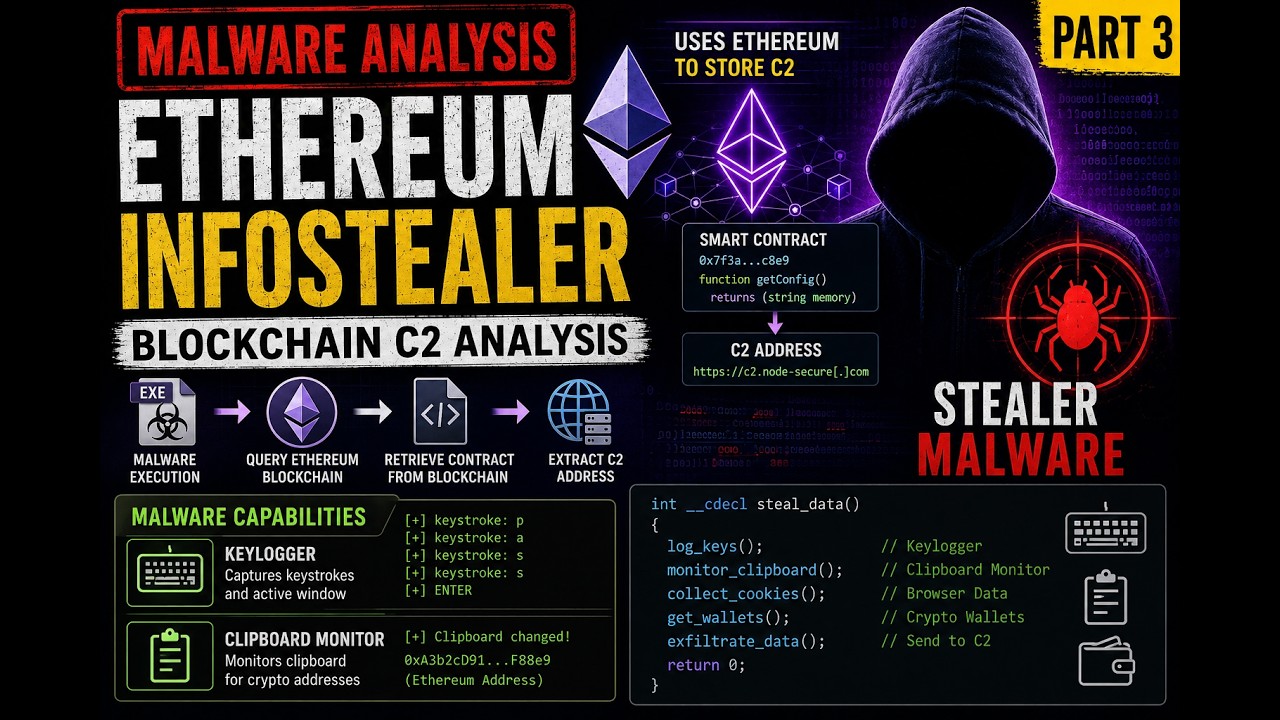
Reverse Engineering an Ethereum-Powered Infostealer | Blockchain C2 Malware Analysis – Part 3
Source: YouTube · Malware Research Diary · published May 25, 2026 · 32:05
[BLUF] The video analyzes a malware stealer that utilizes Ethereum smart contracts and public trackers to conceal and manage its Command and Control (C2) infrastructure 1:02.
Key Takeaways:
• The malware employs a specific Ethereum address to interact with various public Ethereum trackers, allowing it to forward data or instructions 0:33.
• Investigators discovered that the malware leverages smart contracts to create and store C2 configurations directly within the payload, rather than using traditional hardcoded servers 1:06.
• By searching for the specific contract ID associated with the malware, researchers were able to trace the contract interactions and understand the C2 mechanism 1:19.
• This technique highlights a sophisticated evasion strategy where blockchain technology is abused to maintain resilient and decentralized command structures 0:24.
[Closing statement] This analysis demonstrates how threat actors are increasingly integrating blockchain technologies into malware to enhance persistence and evade detection. Understanding these contract-based C2 methods is crucial for effective threat intelligence and mitigation.
Sources:
- 0:01 Introduction to the malware stealer analysis session.
- 0:33 Explanation of using Ethereum trackers to forward data.
- 1:02 Discovery that the malware uses smart contracts for C2.
- 1:19 Method of searching for the contract ID to trace activity.
- 0:24 Context on the Ethereum address usage in the malwar
Generate CPE Credits
Generate a professional CPE document from this video's transcript.
Estimated credit: 0.5 CPE hours
Estimate uses the video runtime (1 hour ≈ 1 CPE, rounded to the nearest 0.5, minimum 0.5, maximum 2.0). The final amount can be lower after review, never higher.
Topic: Malware Analysis. Commonly maps to: Security Operations, Security Architecture and Engineering. Exact CISSP domains are assigned during generation.
Free account. One generation at a time, with a daily limit.
CPEBuddy is independent and not affiliated with or endorsed by ISC2, ISACA, or any certification body. Exports are formatted for common CPE submissions; acceptance is at your certification body's discretion.
Transcript Preview
First 800 characters of the transcript
Hello everyone. Um welcome back to the last um session of this. Um we're going to take a quick look and see um the stealer for for this malware. So during the last conversation we was um wasn't sure um what this mailware does but what interesting things about this is they they have a hex right the the Ethereum address here and they using variety of different um Ethereum um public um tracker to forward. So, um what I did um so I did a little digger digging into this and what turned out is the malware was using the contracts. Um so they um they're using this um contract to create or storing the C2 um in in the in the payload. Right? So here's an example of um let's go back. So I did a searching using this contract ID right here. Um, I do a search in it. And when we look at the contracts here…