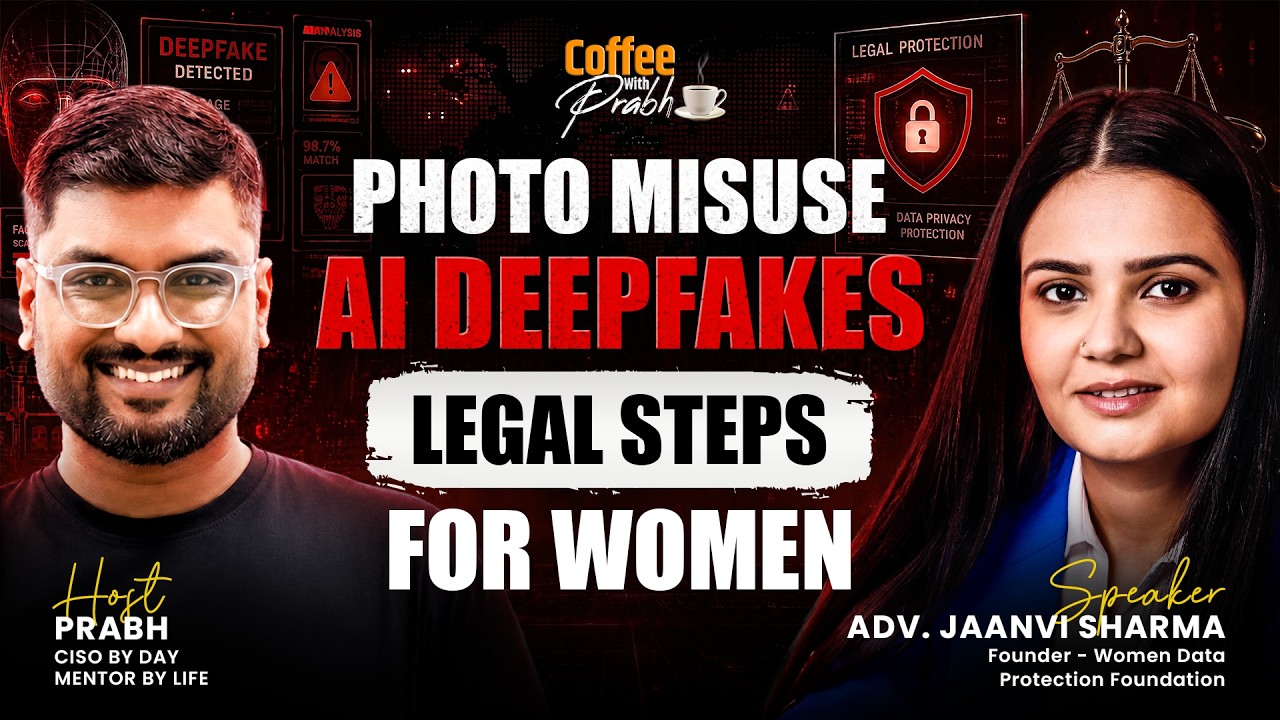
Digital Rights for Women in India: Privacy, Consent, Cybercrime & AI Abuse
Source: YouTube · Prabh Nair · published Jul 8, 2026 · 42:29
This discussion explores how AI is weaponized to harm women's reputations through deepfakes and image-based abuse, outlining Indian legal protections and practical steps for victims to seek justice 2:25.
Key Takeaways:
• AI-facilitated abuse—like morphing innocent videos into inappropriate content—intersects with cybercrime, dignity violations, and privacy breaches, as being a public figure does not grant consent for image misuse 4:26.
• Not all profile viewing constitutes cyberstalking; it requires repeated, uncomfortable following or persistent inappropriate messaging after being told to stop 7:30.
• Indian law provides multiple remedies: Section 66D of the IT Act covers identity theft/impersonation, Sections 67/67A address obscene or sexually explicit content, Section 67B protects minors, and BNS Sections 75, 77, and 78 cover intimate images, stalking, and insults 9:28.
• Victims should immediately confide in someone, preserve all evidence (screenshots, URLs), call 1930, file on cybercrime.gov.in, and request platform takedowns—simultaneously pursuing legal notices or court injunctions to stop content spread 18:54.
• The Digital Personal Data Protection Act (DPDPA) frames photos as personal data and social media platforms as data fiduciaries, empowering victims to request takedowns based on consent violations, though it serves as a compliance law rather than a criminal one 38:00.
Victims must remain bold and take comprehensive action rather than waiting, as deepfakes can be created in minutes while legal and platform removal processes take significantly longer.
Sources:
Generate CPE Credits
Generate a professional CPE document from this video's transcript.
Estimated credit: 0.5 CPE hours
Estimate uses the video runtime (1 hour ≈ 1 CPE, rounded to the nearest 0.5, minimum 0.5, maximum 2.0). The final amount can be lower after review, never higher.
Topic: Cybersecurity. Commonly maps to: Security and Risk Management, Security Operations. Exact CISSP domains are assigned during generation.
Free account. One generation at a time, with a daily limit.
CPEBuddy is independent and not affiliated with or endorsed by ISC2, ISACA, or any certification body. Exports are formatted for common CPE submissions; acceptance is at your certification body's discretion.
Transcript Preview
First 800 characters of the transcript
What are we going to cover today, Janvi? >> Today, we are going to talk about the artificial intelligence and cyber crimes and how artificial intelligence is harming women's image or their reputations. >> I want to be a bit emotional here because the topic that we are discussing today is very important topic to be discussed in society. Our kids, girls, women's knowingly and unknowingly are victim of this AI. >> Let's divide this question into few parts. Of course, it is a cyber crime issue because if any crime which is happening using the technology or any crime which is happening in cyber space, then it becomes a cyber crime. >> How critical is this word stalking and how we interpret the stalking in the Indian cyber crime perspective? >> If anyone or who is following you in such a way whi…