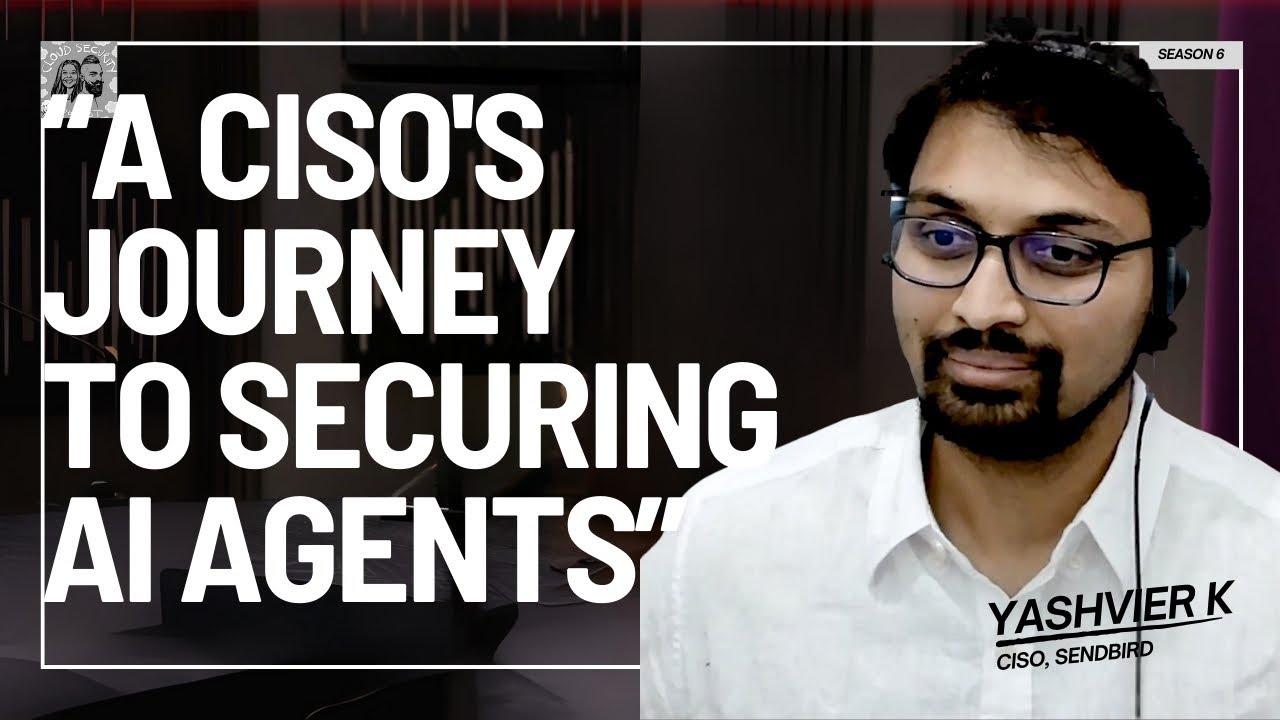
How to secure your AI Agents: A CISOs Journey
Source: YouTube · Cloud Security Podcast · published Dec 9, 2025 · 54:54
Rapidly adopting new AI technologies forces organizations to balance speed with fundamentally different security models, exposing blind spots around enterprise tool trust and shifting the definition of a security incident 0:00.
Key Takeaways:
• Pivoting to new AI tech requires building quickly from the ground up, introducing entirely different attack paths, security issues, and data models 0:02.
• A major security blind spot is the false assumption that enterprise AI tools like GitHub Copilot are inherently secure simply because they are backed by large companies like Microsoft 0:19.
• Genuine security relies on actual multi-layered defenses rather than relying on flashy marketing terms like "zero trust" 0:28.
• The concept of what constitutes a security incident is evolving, particularly when evaluating the risks of AI agents producing sub-optimal or incorrect outputs 0:38.
As AI integration accelerates, security teams must move beyond brand-trust assumptions and adapt their frameworks to address these unique, AI-specific vulnerabilities.
Sources:
Generate CPE Credits
Generate a professional CPE document from this video's transcript.
Estimated credit: 1 CPE hours
Estimate uses the video runtime (1 hour ≈ 1 CPE, rounded to the nearest 0.5, minimum 0.5, maximum 2.0). The final amount can be lower after review, never higher.
Topic: Cybersecurity. Commonly maps to: Security and Risk Management, Security Operations. Exact CISSP domains are assigned during generation.
Free account. One generation at a time, with a daily limit.
CPEBuddy is independent and not affiliated with or endorsed by ISC2, ISACA, or any certification body. Exports are formatted for common CPE submissions; acceptance is at your certification body's discretion.
Transcript Preview
First 800 characters of the transcript
You're now balancing speed with security in a very different level. We went from a mature organization to let's pivot, use this new technology, and then sort of build something new from the ground up very, very quickly. The attack paths are different, the types of security issues are different, the data or security models are different. The major blind spot was the notion of yes, we're using GitHub Copilot, it's an enterprise tool backed by Microsoft, so it's secure, it's okay to use. How different would that be to a traditional zero trust? A true multi-layered approach doesn't use, I guess, flashy marketing terms and call it zero trust. It's plain multi-layers of security. The definition of like what is an incident is also changing. When an AI agent gives a wrong answer or an sub-optimal …