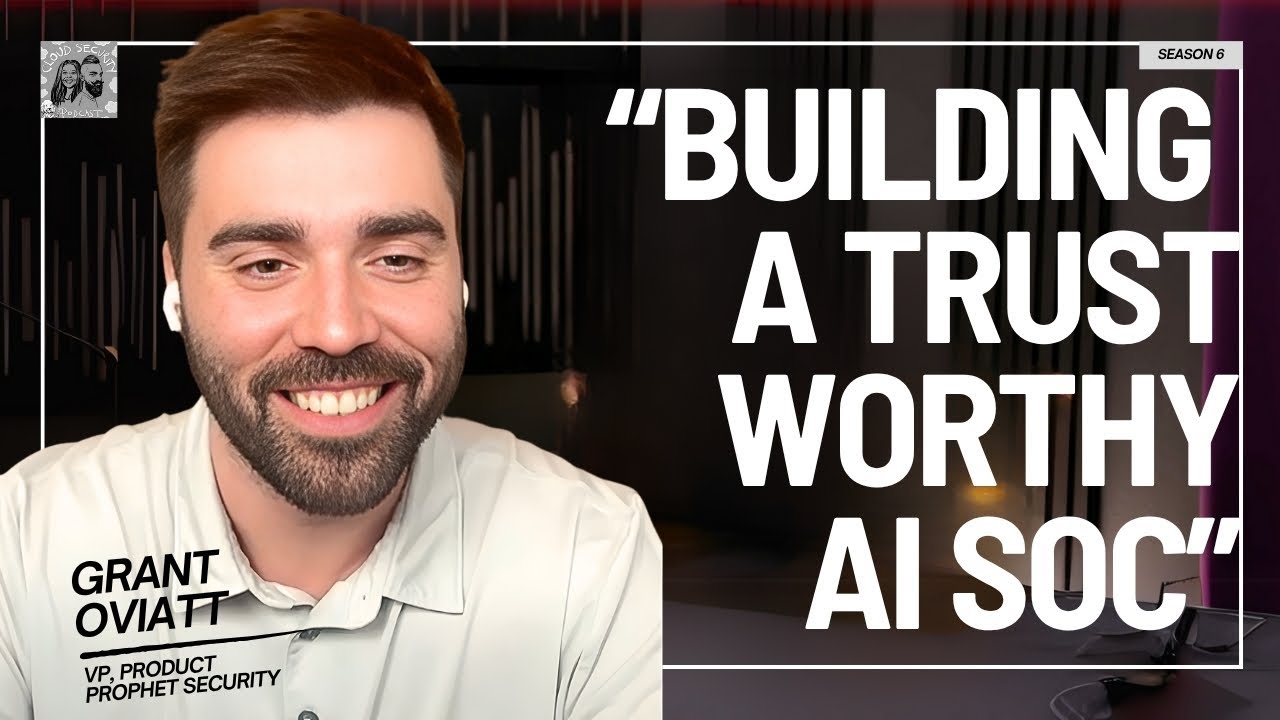
How to Build Trust in an AI SOC for Regulated Environments
Source: YouTube · Cloud Security Podcast · published Nov 18, 2025 · 42:17
BLUF: This video discusses establishing trust in AI for regulated security environments, highlighting that while AI automates 95% of false positive closures, human oversight remains critical for the remaining complex cases 0:00.
Key Takeaways:
• AI skepticism is common, especially regarding detection technologies, but trust is built through consistent performance in regulated spaces 0:00-0:05.
• The average investigation time has dropped to around 4 minutes, significantly faster than traditional security analyst response times 0:14-0:18.
• AI systems automatically close over 95% of alerts as false positives, allowing humans to focus on the critical 5% that require nuanced judgment 0:22-0:30.
• In regulated environments (cloud, on-premise, multi-cloud), specific models and compliance frameworks dictate which AI applications are viable 0:33-0:40.
Closing Statement:
The integration of AI in security operations enhances speed and efficiency, but a hybrid approach ensuring human-in-the-loop for edge cases is essential for maintaining trust and compliance.
Sources:
Generate CPE Credits
Generate a professional CPE document from this video's transcript.
Estimated credit: 0.5 CPE hours
Estimate uses the video runtime (1 hour ≈ 1 CPE, rounded to the nearest 0.5, minimum 0.5, maximum 2.0). The final amount can be lower after review, never higher.
Topic: Cybersecurity. Commonly maps to: Security and Risk Management, Security Operations. Exact CISSP domains are assigned during generation.
Free account. One generation at a time, with a daily limit.
CPEBuddy is independent and not affiliated with or endorsed by ISC2, ISACA, or any certification body. Exports are formatted for common CPE submissions; acceptance is at your certification body's discretion.
Transcript Preview
First 800 characters of the transcript
How does one establish trust in the regulated space especially as an AI sock? >> Skeptics out there, don't blame me. You know, I was you. If I think of 15 years ago with AI, anything AI detection in it scared me to death. I was very skeptical. But do we still need the human in the loop today? >> Our average time to complete an investigation is right around 4 minutes. Most security analyst teams won't even start to look at an alert in 4 minutes. For 95 plus percent of our investigations, we're automatically closing items as false positive. That additional 5% we think bringing in a human is still the right approach today. I don't know if you know this, but in a regulated environments, whether it's in cloud, on premise, or multi-cloud, there are certain kinds of models you can work with. Ther…