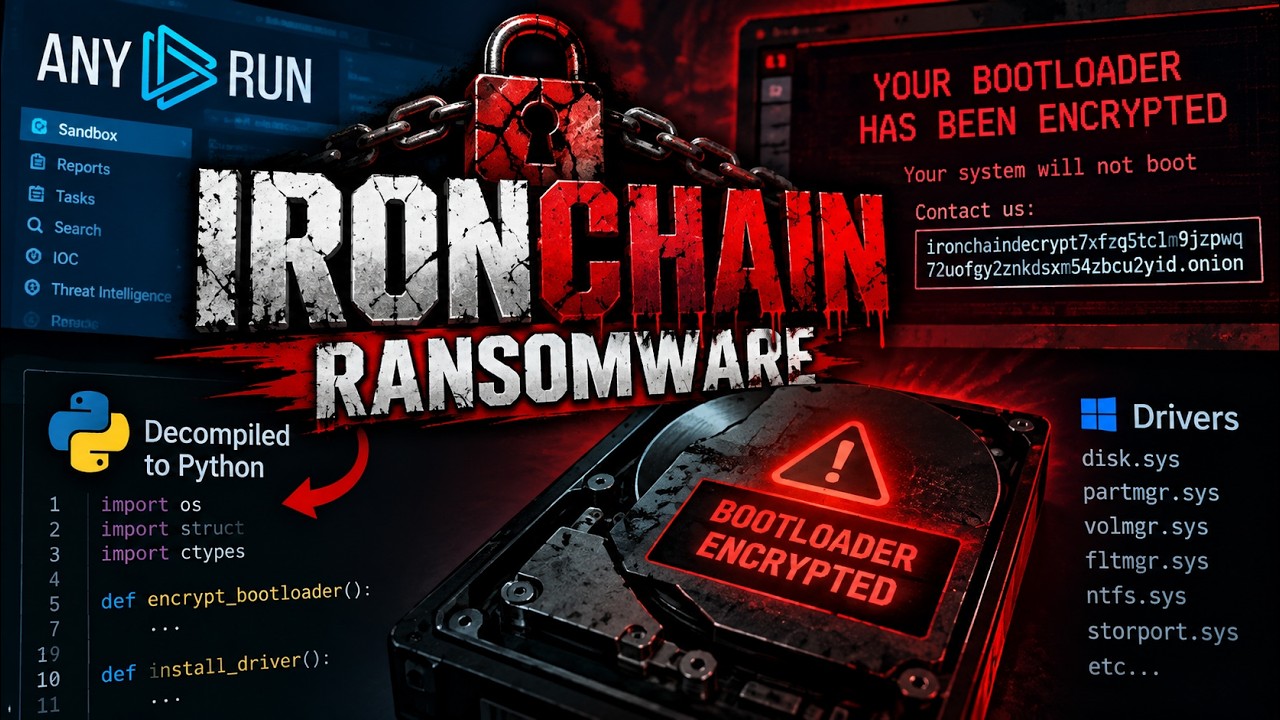
Reverse Engineering IronChain Ransomware | Python Malware That Targets the Bootloader
Source: YouTube · Malware Research Diary · published Oct 8, 2026 · 42:04
[BLUF]
The video analyzes "Iron Chain," a severe ransomware variant that bypasses standard encryption by directly overwriting the physical drive's boot sector using vulnerable, signed drivers for privilege escalation, making data recovery virtually impossible 2:15.
Key Takeaways:
• The malware utilizes a multi-stage approach, extracting a Python-based payload and multiple drivers (including signed ones like "Process Monitor Driver") to bypass security checks and escalate privileges 1:53.
• Unlike typical ransomware that encrypts files, Iron Chain writes directly to the physical drive's boot sector, effectively destroying the system's ability to boot and rendering the data unrecoverable even if the ransom is paid 15:56.
• The attacker employs vulnerable drivers to exploit kernel-level access, allowing them to disable antivirus services, shut down recovery systems, and perform local privilege escalation to gain full control 10:26.
• The ransomware includes brute-force capabilities to steal credentials and performs port scanning to establish communication with its Command and Control (C2) server 22:29.
• A fake countdown timer and ransom note demanding Bitcoin are displayed, but the underlying damage to the boot sector means the system remains non-functional regardless of payment 1:06.
[Closing statement]
This analysis highlights a dangerous evolution in ransomware tactics, moving from file encryption to complete system destruction via boot sector manipulation. Security professionals must prioritize driver integrity and kernel-level monitoring to detect such sophisticated threats.
Sources:
- 0:22 Introduction to the Iron Chain malware sample.
- 1:53 Analysis of the extracted driver files and their purpose.
- 10:26 Explanation of privilege escalation techniques using vulnerable drivers.
- 15:56 Demonstration of direct boot sector overwriting.
- 22:29 Overview of credential theft and C2 communication methods.
- 41:12 Discussion on the futility of paying the ransom due to unrecoverable damage.
Generate CPE Credits
Generate a professional CPE document from this video's transcript.
Estimated credit: 0.5 CPE hours
Estimate uses the video runtime (1 hour ≈ 1 CPE, rounded to the nearest 0.5, minimum 0.5, maximum 2.0). The final amount can be lower after review, never higher.
Topic: Malware Analysis. Commonly maps to: Security Operations, Security Architecture and Engineering. Exact CISSP domains are assigned during generation.
Free account. One generation at a time, with a daily limit.
CPEBuddy is independent and not affiliated with or endorsed by ISC2, ISACA, or any certification body. Exports are formatted for common CPE submissions; acceptance is at your certification body's discretion.
Transcript Preview
First 800 characters of the transcript
Hello everyone. Welcome back to another session in analyzing malware. Um today um there's I haven't find anything interesting to analyze recently. Um so I thought might be take a look in ransomware on any. Run. So let's take a look. Um so searching for um today we saw the iron chain.exe here seem to be might be interesting. So BU anti viruses vulnerable driver process monitor driver and throttle Python ransomware. Let's take a look and see. So from a screen um once you execute it drop a file. So personal ID IP address um the onion links and $1,000 um crypto. Okay. And got a timer on it as well. Um in here from from the look of this is um have creating new process, right? Two, one, two, three. So, um admin potential admin escalating um create test schedule. Okay. And turn off profile um AV …