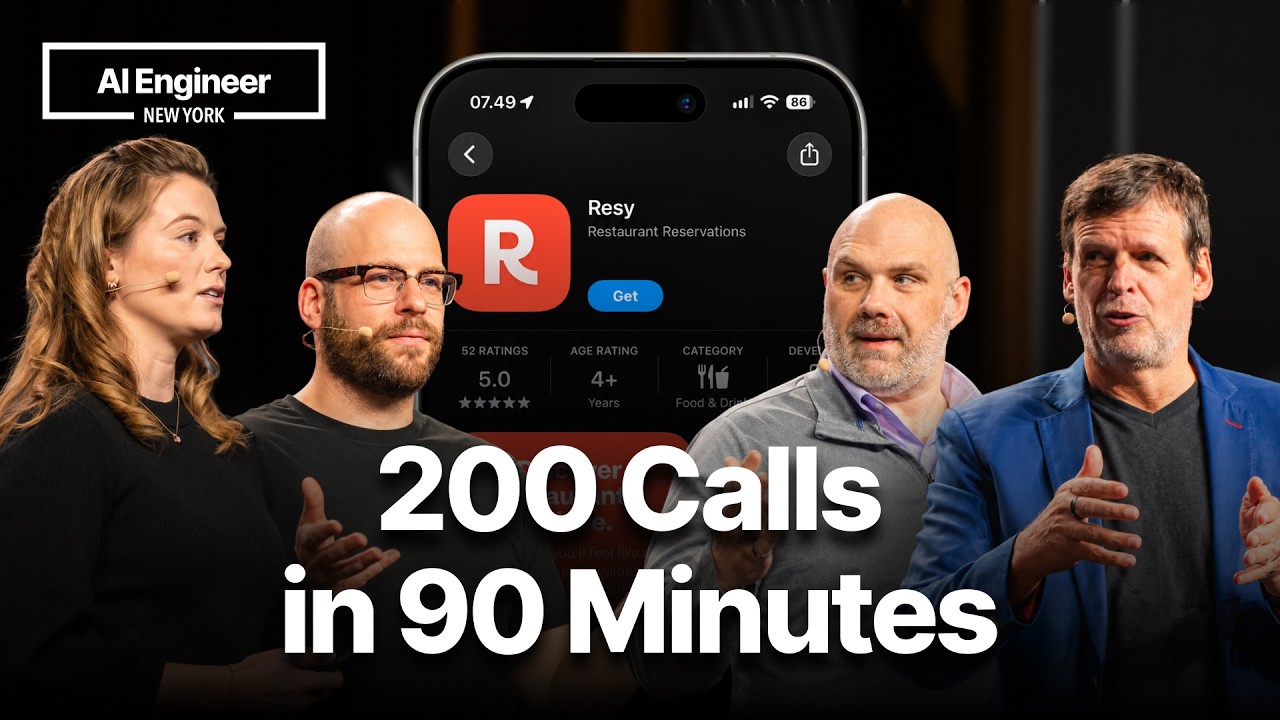
An AI Agent Got Its User Banned From Resy — Keycard, JPMorgan Chase & AAuth
Source: YouTube · AI Engineer · published Oct 17, 2026 · 43:21
BLUF:
Runtime authorization based on intent is essential for enabling safe agent autonomy, as traditional coarse-grained access controls fail to address the dynamic and probabilistic nature of agentic workflows 2:15. By linking permissions to specific missions and contextual signals, organizations can balance security with operational efficiency.
Key Takeaways:
• Beyond Coarse-Grained Access: Current systems like OAuth are too rigid for agents; runtime authorization must evaluate intent and context per tool call rather than relying on broad, pre-granted scopes 1:30.
• The "Mission" Primitive: Authorization decisions should be grounded in a "mission" defined by the user or organization, allowing agents to negotiate boundaries and ensuring all actions align with the overarching goal 9:20.
• Decoupling Brains and Hands: To prevent misuse, the agent's reasoning model ("brain") must be separated from its execution capabilities ("hands") via an egress proxy, where deterministic policies enforce constraints 29:00.
• Resource Budgeting: Unlike simple rate limiting, resource budgets provide agents with feedback on consumption, allowing them to adjust behavior dynamically while preventing downstream abuse 26:00.
• Accountability and Forensics: Intent-based logs create a clear audit trail that links human users to agent actions, which is critical for liability and diagnosing why an agent failed or acted maliciously 38:00.
Closing Statement:
Implementing intent-based authorization transforms agent security from a static barrier into a dynamic, contextual framework. This approach not only mitigates risks but also fosters trust, enabling the widespread adoption of autonomous agents in enterprise environments.
Sources:
- 2:15 Discussion on why current coarse-grained systems fail for agents.
- 1:30 Introduction to runtime authorization and intent as a solution.
- 9:20 Definition of the "mission" concept in OIDC for agents.
- 29:00 Explanation of the "brain and hands" architectural separation.
- 26:00 How resource budgets prevent agent abuse compared to rate limiting.
- 38:00 The importance of tamper-resistant auditing for liability.
Generate CPE Credits
Generate a professional CPE document from this video's transcript.
Estimated credit: 0.5 CPE hours
Estimate uses the video runtime (1 hour ≈ 1 CPE, rounded to the nearest 0.5, minimum 0.5, maximum 2.0). The final amount can be lower after review, never higher.
Topic: Cybersecurity. Commonly maps to: Security and Risk Management, Security Operations. Exact CISSP domains are assigned during generation.
Free account. One generation at a time, with a daily limit.
CPEBuddy is independent and not affiliated with or endorsed by ISC2, ISACA, or any certification body. Exports are formatted for common CPE submissions; acceptance is at your certification body's discretion.
Transcript Preview
First 800 characters of the transcript
Um, hi everyone. Welcome to um, AI Engineer New York. I'm super excited to be here today. Uh, my name is Ally. How I'm a member of technical staff at Keycard. Um, I'm here with some amazing panelists today. We have Ian, CEO of Keycard. We have Michael Davis, um, global chief security architect at JP Morgan Chase, and we have we have Dick Hart, the founder of AOTH and co-creator of OOTH with us on stage today. I'm super excited to talk to all of them about intentbased authorization. Um, and to set the stage, I want to bring to light that as more companies are looking to give their agents increased levels of autonomy, they're looking to runtime authorization to help. Runtime off is the practice of authorizing an agent per tool call rather than having the agent hold broadstanding access that …