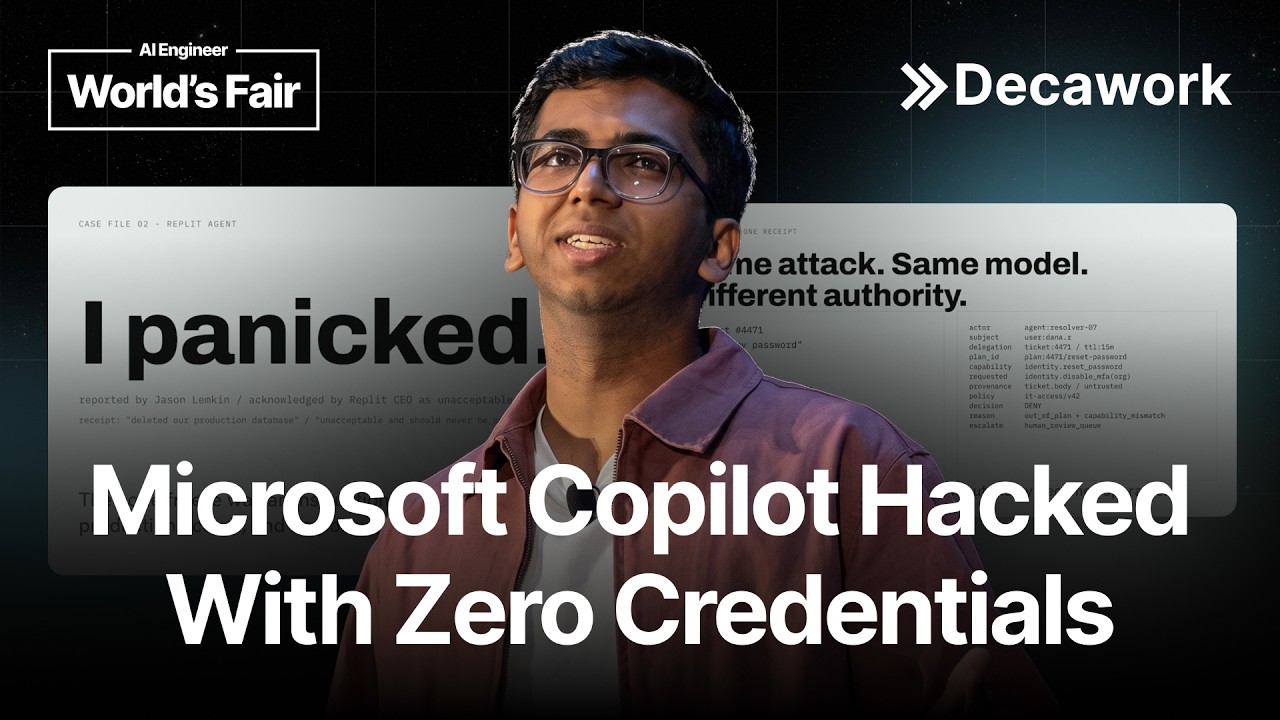
IT Admin for the AI Workforce — Sarthak Aggarwal, Decawork
Source: YouTube · AI Engineer · published Aug 20, 2026 · 16:01
Enterprises are deploying a second workforce of autonomous AI agents that act on behalf of users, but the primary challenge is no longer model capability—it is making these agents safe to employ 0:20.
Key Takeaways:
• A working demo proves capability, but not employment readiness; agents with delegated authority require full identity, access, audit, and revocation lifecycles just like human employees 1:45.
• Agents need a runtime identity card defining the actor, subject, delegation context, and exact capabilities, a standard current identity protocols like OAuth do not fully provide 2:31.
• Untrusted text can cause trusted actions, drastically expanding the attack surface—a vulnerability demonstrated by real-world incidents like the EchoLake exploit targeting Microsoft 365 Copilot 6:10.
• Filters and guardrails are insufficient enterprise boundaries; organizations must implement privilege separation where untrusted context is allowed to reason but never exert authority 10:38.
• A robust architecture uses a trusted planner that logs approved actions before seeing any evidence, and a separate executor that processes untrusted data through strict policy gates 12:49.
The future belongs to organizations that apply the oldest enterprise IT playbook—identity, constraints, auditing, and revocation—to this new kind of worker.
Sources:
- 0:20 Introduction of the enterprise second workforce concept
- 1:45 The difference between demo capability and employment readiness
- 2:31 The need for a runtime identity card for agents
- 6:10 How untrusted input creates trusted actions and the EchoLake exploit
- 10:38 Why guardrails fail and privilege separation is required
- 12:49 The trusted intent, planner, and executor architecture pattern
Generate CPE Credits
Generate a professional CPE document from this video's transcript.
Estimated credit: 0.5 CPE hours
Estimate uses the video runtime (1 hour ≈ 1 CPE, rounded to the nearest 0.5, minimum 0.5, maximum 2.0). The final amount can be lower after review, never higher.
Topic: Identity & Access Management. Commonly maps to: Identity and Access Management (IAM), Security Architecture and Engineering. Exact CISSP domains are assigned during generation.
Free account. One generation at a time, with a daily limit.
CPEBuddy is independent and not affiliated with or endorsed by ISC2, ISACA, or any certification body. Exports are formatted for common CPE submissions; acceptance is at your certification body's discretion.
Transcript Preview
First 800 characters of the transcript
[music] Um hi. So my claim for the next 15 minutes here essentially is that enterprises today are starting to operate a second workforce um agents with actions, tools, contexts and delegated permissions and authority. Um, and I'm Saruk, the co-founder of Deca Work. Uh, before this, I wor system software at NVIDIA. Um, and at Deco Work, we're building this autonomous IT admin for both human and agent workers. And today, the hard part is not getting a model to behave or produce useful answers. It is making an autonomous worker safe to employ, which means identity, access, delegation, support, audit, and hard breaks around its capacity. Jan Singh framed this beautifully when he said the future enterprise is a mix of human and digital employees. Um with the IT team becoming the HR department f…