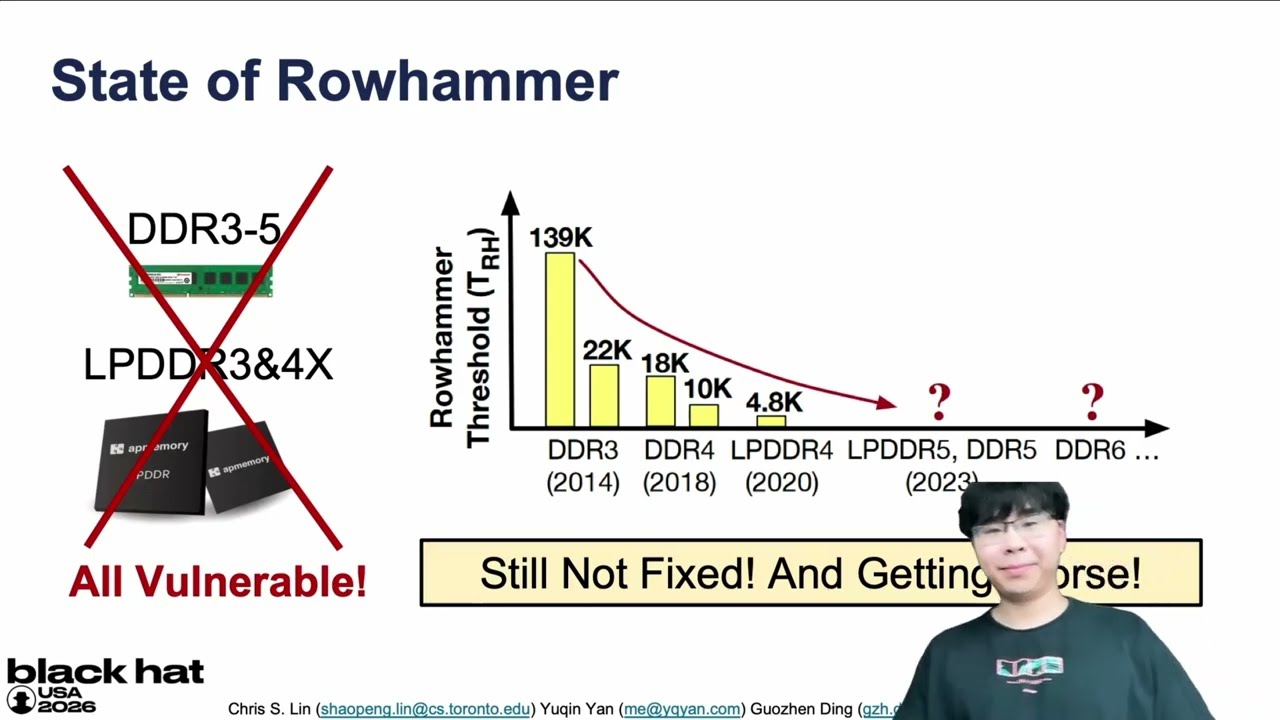
Black Hat USA 2026 | GPUBreach: Privilege Escalation Attacks on GPUs Using Rowhammer
Source: YouTube · Black Hat · published Nov 19, 2026 · 36:04
BLUF: Researchers from the University of Toronto demonstrate GPU Bridge, a hardware-level vulnerability on Nvidia GPUs that allows attackers to escalate privileges from a standard CUDA program to root access via GPU Rowhammer attacks 0:10. This exploit leverages bit flips in GPU memory to corrupt page tables, enabling arbitrary read/write access to both GPU and CPU memory, ultimately bypassing security boundaries 2:15.
Key Takeaways:
- GPU Rowhammer Mechanics: The attack exploits physical proximity in GDDR6 memory; rapid access to specific rows causes electrical interference that flips bits in adjacent rows, corrupting critical data structures like page tables 4:15.
- Page Table Tempering: Attackers manipulate the GPU's Unified Virtual Memory (UVM) allocator to force page table entries (PTEs) into vulnerable memory locations, allowing them to redirect virtual addresses to arbitrary physical memory regions 7:30.
- Arbitrary Read/Write Primitive: By corrupting PTEs, the attacker gains full read/write access to the entire GPU VRAM, which can be used to steal machine learning model weights or cryptographic keys from other processes 19:56.
- CPU Privilege Escalation: The exploit crosses the GPU-CPU boundary by modifying DMA (Direct Memory Access) mappings in the CPU driver's message queue, leading to a buffer overflow that grants root shell access 27:43.
- Mitigation Challenges: While ECC memory and isolating page tables offer some protection, they are not foolproof; the primary long-term fix requires vendors to sanitize all data sent from untrusted GPUs to the CPU 34:04.
Closing Statement:
The GPU Bridge vulnerability highlights a critical security gap where hardware-level physical effects can be weaponized to bypass software security models. It underscores the urgent need for GPU vendors to treat the GPU as an inherently untrusted device and for the industry to develop robust hardware-based isolation techniques.
Sources:
- 0:10 Introduction to GPU Bridge and the research team.
- 2:15 Explanation of the GPU Rowhammer attack vector.
- 4:15 Technical details on how Rowhammer flips bits in memory.
- 7:30 Overview of GPU page tables and address translation.
- 19:56 Demonstration of arbitrary read/write on GPU memory.
- 27:43 Exploit walkthrough for CPU privilege escalation.
- 34:04 Discussion on mitigations and responsible disclosure.
Generate CPE Credits
Generate a professional CPE document from this video's transcript.
Estimated credit: 0.5 CPE hours
Estimate uses the video runtime (1 hour ≈ 1 CPE, rounded to the nearest 0.5, minimum 0.5, maximum 2.0). The final amount can be lower after review, never higher.
Topic: Cybersecurity. Commonly maps to: Security and Risk Management, Security Operations. Exact CISSP domains are assigned during generation.
Free account. One generation at a time, with a daily limit.
CPEBuddy is independent and not affiliated with or endorsed by ISC2, ISACA, or any certification body. Exports are formatted for common CPE submissions; acceptance is at your certification body's discretion.
Transcript Preview
First 800 characters of the transcript
Hi everyone, welcome to our talk GPU bridge privilege escalation attacks on GPUs using real hammer. We are a group of researchers from the University of Toronto. Chris Gordon and I will jointly present this work to you. Unfortunately, Chris cannot be here with us in person today, but let me connect with him on screen. >> Hi everyone. I am Chris's AI assistant, Lobster Hacker 247. He will be back in a sec. Actually, Guin asked Chris to write a joke for today. Let me help him do it. I am going to use a local AI model runner similar to O Lama to ask GPT OSS. Okay, GPT, write me a joke for the black hat audience. Wow, very original. Fine. Who's there? Well, this is not good. A model runner is asking me for Bitcoin and taunting me with a root shell. Maybe I am hallucinating. I should double che…