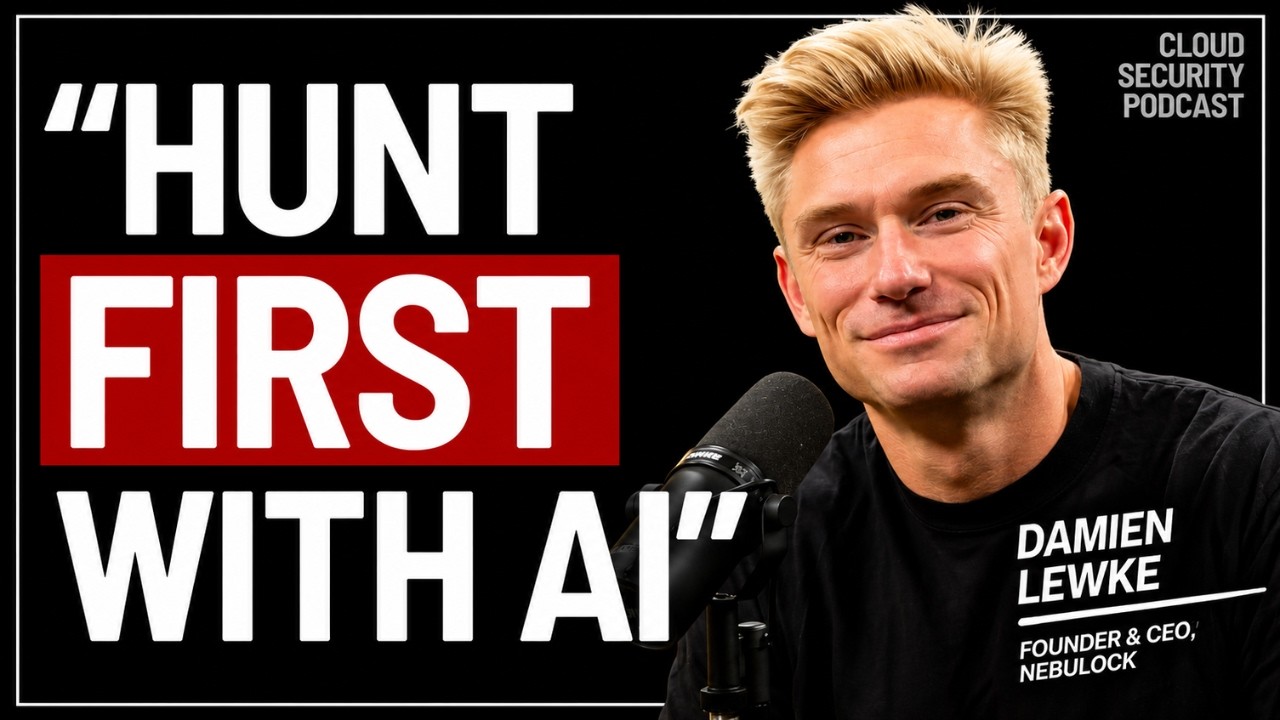
The "Hunt First" AI Security Strategy | Damien Lewke, Nebulock
Source: YouTube · Cloud Security Podcast · published Aug 25, 2026 · 46:32
BLUF: AI is democratizing threat hunting, allowing organizations of any size to proactively detect sophisticated, malware-free intrusions by analyzing telemetry rather than relying solely on alerts 2:15.
Key Takeaways:
- The threat landscape has shifted dramatically, with 82% of intrusions now occurring without malware and AI-augmented attacks rising 89% year-over-year 0:00.
- Traditional security operations are often bottlenecked by alert fatigue; small teams cannot sustain threat hunting while managing high volumes of routine tickets 0:12.
- The "Hunt First" methodology emphasizes a proactive mindset, using AI agents to analyze raw telemetry for anomalous patterns that traditional alerts miss 1:07.
- AI democratizes elite security skills, enabling even organizations with limited resources or junior staff to perform effective threat hunting through transparent, explainable agent reasoning 5:50.
- Security teams should prioritize detecting "Shadow AI" and unauthorized agent activity by establishing baselines for normal MCP (Model Context Protocol) usage and monitoring for behavioral deviations 19:10.
- While SIEMs remain vital for data storage and compliance, active security analytics and detection engineering should shift to purpose-built platforms to avoid data bloat and cost inefficiencies 29:00.
Closing Statement:
Organizations must adapt to the reality that the time to exploit is shrinking rapidly, making proactive, AI-assisted threat hunting essential for survival. By leveraging transparent AI agents to analyze telemetry, defenders can uncover hidden risks and maintain security posture regardless of team size or maturity.
Sources:
- 0:00 Discussion on the rise of malware-free intrusions and AI-augmented attacks.
- 0:12 Challenges of staffing and alert volume preventing threat hunting.
- 1:07 Introduction to the "Hunt First" methodology and proactive security.
- 5:50 How AI democratizes threat hunting capabilities for all organization sizes.
- 19:10 Strategy for hunting Shadow AI and monitoring MCP activity.
- 29:00 The future role of SIEMs vs. specialized security platforms.
Generate CPE Credits
Generate a professional CPE document from this video's transcript.
Estimated credit: 1 CPE hours
Estimate uses the video runtime (1 hour ≈ 1 CPE, rounded to the nearest 0.5, minimum 0.5, maximum 2.0). The final amount can be lower after review, never higher.
Topic: Cybersecurity. Commonly maps to: Security and Risk Management, Security Operations. Exact CISSP domains are assigned during generation.
Free account. One generation at a time, with a daily limit.
CPEBuddy is independent and not affiliated with or endorsed by ISC2, ISACA, or any certification body. Exports are formatted for common CPE submissions; acceptance is at your certification body's discretion.
Transcript Preview
First 800 characters of the transcript
82% of all intrusions don't involve any sort of malware. AI [music] augmented or AI generated attacks are up 89% year-over-year. Breaches happen in silence. Breaches happen because we missed something. >> I only have six people, each one of them doing at least 50-60 tickets a day. By the time you multiply that, there's not enough time for threat hunting at this point. >> We have surfaced over 4,000 active incidents, so active intrusions that otherwise would have been missed by just focusing on alerts. Open weights models are actively being distilled and two dudes in a GPU can point their rig at an environment and go to town. No one's writing signatures or detections for this. And after a couple weeks, unbeknownst to anybody, it goes out and it touches a production DB. That's no one's fault…