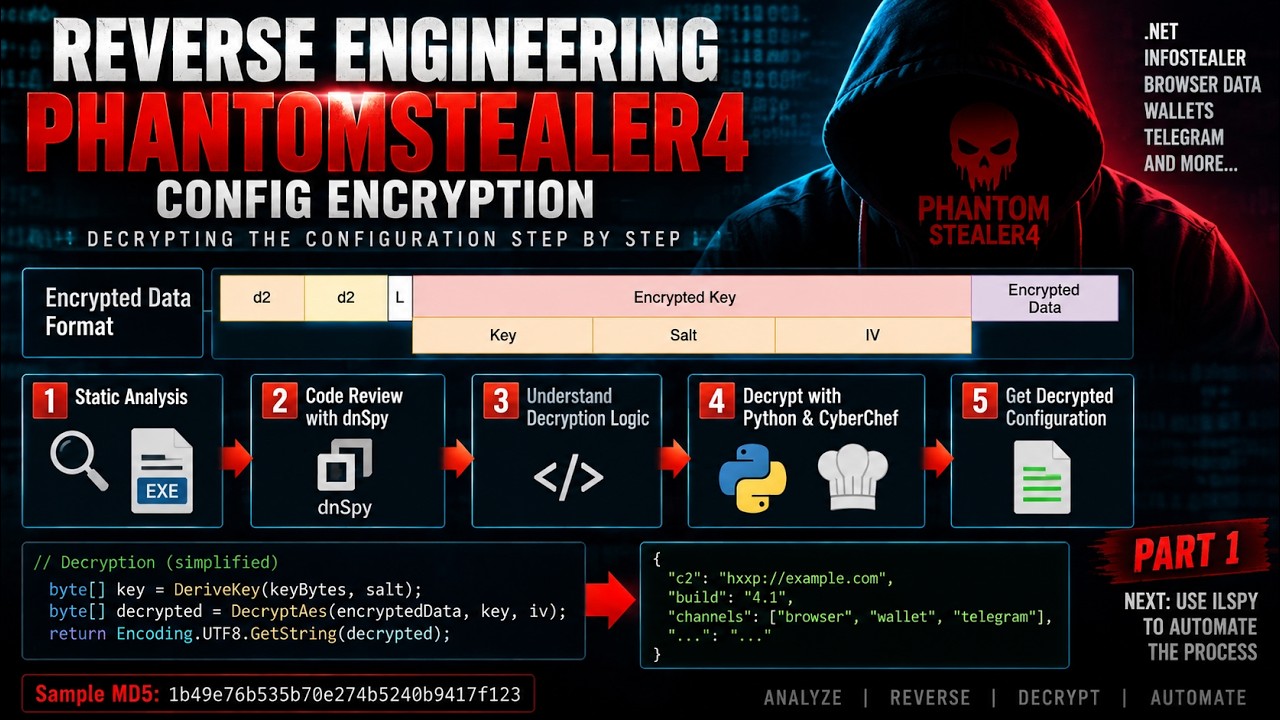
Build PhantomStealer4 Config Decryptor | Decrypting the Configuration Step by Step - Part 1
Source: YouTube · Malware Research Diary · published Sep 23, 2026 · 38:49
BLUF: The video demonstrates the static analysis of the Phantom Stealer malware, focusing on reverse engineering its complex multi-layered encryption to extract the Command and Control (C2) configuration without executing the sample 0:36.
Key Takeaways:
• The malware sample is identified as Phantom Stealer v4, a .NET-based infostealer containing modules for credit card theft, keylogging, and browser credential harvesting 2:42.
• Analysis reveals that the C2 configuration is not hardcoded in plain text but is protected by a nested encryption scheme involving Base64 decoding and AES-CBC with PKCS7 padding 10:08.
• The reverse engineering process involves tracing the Intermediate Language (IL) code to identify the master key, Initialization Vector (IV), and salt parameters required for decryption 6:50.
• The analyst manually reconstructs the decryption logic using Python, noting that the salt is unused in this specific instance, simplifying the extraction process 30:53.
• The ultimate goal is to automate this extraction via a script, which will be completed in a subsequent video using tools like dnSpy for decompilation 14:26.
Closing Statement:
This analysis highlights the necessity of deep static analysis to bypass obfuscation in modern malware families. The next step involves automating these findings to streamline threat intelligence gathering.
Sources:
- 0:36 Introduction to the goal of automatically extracting Phantom Stealer configuration.
- 2:42 Identification of the malware as Phantom Stealer v4 and its modules.
- 6:50 Explanation of using decompilers to view Intermediate Language code.
- 10:08 Detailing the AES decryption algorithm and key parameters.
- 30:53 Discovery that the salt is not used in the current encryption scheme.
- 14:26 Plan to automate the extraction process in future work.
Generate CPE Credits
Generate a professional CPE document from this video's transcript.
Estimated credit: 0.5 CPE hours
Estimate uses the video runtime (1 hour ≈ 1 CPE, rounded to the nearest 0.5, minimum 0.5, maximum 2.0). The final amount can be lower after review, never higher.
Topic: Malware Analysis. Commonly maps to: Security Operations, Security Architecture and Engineering. Exact CISSP domains are assigned during generation.
Free account. One generation at a time, with a daily limit.
CPEBuddy is independent and not affiliated with or endorsed by ISC2, ISACA, or any certification body. Exports are formatted for common CPE submissions; acceptance is at your certification body's discretion.
Transcript Preview
First 800 characters of the transcript
Hello everyone, welcome back. Um, today I noticed that um, Phantom Stealer is fairly popular. Um, there's a lot of campaign every day that I seen. Um so they are using um variety of different techniques to um I think we analyzed it previously and they was equipping their um C2 right information from their um data. So, I'm um I'm curious if there's a way for us to build a um a script to automatically extract out the um configuration of this malware. So, that's the goal for today. So, I download this um malware sample from yesterday. So, it's um see let's check on first total It's pretty well known detected. Um there's no type in here that seen is a mass logger. Um tango stealer. So a lot of different mis um detection here. Oh, that's one phantom by um this sample this malware is a net malwa…