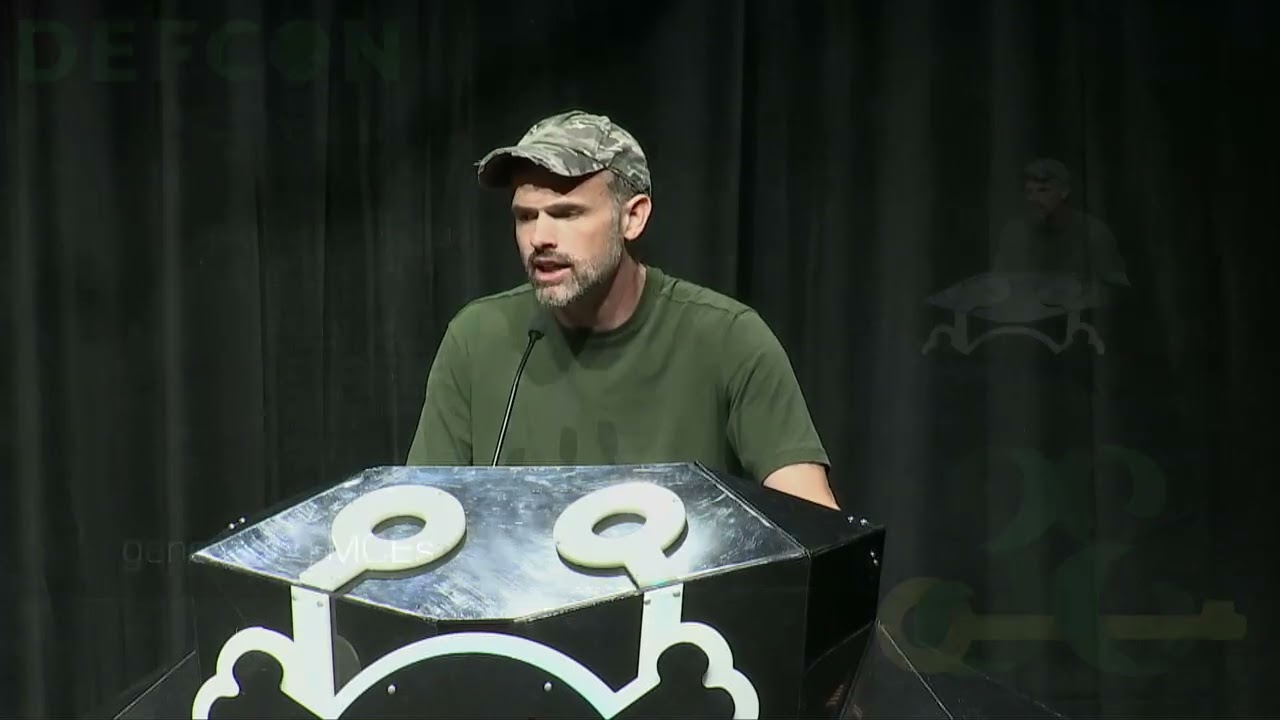
DEF CON 33 - Conjuring Hardware Failures for Cross-ring Privilege Escalation - Christopher Domas
Source: YouTube · DEFCONConference · published Oct 10, 2025 · 45:05
Optimized Summary:
BLUF:
The video reveals a novel method to generate machine check exceptions (MCEs) on-demand using software, enabling targeted privilege escalation into highly secure execution modes—specifically System Management Mode (SMM, ring -2)—by exploiting hardware-level error handling and interrupt vulnerabilities.
Key Takeaways (Refined & Structured):
On-Demand Machine Check Generation
Machine check exceptions—designed to signal catastrophic hardware failures—are typically rare and unpredictable. This research demonstrates that they can be triggered reliably via software by accessing non-existent PCI devices through unaligned, 8-byte MMIO accesses, which generate a master abort and propagate into a machine check. This is a first demonstration of on-demand MCE generation from user-space.A "Fuse" Instruction to Delay Machine Checks
By violating standard CPU specifications—using the 8-byte RAX register instead of the mandated EAX and performing an unaligned 4-byte access—the researchers construct a custom "fuse" instruction. This instruction significantly delays MCE generation:- Standard MMIO accesses take ~700 cycles.
- Unaligned, 8-byte accesses on a slow PCI device extend this to 12,000 cycles.
- The delay is achieved by breaking the MMIO access into three 4-byte segments, with the final segment hitting a non-existent device, triggering a master abort.
This creates a tunable, precise timing window for privilege escalation.
Exploitation of SMM (Ring -2) via Timing Windows
The attack targets SMM, a privileged execution mode invisible to the OS and hypervisor, with access to firmware and persistent implants. The vulnerability arises because:- SMM inherits an unmodified IDTR (Interrupt Descriptor Table), meaning any exception—like a machine check—is routed to an untrusted handler.
- The CPU design assumes secure mode execution, b
Generate CPE Credits
Generate a professional CPE document from this video's transcript.
Estimated credit: 1 CPE hours
Estimate uses the video runtime (1 hour ≈ 1 CPE, rounded to the nearest 0.5, minimum 0.5, maximum 2.0). The final amount can be lower after review, never higher.
Topic: Cybersecurity. Commonly maps to: Security and Risk Management, Security Operations. Exact CISSP domains are assigned during generation.
Free account. One generation at a time, with a daily limit.
CPEBuddy is independent and not affiliated with or endorsed by ISC2, ISACA, or any certification body. Exports are formatted for common CPE submissions; acceptance is at your certification body's discretion.
Transcript Preview
First 800 characters of the transcript
Um, so I'm here today to talk to you about uh machine check exceptions. Basically, what happens on your computer when something goes terribly catastrophically wrong with the hardware. So why do we want to look at that? Well, it turns out that it's got some interesting applications for security that nobody's ever looked at before. But in order to explore it a little bit more, we uh really really want to be able to see a machine check actually happen. So my setup here is on the left. I've got an x86 platform and I'm going to be talking about x86 architecture today, but a lot of this will apply to other architectures as well. And on the right, we've got a a little program running on this machine. Uh it's just shuffling some letters around uh just to show us that something's actually uh runnin…