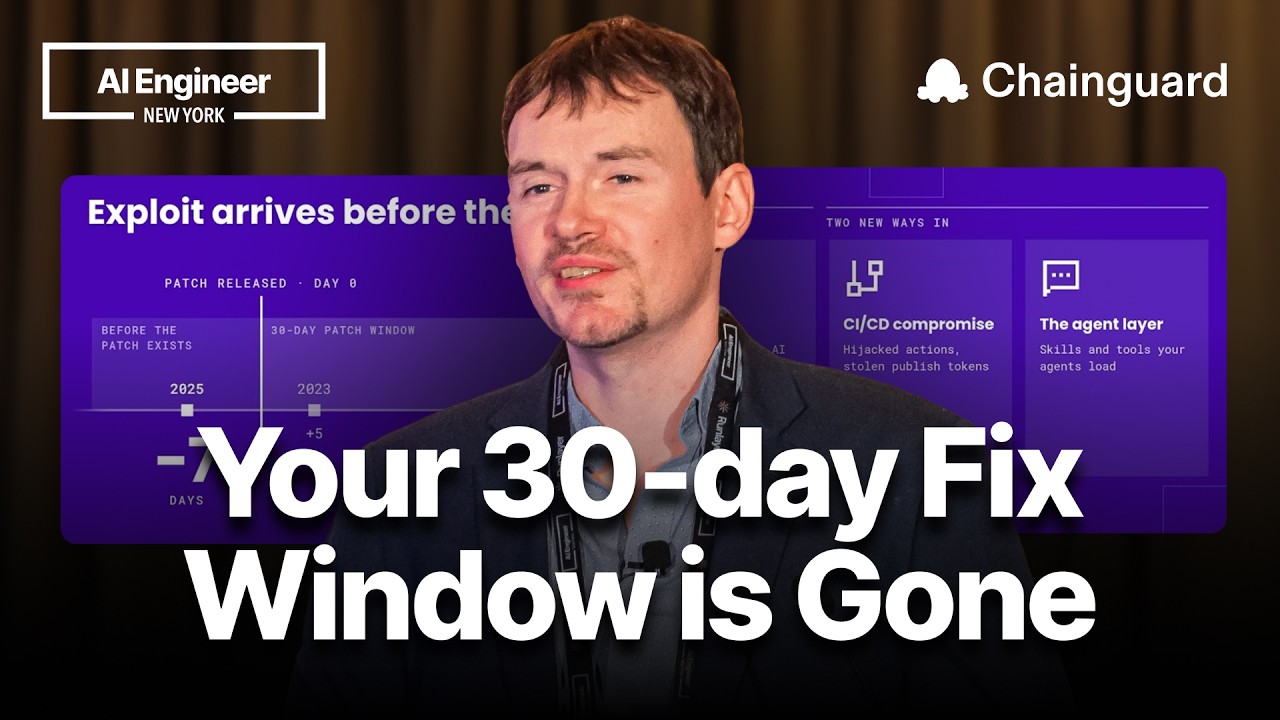
Exploits Now Beat Patches: Open Source Security in the AI Era - Patrick Smyth, Chainguard
Source: YouTube · AI Engineer · published Oct 28, 2026 · 21:43
BLUF: Frontier AI capabilities have drastically accelerated the threat landscape, reducing the window between vulnerability discovery and exploitation to negative values, thereby rendering traditional security timelines obsolete and necessitating a shift toward zero-trust supply chain practices 0:30.
Key Takeaways:
• The average time for an exploit to hit before a patch is released has dropped to -70 days, meaning attacks now occur faster than remediation efforts can respond 3:37.
• Frontiers AI models are lowering the barrier for attackers, enabling less technical individuals to conduct sophisticated campaigns like ransomware and supply chain compromises 2:15.
• Attackers are increasingly targeting "soft" entry points such as CI/CD pipelines, developer workstations, and AI agent skills rather than just production code 13:06.
• Traditional reliance on upstream package repositories is risky; Chainguard advocates for built-from-source libraries to prevent post-source injection attacks 18:06.
• Cryptographic signing via Sigstore and Salsa is essential for establishing provenance and ensuring zero-trust integrity across pipelines 17:10.
• Minimalist operating systems like Wolfi reduce the attack surface for zero-day exploits by eliminating unnecessary code and dependencies 21:22.
The security environment has fundamentally shifted from a manageable risk to an immediate, pervasive threat requiring proactive, structural defenses rather than reactive patching. Organizations must prioritize hardened infrastructure and cryptographic verification to survive in this new era of accelerated cyber warfare.
Sources:
- 0:30 Introduction to the speaker and the topic of how Frontier AI changes risk tolerance.
- 3:37 Data showing exploits now occur before patches are released.
- 2:15 Discussion on how AI empowers attackers to reach higher threat levels.
- 13:06 Identification of new attack vectors like CI/CD and developer laptops.
- 18:06 Explanation of Chainguard's built-from-source library approach.
- 17:10 Recommendation for using Sigstore and Salsa for artifact signing.
- 21:22 Benefits of minimal operating systems like Wolfi for security.
Generate CPE Credits
Generate a professional CPE document from this video's transcript.
Estimated credit: 0.5 CPE hours
Estimate uses the video runtime (1 hour ≈ 1 CPE, rounded to the nearest 0.5, minimum 0.5, maximum 2.0). The final amount can be lower after review, never higher.
Topic: Cybersecurity. Commonly maps to: Security and Risk Management, Security Operations. Exact CISSP domains are assigned during generation.
Free account. One generation at a time, with a daily limit.
CPEBuddy is independent and not affiliated with or endorsed by ISC2, ISACA, or any certification body. Exports are formatted for common CPE submissions; acceptance is at your certification body's discretion.
Transcript Preview
First 800 characters of the transcript
[music] >> So, this is how Frontier AI changed risk tolerance for open source. Kind of wanted to subtitle it, you know, how I learned to love the atomic bomb or whatever, but uh decided not to go for that. So, I'm Patrick Smith. I work for Chainguard. When I'm not thinking about the software supply chain or messing around with um you know, Frontier AI, uh I am hanging out in Queens. >> [snorts] >> I'm one of these annoying people who like saunas all the time. If you're out of town, we have some great ones in the city. There's 10th Street. That's one since around since the 19th century, and they have great food. And then there's one at FiDi, too. So, um you know, and then I know there's a lot of finance folks interested in this, so that's the one. 88 Fulton. That's the one if you're if you'…