How Ethical Hackers Actually Break Into Systems
Source: YouTube · freeCodeCamp.org · published Oct 28, 2026 · 2:37:18
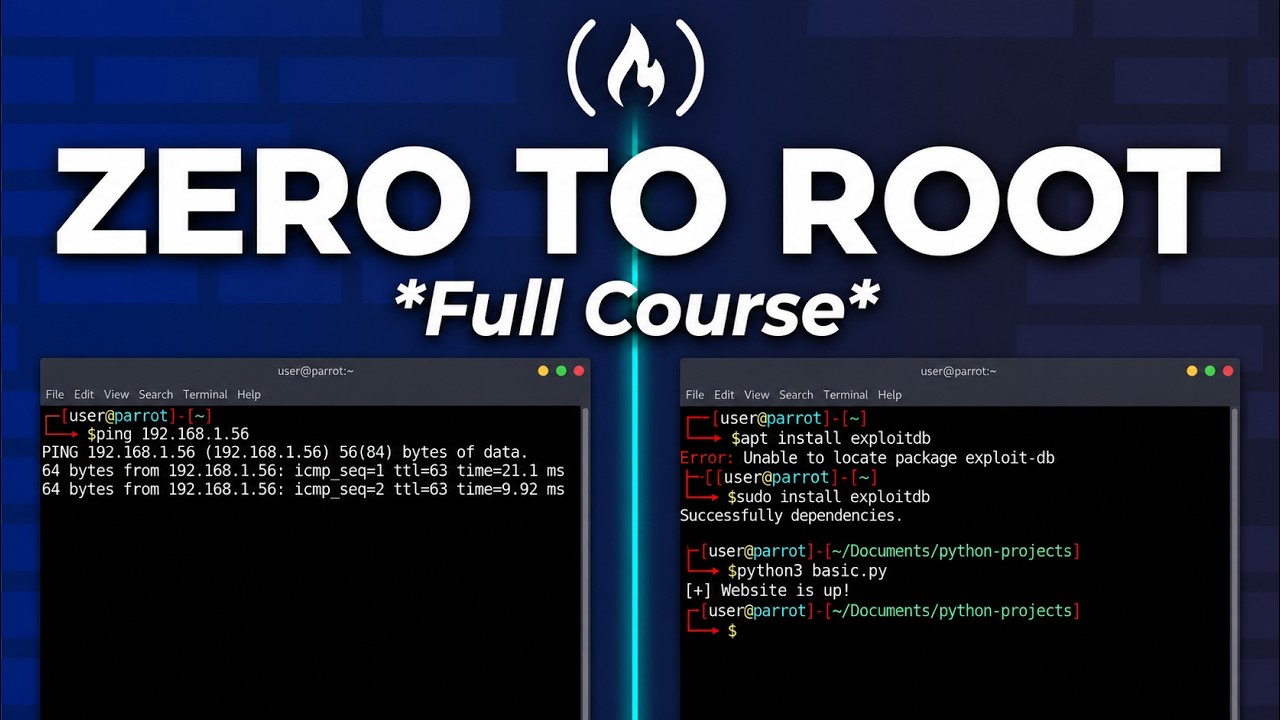
[BLUF] This video provides a hands-on ethical hacking crash course, covering Linux command line fundamentals, network scanning with Nmap, web enumeration using tools like Dirsearch and FFuf, and Python scripting for automation, all demonstrated within a safe, legal local CTF lab environment 0:00.
Key Takeaways:
• The instructor begins with essential Linux terminal commands, such as ls, cd, mkdir, and nano, demonstrating how to navigate files and manage directories effectively 1:29.
• Network connectivity and system information are verified using commands like ping, ip a, and uname -r, while netdiscover is used to identify devices on the local network 17:28.
• Nmap is utilized for network scanning, including basic host discovery, service version detection (-sV), and stealth SYN scans (-sS) with decoys to evade detection 16:07.
• Web enumeration is performed using tools like whatweb for fingerprinting, dirsearch for directory discovery, and FFuf for aggressive fuzzing and brute-forcing login credentials 35:39.
• The instructor demonstrates setting up a vulnerable VM (Explorer) in VirtualBox and exploiting a file upload vulnerability to gain access, followed by using searchsploit to find related exploits 07:32.
• Python scripting is introduced to automate reconnaissance tasks, showing how to use libraries like socket and requests to resolve IPs and fetch HTTP headers programmatically 20:02.
By mastering these core tools and scripting techniques, viewers can effectively perform penetration testing and automate repetitive security auditing tasks in a controlled environment.
Sources:
- 0:00 Introduction to the ethical hacking crash course and lab environment.
- 1:29 Tutorial on basic Linux terminal commands and file navigation.
- 17:28 Demonstration of network discovery and connectivity testing commands.
- 16:07 Overview of Nmap scanning techniques and arguments.
- 35:39 Use of web enumeration tools like whatweb and FFuf.
- 07:32 Setup and exploitation of a vulnerable web application.
- 20:02 Introduction to Python scripting for automation and networking.
Generate CPE Credits
Generate a professional CPE document from this video's transcript.
Estimated credit: 2 CPE hours
Estimate uses the video runtime (1 hour ≈ 1 CPE, rounded to the nearest 0.5, minimum 0.5, maximum 2.0). The final amount can be lower after review, never higher.
Topic: Penetration Testing. Commonly maps to: Security Assessment and Testing, Security Operations. Exact CISSP domains are assigned during generation.
Free account. One generation at a time, with a daily limit.
CPEBuddy is independent and not affiliated with or endorsed by ISC2, ISACA, or any certification body. Exports are formatted for common CPE submissions; acceptance is at your certification body's discretion.
Transcript Preview
First 800 characters of the transcript
Welcome to this hands-on ethical hacking crash course taught by cyber security instructor Declan Middleton. Throughout this course, you will learn the core Linux fundamentals and essential command line tools needed to navigate and audit target systems effectively. From network scanning and web enumeration with tools like inmap, dur search and burp suite to exploiting vulnerabilities and writing your own automation scripts. You will gain practical real world skills. Everything is demonstrated safely and legally inside a local CTF lab environment. So let's dive right in and get started. >> This is power. It's very similar to Ki Linux. Uh not much different really. Uh the only thing that's different is obviously the brand, the color scheme, and maybe a little bit a few more of these tools ins…