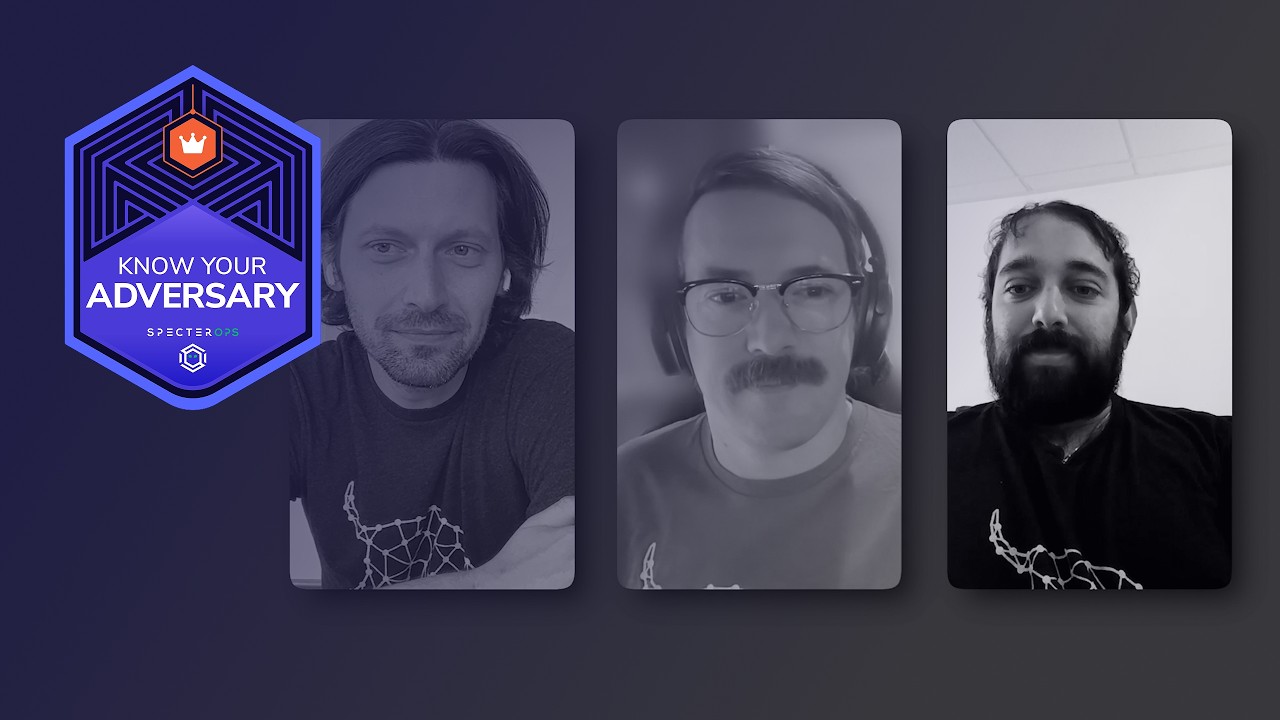
Know Your Adversary | 10-Year BloodHound Anniversary Pt. 1 (Ep. 13)
Source: YouTube · SpecterOps · published Aug 17, 2026 · 55:39
The creators of Blood Hound reflect on its 10-year evolution from a niche red team utility to a foundational cybersecurity tool, highlighting how it democratized attack path visualization and shifted industry standards from manual exploitation to proactive defense 2:15.
Key Takeaways:
• The tool originated from the frustration of manually chaining PowerShell scripts to find "derivative local admin" paths in complex Active Directory environments, which became unmanageable at scale 1:41.
• The pivotal moment occurred when the founders realized graph theory could solve their data scaling issues, leading them to adopt Neo4j and develop a visual interface to map attack paths effectively 3:50.
• Blood Hound’s schema expanded significantly beyond its original three nodes to include Access Control Lists (ACLs), Group Policy, and Certificate Services, uncovering attack paths that were always present but previously invisible 22:34.
• The project’s impact is evident in its ability to force defenders to remediate vulnerabilities; one founder noted the embarrassment of finding no attack paths in a secured environment, signaling that their work had successfully hardened targets 46:03.
• Originally designed for offensive use, the tool’s utility shifted toward defense as blue teams began using it to identify and fix high-value target exposures, leading to the creation of Blood Hound Enterprise 41:38.
Blood Hound stands as a testament to how solving specific operational pain points can lead to industry-wide innovations that bridge the gap between offensive tradecraft and defensive strategy.
Sources:
- 0:26 Introduction of Blood Hound’s 10th anniversary and founders.
- 2:15 Discussion of "derivative local admin" and manual path chaining.
- 3:50 The realization of using graph theory and Neo4j.
- 22:34 Expansion of the schema to include ACLs and other complex edges.
- 46:03 Anecdote about a secured environment where no paths were found.
- 52:38 Reflections on the open-source nature and legacy of the project.
Generate CPE Credits
Generate a professional CPE document from this video's transcript.
Estimated credit: 1 CPE hours
Estimate uses the video runtime (1 hour ≈ 1 CPE, rounded to the nearest 0.5, minimum 0.5, maximum 2.0). The final amount can be lower after review, never higher.
Topic: Cybersecurity. Commonly maps to: Security and Risk Management, Security Operations. Exact CISSP domains are assigned during generation.
Free account. One generation at a time, with a daily limit.
CPEBuddy is independent and not affiliated with or endorsed by ISC2, ISACA, or any certification body. Exports are formatted for common CPE submissions; acceptance is at your certification body's discretion.
Transcript Preview
First 800 characters of the transcript
[music] [music] Welcome back to the Know Your Adversary podcast. I'm Jared Atinson and I'm joined by Justin Culler. >> And today is a very special episode because we're joined by the three founders and creators of Blood Hound, uh, which is now reaching its 10th year anniversary from when it was originally presented. I think the original presentation was at was it Besides Las Vegas or Defcon? >> I think it was Defcon Arsenal technically. >> Okay, cool. Cool. So, uh, we got Andy Andy Robbins. Go ahead and wave. I'll let you wave. We got Will Schroeder with that that mustache. Uh, if you're not watching, just keep the video off is what I'll recommend. And then we got Rohan Berserker uh joining us. And what we're going to do is we're going to do go down like a little tour of memory lane talkin…