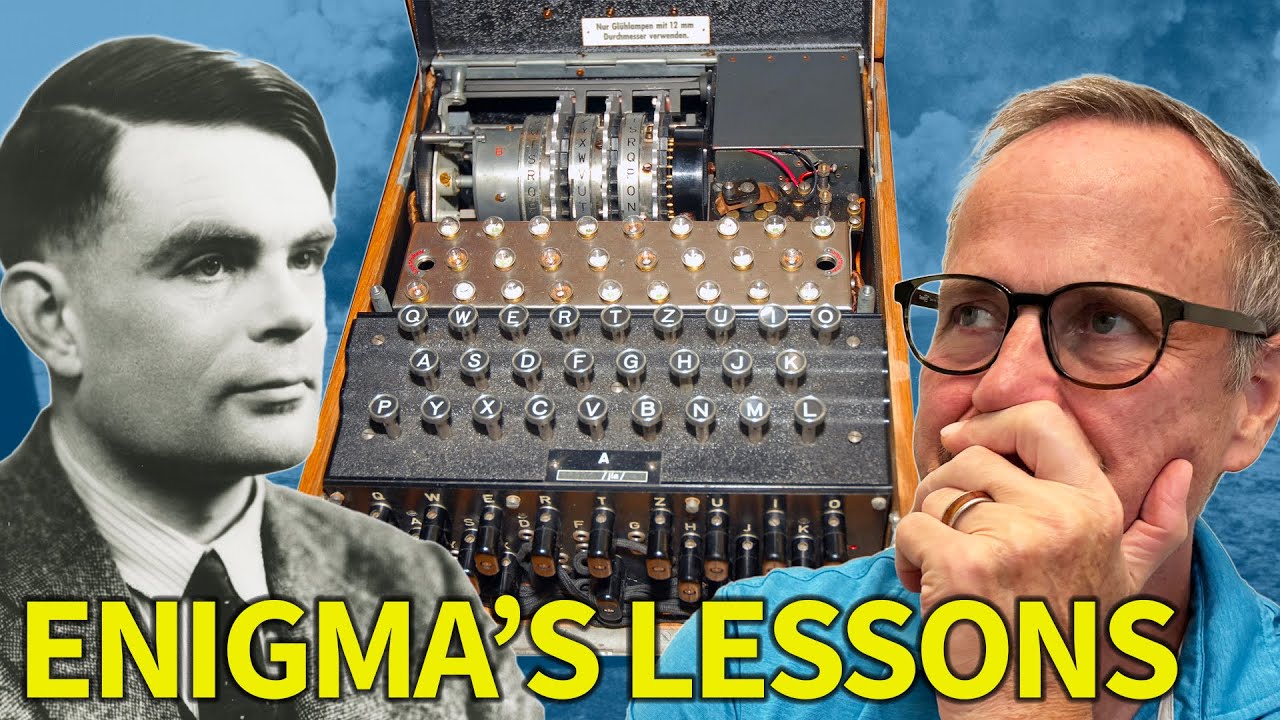
Cracking Enigma: Codebreakers, Hubris & Lessons Learned
Source: YouTube · Dr. Know-it-all Knows it all · published Oct 18, 2025 · 50:43
Revised Summary: "The Enigma Machine: Lessons in Security, Hubris, and Human Insight"
This video explores the fascinating history of the Enigma machine during WWII and how it was broken, drawing crucial lessons for our modern digital age. The creator, Dr. Know-it-It All, experiments with AI collaboration while maintaining historical curation [0:03-0:23]. Through this experimental approach, the video examines not just the technical aspects of the Enigma, but the human elements of confidence, collaboration, and critical thinking that led to its downfall.
Key Takeaways:
Historical Context & Technical Breakdown
• The Enigma machine, developed by German engineer Arthur Scherbius, was adopted by German military forces in the late 1920s-early 1930s, creating a false sense of security among operators who believed it was unbreakable 2:16-2:22
• Enigma's operation involved multiple layers of security: rotors with internal wiring that changed with each keypress, a plugboard that swapped letter pairs, and a reflector that sent current back through the system
• A critical vulnerability was that no letter could encrypt to itself due to the reflector design—a seemingly small detail that would prove crucial to codebreakers
The Polish Breakthrough
• Polish mathematicians led by Marian Rejewski were first to break Enigma using algebraic methods and group theory, not computers [13:12-13:14, 17:11-17:13]
• Rejewski's breakthrough came from analyzing mathematical relationships in the double-encrypted message indicators, allowing him to deduce the rotor wiring
• By 1933, the Polish team was reading German traffic and had built replica Enigma machines, along with specialized tools like the cyclometer, Zygalski sheets, and the "bomba" (an electromechanical testing device)
• Their breakthrough was shared with Britain just weeks before Germany invaded Poland, providing crucial intelligence that saved countl
Generate CPE Credits
Generate a professional CPE document from this video's transcript.
Estimated credit: 1 CPE hours
Estimate uses the video runtime (1 hour ≈ 1 CPE, rounded to the nearest 0.5, minimum 0.5, maximum 2.0). The final amount can be lower after review, never higher.
Topic: Cybersecurity. Commonly maps to: Security and Risk Management, Security Operations. Exact CISSP domains are assigned during generation.
Free account. One generation at a time, with a daily limit.
CPEBuddy is independent and not affiliated with or endorsed by ISC2, ISACA, or any certification body. Exports are formatted for common CPE submissions; acceptance is at your certification body's discretion.
Transcript Preview
First 800 characters of the transcript
Hey y'all, it's Dr. Know-it-It All. I'm trying an experiment here. I'm collaborating with AI to make some videos about the history of technology with a connection to today. As a student of history myself, I'm curating events and themes from the past that I believe have something to teach us today. This collaboration allows me to explore these topics in depth and still be able to produce them with a team of just me. I know many of you do not like AI generated content. So each of these videos will have a watermark at the beginning stating made in collaboration with AI. So at least you'll know and you'll be able to choose or choose not to view them. Of course, my current topic videos will still be 100% me. Let me know what you think about this idea in the comments and any suggestions you have…