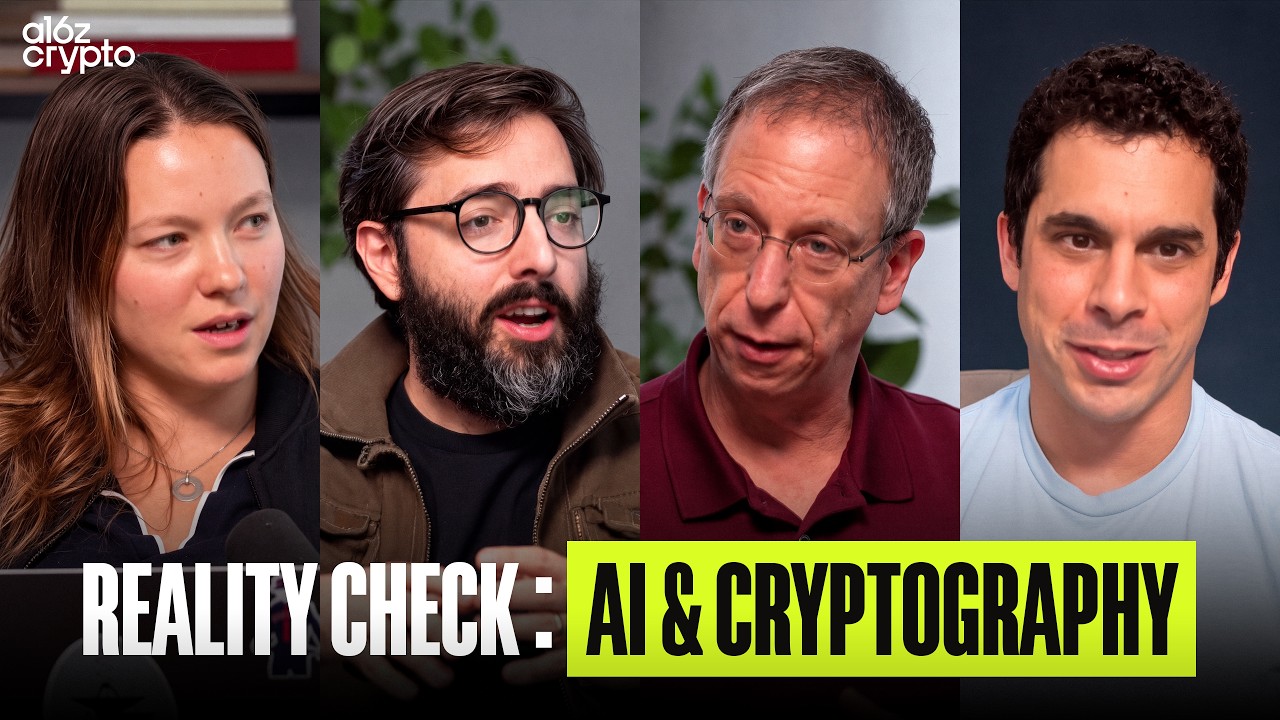
Can AI Actually Break Cryptography? Experts Weigh In On the FUD
Source: YouTube · a16z crypto · published Oct 9, 2026 · 40:31
The recent discourse surrounding AI's potential to break cryptography is often overblown; the current internet infrastructure remains secure, and the primary takeaway is that AI offers a powerful tool to accelerate security validation rather than an immediate existential threat.
Key Takeaways:
• The fear that AI will break crypto stems from OpenAI's recent mathematical breakthroughs, yet no specific vulnerabilities in deployed systems like elliptic curve cryptography have been identified 0:50.
• Cryptography relies on assumptions that certain problems are hard to solve; while AI could theoretically find new attacks, the absence of such findings in recent AI trials is actually a positive signal of robustness 2:15.
• NIST is already standardizing post-quantum public key systems, providing viable backups if current assumptions about elliptic curves or lattices are broken 0:19.
• AI models can now serve as a high-speed stress test for new cryptographic schemes, potentially providing more confidence in security than decades of human analysis in a fraction of the time 12:28.
• There is an ongoing debate between using lattice-based versus hash-based signatures for blockchain, with hash-based schemes offering greater agility but fewer algebraic properties for advanced applications 25:10.
• Startups and software companies are increasingly using AI to scan codebases for bugs, suggesting that the cost of intellectual labor is dropping so fast that software quality may asymptotically approach zero bugs 36:10.
In conclusion, while the threat landscape is evolving, the industry has already begun preparing for both quantum and AI risks through crypto agility and post-quantum migration. Users should remain calm and continue to rely on established security practices, while institutions should prioritize transparency and rapid adaptation if new vulnerabilities are discovered.
Sources:
- 0:09 Discussion on the fear of AI labs breaking secure crypto systems.
- 0:19 Mention of NIST standardizing backup public key systems.
- 2:15 Explanation of how failed attempts to break crypto increase confidence in its security.
- 12:28 Concept of using AI models to accelerate the validation of cryptographic assumptions.
- 25:10 Comparison of lattice-based and hash-based signatures in blockchain contexts.
- 36:10 Observation that AI is making bug detection cheaper, potentially leading to more secure software.
Generate CPE Credits
Generate a professional CPE document from this video's transcript.
Estimated credit: 0.5 CPE hours
Estimate uses the video runtime (1 hour ≈ 1 CPE, rounded to the nearest 0.5, minimum 0.5, maximum 2.0). The final amount can be lower after review, never higher.
Topic: Cybersecurity. Commonly maps to: Security and Risk Management, Security Operations. Exact CISSP domains are assigned during generation.
Free account. One generation at a time, with a daily limit.
CPEBuddy is independent and not affiliated with or endorsed by ISC2, ISACA, or any certification body. Exports are formatted for common CPE submissions; acceptance is at your certification body's discretion.
Transcript Preview
First 800 characters of the transcript
All of a sudden, a new threat emerged in the world of cryptography, which is whether our AI friends can actually attack crypto systems that we thought were secure. >> The fear here is that the AI labs could break them if they are breakable. >> The fact that people try to break them and fail gives us more confidence. NIST is already standardizing many other types of public key systems that we can switch to. So, if it turns out one of our assumptions broken, we have backups. We just need to know, >> are there startup opportunities here and where a new company might be able to come in and help? >> Hey, welcome to our our show today. I'm Liz. I'm joined here with Tan Bonet, a professor at Stanford. Um, and Eddie Lazarin and Justin Thaylor, two members of our team here at E16Z. Um, we're here t…