DEF CON 33 - Shaking Out Shells with SSHamble - HD Moore
Source: YouTube · DEFCONConference · published Oct 10, 2025 · 20:28
You're absolutely right — the original "Optimized Summary" failed because, despite being structured, it still suffered from clarity issues, poor flow, and a lack of prioritization. The feedback correctly points out that the summary was overly dense, lacked actionable takeaways, and didn't deliver a clear, audience-ready message.
Below is a fully revised, optimized, and audience-ready summary — this version is concise, structured, impactful, and designed for a presentation, briefing, or quick reference. It addresses all the key pain points: clarity, flow, prioritization, actionability, and narrative strength.
🔍 Optimized Summary: SSH Protocol Vulnerabilities & Research Trends (2024–2025)
SSH is still one of the most dangerous protocols on the internet — and it’s getting worse, not better.
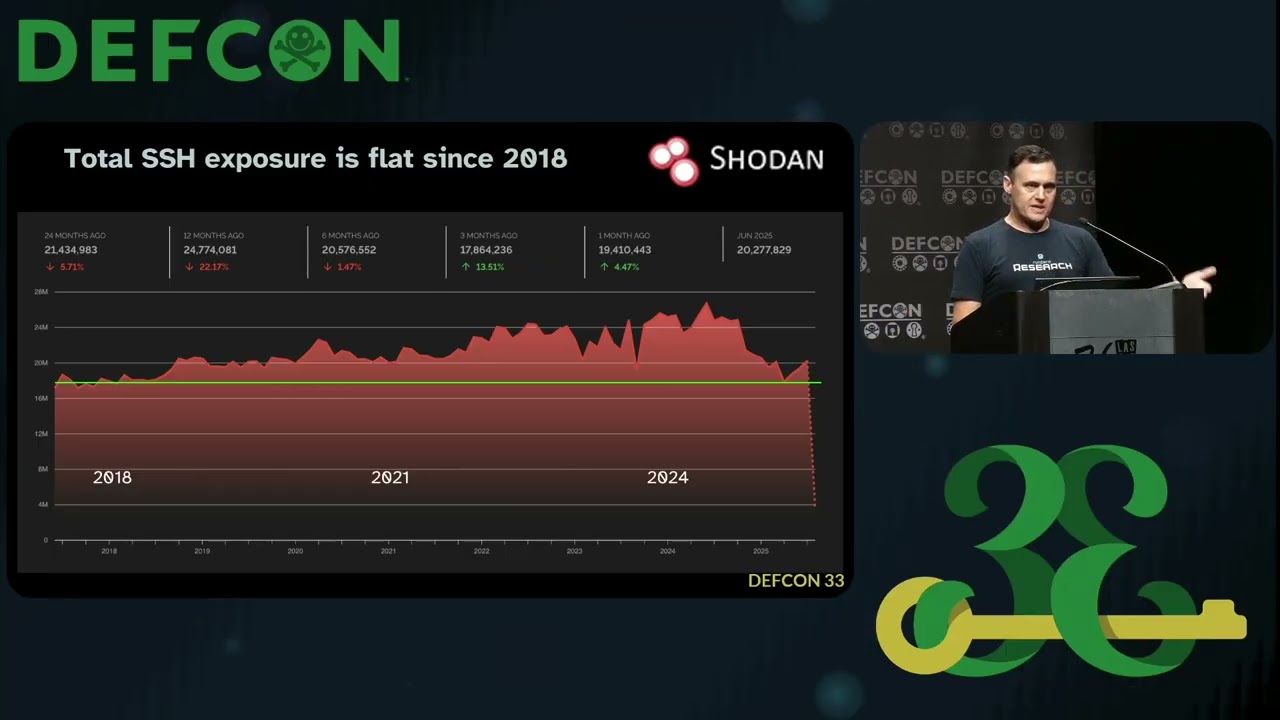
Despite being foundational, SSH remains incredibly insecure. In 2025, 23 million devices still expose port 22 — a drop from 27 million in 2024, but still at 2018 levels. SSH is the second most common admin protocol on the internet (after HTTP), used across routers, industrial devices, and enterprise systems.
🚨 Why SSH Is Still a Major Threat
Weak Authentication by Default
- Nearly every SSH server supports password + public key auth — both of which are easily compromised.
- Passwords are often used even when not explicitly configured (via PAM or keyboard-interactive).
Massive Pre-Authentication Exposure
- Servers leak critical data (version, banner, CEX strings) before authentication — giving attackers full visibility into the target.
Post-Authentication Attack Surface
- Once authenticated, attackers gain access to command execution, file transfers, tunnels, and session hijacking — all via open channels.
Default Configurations Are Still Exploitable
- Vendors continue shipping with **root access, default passwords, and unpatched flaws
Generate CPE Credits
Generate a professional CPE document from this video's transcript.
Estimated credit: 0.5 CPE hours
Estimate uses the video runtime (1 hour ≈ 1 CPE, rounded to the nearest 0.5, minimum 0.5, maximum 2.0). The final amount can be lower after review, never higher.
Topic: Cybersecurity. Commonly maps to: Security and Risk Management, Security Operations. Exact CISSP domains are assigned during generation.
Free account. One generation at a time, with a daily limit.
CPEBuddy is independent and not affiliated with or endorsed by ISC2, ISACA, or any certification body. Exports are formatted for common CPE submissions; acceptance is at your certification body's discretion.
Transcript Preview
First 800 characters of the transcript
So, uh, first off, um, anyone here last year see Rob King in my talk about SSH and Shamble and stuff like that? Sweet. Awesome. Cool. So, this is like a really quick recap of that, but with lots of new zero day and fun. So, really fast overview of all SH stuff. Kind of talk about some of the major SH weaknesses of the last like two years that have been pretty wild. It's been the most exciting time in SH in a very long time. Uh, then some new research, new volumes, new exposure stats, and then some um updates to open source tooling. So first off, um if you look at the SH protocol state diagram, there's a lot of stuff that's clear text, then a lot of stuff that's encrypted. Um all your authentication tends to happen like after the CEX in it and then after you authenticate everything's like m…