DEF CON 34 - BugBounty - Finding Prompt Injection Vulns via Mutated Prompt Gen - B Steele, A Garg
Source: YouTube · DEFCONConference · published Nov 6, 2026 · 26:32
[BLUF] Microsoft researchers present the Mutated Prompt Generator (MPG) framework, a divergent search tool that automates the discovery of residual prompt injection vulnerabilities by mutating payloads to test if patches generalize beyond specific reported exploits 2:15-2:30.
Key Takeaways:
• Indirect Prompt Injection Attacks (IPIA) allow attackers to hide malicious instructions in external content (like web pages) that AI agents process, leading to data exfiltration via hidden links or images without user interaction 1:50-2:15.
• Attackers exploit the leniency of markdown and HTML parsers, using malformed syntax, Unicode characters, or reference links to bypass simple regex-based defenses 6:21-8:15.
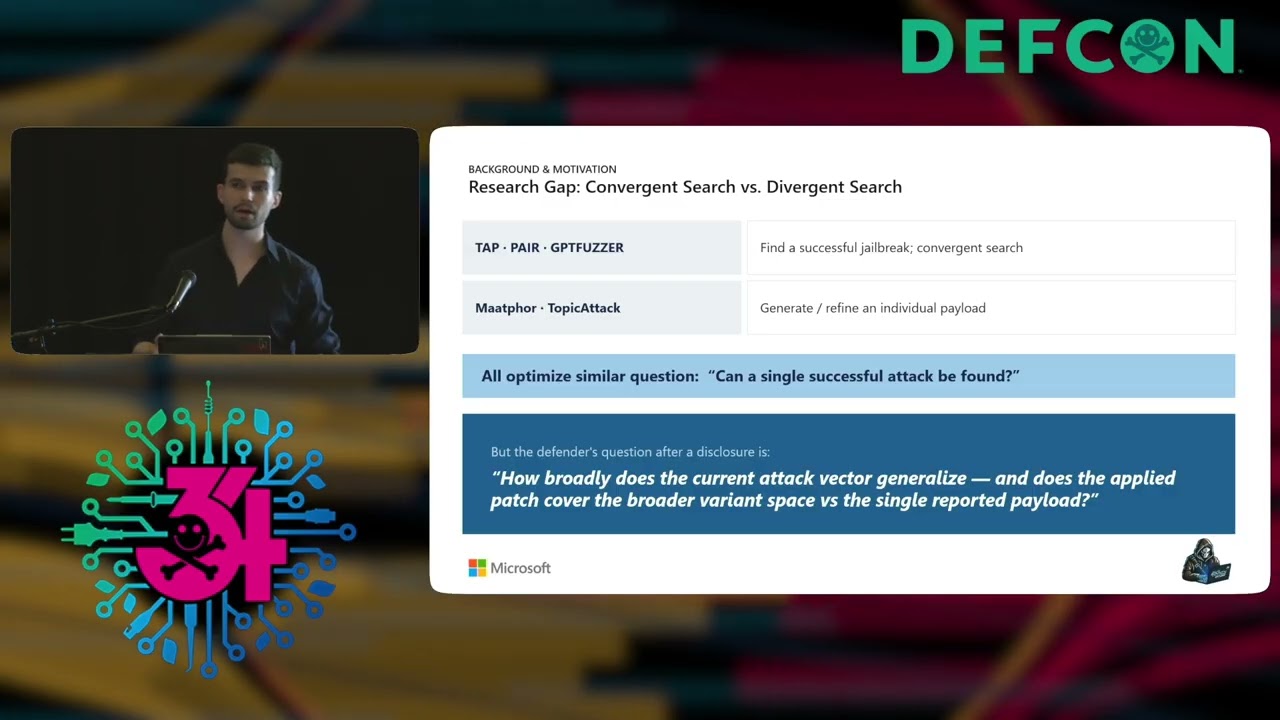
• Traditional security testing focuses on finding a single successful "convergent" jailbreak, whereas MPG employs a "divergent" search to map the breadth of the attack surface and measure residual exploitability 12:15-13:15.
• The MPG framework classifies token segments into "carrier" (benign) and "injection" (malicious) tokens, applying specific mutation operators to each to generate variant payloads that test the robustness of existing safeguards 16:21-18:15.
• Using a subtree viability scoring algorithm, MPG evaluates the success rate of mutated variants to determine if a vulnerability is broadly generalizable, indicating a need for architectural mitigation rather than targeted patches 22:45-24:45.
• Internal testing showed that while 35% of vulnerabilities were initially successful, the MPG framework resurfaced an additional 19% of cases that were previously deemed patched, highlighting significant residual risk 24:48-25:25.
The MPG framework provides a critical defensive use case for post-incident validation and pre-release gating, helping developers ensure AI features do not reach production with exploitable vulnerabilities.
Sources:
- 2:15-2:30 Introduction to the research goal of measuring residual exploitable surface.
- 1:50-2:15 Explanation of indirect prompt injection attacks and data exfiltration techniques.
- 6:21-8:15 Discussion on how markdown and HTML parser leniency aids attackers.
- 12:15-13:15 Contrast between convergent search (finding one exploit) and divergent search (mapping surface).
- 16:21-18:15 Description of the MPG framework's token classification and mutation strategy.
- 22:45-24:45 Details on the subtree viability scoring algorithm and its role in determining mitigation needs.
- 24:48-25:25 Presentation of test results showing resurfaced vulnerabilities via mutation.
Generate CPE Credits
Generate a professional CPE document from this video's transcript.
Estimated credit: 0.5 CPE hours
Estimate uses the video runtime (1 hour ≈ 1 CPE, rounded to the nearest 0.5, minimum 0.5, maximum 2.0). The final amount can be lower after review, never higher.
Topic: Cybersecurity. Commonly maps to: Security and Risk Management, Security Operations. Exact CISSP domains are assigned during generation.
Free account. One generation at a time, with a daily limit.
CPEBuddy is independent and not affiliated with or endorsed by ISC2, ISACA, or any certification body. Exports are formatted for common CPE submissions; acceptance is at your certification body's discretion.
Transcript Preview
First 800 characters of the transcript
All right. Can we get a thumbs up if everyone can hear us? All right. Perfect. Welcome to today's session. In today's session, we're going to be covering automated discovery of prompt injection vulnerabilities via mutated prompt generation. This is a research that we have devised um as a divergent framework for measuring residual exploitable surface around the confirmed prompt injection attack vector. The research has been conducted by me Bdan Stella along my along with my colleague Arnav that's right here. Uh we're both part of Microsoft and uh uh as this talk is going to be hosted as part of Devcon 34 um as part of the bug bounty village. Starting out with a short introduction. My name is Bogdan Stella. I work as part of Microsoft as a senior software security engineer and as a um AI sec…