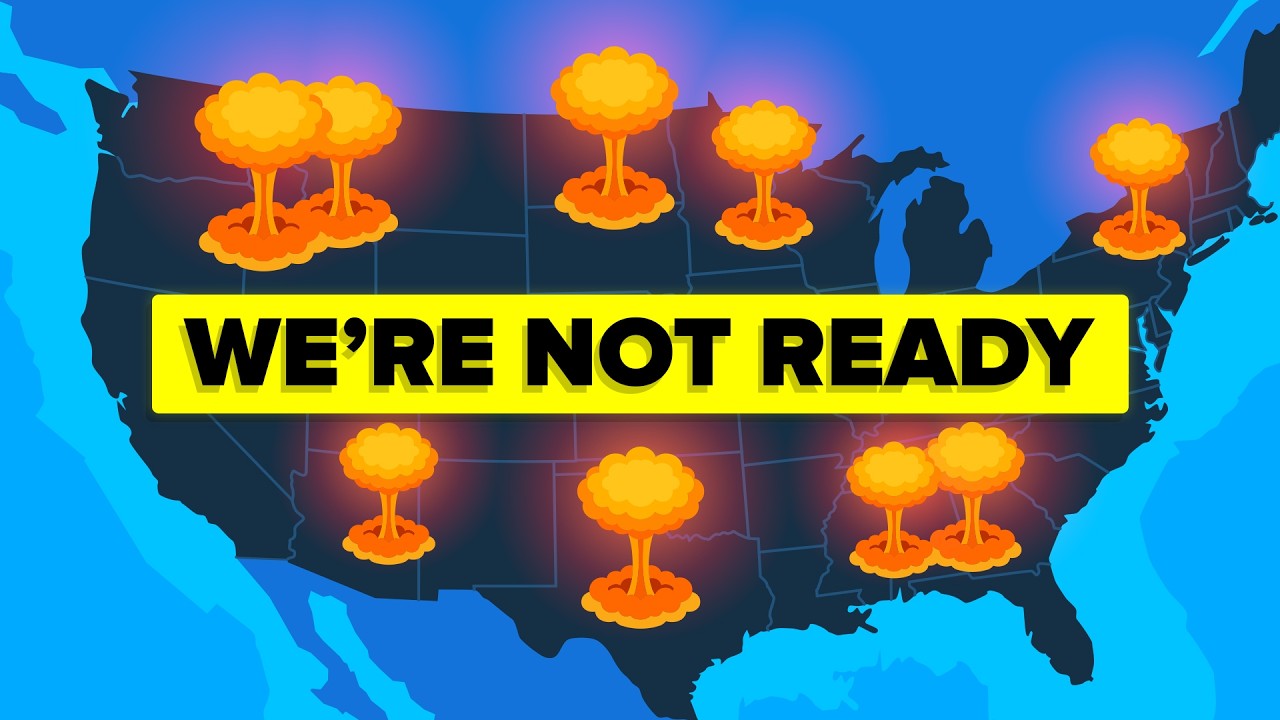
First 20 Minutes of a Nuclear Attack Looks Like THIS
Source: YouTube · The Infographics Show · published Aug 18, 2025 · 22:27
The U.S. is highly vulnerable to nuclear attack, with key regions like the Pacific, Great Plains, Midwest, South, and Northeast facing targeted destruction due to military, economic, and strategic value 0:19. Nuclear targeting strategies—counterforce (destroying military infrastructure) and countervalue (attacking cities and industry)—make the nation’s critical assets prime targets 0:46. The Great Plains’ missile fields act as “nuclear sponges,” absorbing hundreds of warheads but spreading deadly fallout across the Midwest and East Coast 1:31. Major cities like Chicago, Detroit, and New York are high-priority countervalue targets due to economic and morale impacts 1:41. Military bases across the South and Northeast—such as those in Georgia, Virginia, and New York—are targeted for their strategic role in defense and intelligence 19:08. Even civilian infrastructure, including ports, refineries, and power grids, is at risk, threatening the U.S. economy and daily life 21:41. In a full-scale nuclear war, there is no safe zone—only varying degrees of devastation 22:04.
Sources:
Generate CPE Credits
Generate a professional CPE document from this video's transcript.
Estimated credit: 0.5 CPE hours
Estimate uses the video runtime (1 hour ≈ 1 CPE, rounded to the nearest 0.5, minimum 0.5, maximum 2.0). The final amount can be lower after review, never higher.
Topic: Cybersecurity. Commonly maps to: Security and Risk Management, Security Operations. Exact CISSP domains are assigned during generation.
Free account. One generation at a time, with a daily limit.
CPEBuddy is independent and not affiliated with or endorsed by ISC2, ISACA, or any certification body. Exports are formatted for common CPE submissions; acceptance is at your certification body's discretion.
Transcript Preview
First 800 characters of the transcript
Think America’s untouchable in a
nuclear war? You might want to sit down - because you’re already in the blast zone.
The U.S. spends more on nuclear maintenance than Russia did on its entire military before
invading Ukraine, giving Americans a false sense of security. But as global tensions rise,
the truth is grim: Russia and China have nukes aimed at various parts of the U.S. So… how long
would you survive, depending on where you live? The United States can be broken down into five
key regions: the Pacific Coast, the Great Plains, the Midwest, the South, and the Northeastern
Seaboard. These aren’t just geographical zones - they’re the backbone of America’s
military, economic, and political power. And in the event of a nuclear war, they become the
most valuable - and most vulnerabl…