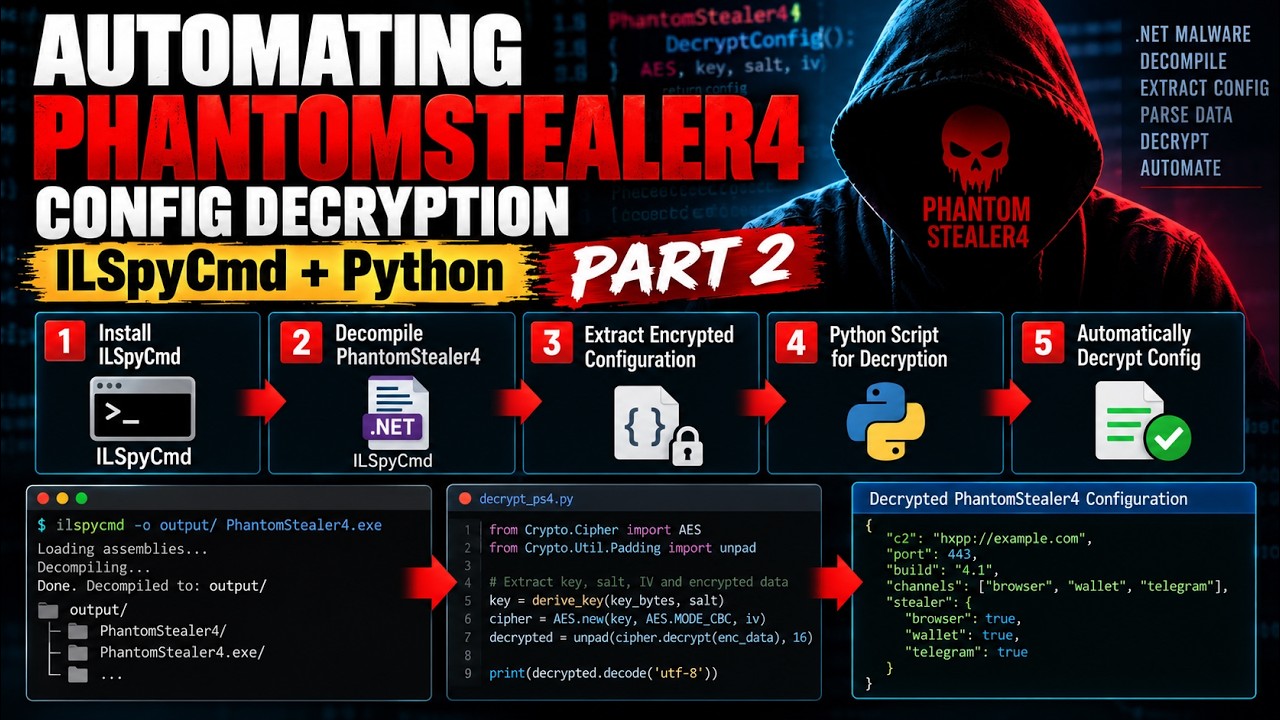
Automating PhantomStealer4 Config Decryption | ILSpyCmd + Python - Part 2
Source: YouTube · Malware Research Diary · published Sep 24, 2026 · 43:45
This video shows how to automate Phantom Stealer config decryption in Python, building on a previous manual decryption session 0:03-0:26.
Key Takeaways:
• ilspycmd (installed via .NET tools) decompiles the Phantom Stealer binary on Linux, outputting source to a file 0:44-2:12
• The decompiled source reveals the AES decryption function and encrypted config fields (SMTP server, sender, SMS, etc.) 2:35-4:01
• The Python script finds parameter names in the binary and extracts base64 config data between them, using a start > i + 50 heuristic to skip empty fields 4:42-14:10
• Master key/IV are extracted as base64, then two-stage AES-CBC decryption is implemented: decrypt the embedded key (parsing a little-endian 4-byte length after skipping unused D1/D2 buffers), then the config 15:05-31:48
• Debugging a padding error revealed a byte-order issue—int.from_bytes with "little" correctly yields 80 37:38-41:11
• SMTP server, sender, and password decrypt successfully, proving the pipeline works 42:11-43:21
The full automated decryption works end-to-end; next step is bundling everything into one script.
Sources:
Generate CPE Credits
Generate a professional CPE document from this video's transcript.
Estimated credit: 0.5 CPE hours
Estimate uses the video runtime (1 hour ≈ 1 CPE, rounded to the nearest 0.5, minimum 0.5, maximum 2.0). The final amount can be lower after review, never higher.
Topic: Malware Analysis. Commonly maps to: Security Operations, Security Architecture and Engineering. Exact CISSP domains are assigned during generation.
Free account. One generation at a time, with a daily limit.
CPEBuddy is independent and not affiliated with or endorsed by ISC2, ISACA, or any certification body. Exports are formatted for common CPE submissions; acceptance is at your certification body's discretion.
Transcript Preview
First 800 characters of the transcript
Hello everyone, welcome back to another um the second part in um developing a decoder for phantom staler. So as mentioned um previously we decrypt the um the the configuration from the phantom stler and now we going to automate the whole process. So because the strings the data in the um phantom staler is encrypted and um we have to decompile it um from there. So I'm using um l spy cmd. So this seem to be a tools to um on Linux to um decode or de the compiler the executable. So you can um basically just install the net tools then do the two install global um IO spies here. Once you finish this then um you can um you can create um decompile it using the command. So it's going to be phantoms. This thing should hopefully display it locally. It's going to take some time because the server I'm …