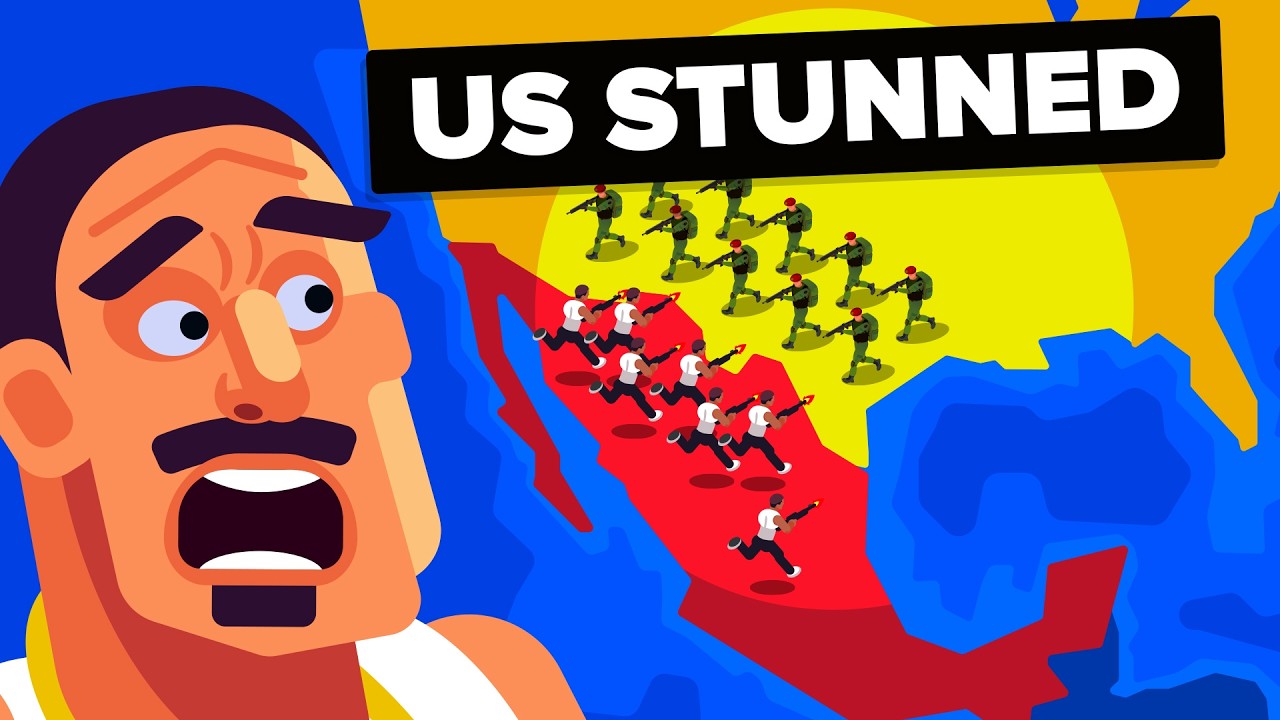
Real Reason US Doesn't Wipe Out the Mexican Cartels
Source: YouTube · The Infographics Show · published Jun 22, 2025 · 18:28
The U.S. is unlikely to launch military strikes against Mexican cartels due to severe legal, diplomatic, economic, and strategic risks—despite the threat of fentanyl and violence. A war would violate international law, damage U.S. credibility, and spark retaliation, including on U.S. soil, while failing to reduce fentanyl supply due to its easy production and high profit margins.
Key Takeaways:
• Legal barriers prevent U.S. action without Mexican consent or self-defense justification 2:30-3:37
• Fentanyl production is highly resilient and decentralized, making it nearly impossible to eliminate through strikes 15:10-16:37
• U.S. military action would likely provoke violent retaliation, including cyberattacks and assassinations on U.S. personnel 10:21-12:06
• Cartel violence would escalate, creating a prolonged conflict with high casualties and costs, akin to Afghanistan 13:43-14:02
• A more effective solution is legalizing and regulating fentanyl to undercut cartel profits, reduce addiction, and improve public health 17:11-18:08
The U.S. should avoid military intervention and instead focus on health-based solutions to dismantle the fentanyl trade sustainably.
Sources:
- 2:30-3:37 International law limits U.S. use of force without consent or self-defense
- 15:10-16:37 Fentanyl is easy to produce and highly profitable, making it resilient to attacks
- 10:21-12:06 Cartels would retaliate with violence and cyberattacks on U.S. targets
- 13:43-14:02 Military stri
Generate CPE Credits
Generate a professional CPE document from this video's transcript.
Estimated credit: 0.5 CPE hours
Estimate uses the video runtime (1 hour ≈ 1 CPE, rounded to the nearest 0.5, minimum 0.5, maximum 2.0). The final amount can be lower after review, never higher.
Topic: Cybersecurity. Commonly maps to: Security and Risk Management, Security Operations. Exact CISSP domains are assigned during generation.
Free account. One generation at a time, with a daily limit.
CPEBuddy is independent and not affiliated with or endorsed by ISC2, ISACA, or any certification body. Exports are formatted for common CPE submissions; acceptance is at your certification body's discretion.
Transcript Preview
First 800 characters of the transcript
Deep in the heart of Sinaloa, Mexico, a
cartel boss lounges in his sprawling mansion, barking orders into a satellite phone.
Outside, guards lean on fortified walls, casually smoking cigarettes -
completely unaware of what’s coming. High above them, a U.S. Mojave drone
is about to unleash its full load of 16 AGM-114 Hellfire missiles directly at them.
In minutes, nearly 1,800 pounds (816 kg) of precision-guided destruction could
wipe the entire compound off the map. This is exactly how a U.S. war on the cartels
might begin. And let’s be clear—up against the might of the U.S. military, the
cartels would be trying to shoot down missiles with metaphorical pea-shooters.
So why hasn’t the U.S. pulled the trigger? Well, the answer is more complicated than
it seems. And we’ll break it a…